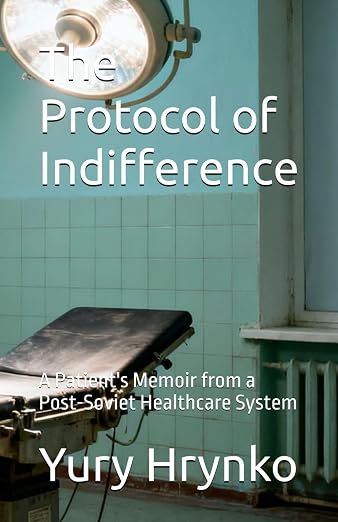
The Protocol of Indifference – A Patient’s Memoir from a Post-Soviet Healthcare System by Yury Hrynko
Publisher: Self-published
Genre: Non-Fiction, Contemporary
Rating: 5 Stars
Reviewed by AstilbeA bilateral tonsillectomy was supposed to be a step toward better health. Instead, Yury Hrynko woke up in intensive care unable to see, unable to speak, and fighting for every breath.
After regaining consciousness, he found himself facing a terrifying reality: unbearable pain, the sudden loss of his vision, the inability to communicate, and a desperate struggle to survive.
The Protocol of Indifference is a medical memoir about survival, resilience, and the human cost of traumatic complications after a medical procedure. Told through the voices of Yury and those closest to him—including his wife and parents—this book follows one family’s journey through a year of uncertainty, fear, determination, and hope.
Following complications that occurred during and after the procedure, Yury faced a cascade of life-changing consequences: a loss of vision that gradually returned over time, nerve damage, loss of his voice, severe neurological complications, and a dangerous infection that threatened his recovery. For months, he had to relearn basic abilities, including speaking, while adapting to a body and life that had suddenly changed.
Yet the greatest challenge was not only physical recovery—it was being heard when his condition was repeatedly underestimated.
From the frightening moments immediately after the procedure, to the days when his symptoms were dismissed, and finally to the doctor who recognized the seriousness of his condition and called for emergency help, this memoir presents a firsthand account of a patient’s struggle to survive, recover, and reclaim his life.
Set within a post-Soviet healthcare system, The Protocol of Indifference is not a story about blaming individuals. It is a story about human vulnerability, family support, resilience, and the importance of compassion in medicine.

Medical mistreatment is never acceptable.
I was flabbergasted by Mr. Hrynko’s experiences with the medical community both as a child when he had his adenoids and part of his tonsils removed without the use of any anesthesia as well as how he was treated as an adult after he had multiple infections of his remaining tonsils and was advised to have a tonsillectomy for health reasons. Untreated pain can be quite traumatic, especially when it’s this severe, and he shared his memories of these surgeries openly and in great detail.
Some of the most memorable portions of this book for me were the ones that explored how people who have disabilities, chronic illnesses, or other medical conditions can struggle to convince the doctors and nurses who are treating them to take their feedback seriously. This is unfortunately far more common than the general public may think it is, and it can cause long delays in treatment and diagnoses that aren’t always accurate. What made this particular case even worse is that the author’s physical difficulties with talking, eating, drinking fluids, and swallowing among a long list of other problems were caused by the same surgery that was supposed to cure him!
What ultimately encouraged me to give this a full five-star rating were the sections written by the author’s wife and parents. Family support is so important for people who are going through health issues, but not everyone necessarily thinks to ask the patient’s support system how they’re feeling during those moments. I loved learning how everyone worked together to make the best of a terrible situation, especially when it came to the soups they made and the daily visits they arranged. Little things like these can be so meaningful and life-saving, especially in a country where a hospital has such limited resources.
The Protocol of Indifference kept me perched on the edge of my seat from the first sentence to the last one. I can’t recommend it highly enough.















Speak Your Mind