Archives for July 2022

My Dawg Koa by Kelly Brakenhoff


My Dawg Koa by Kelly Brakenhoff
Duke the Deaf Dog ASL Series, #3
Publisher: Emerald Prairie Press
Genre: Children’s (0 – 6 y.o.), Contemporary
Rating: 4 Stars
Reviewed by Astilbe

Deaf friends Duke and Koa are the same, but they are also different.

Duke the Deaf Dog learns about similarities and differences between friends and families. A fun, engaging way to teach children that best friends share common interests. Their houses may look different, and their parents may have different rules and expectations, but Duke finds one thing families share no matter what: LOVE.

Kindness is the key to everything.

Duke and Koa’s friendship made me smile. Both of them were used to how their parents ran things and were occasionally surprised by the different types of rules that exist in other households. It made me smile to see how they adjusted to these moments and how their habits rubbed off on each other. They were both wonderful friends to each other, too. What could be better than that?

I did find myself wishing the narrator had spent a little more time developing the plot. Yes, it was important to explain how someone who is deaf knows when someone is knocking at the door or wakes up at a specific time in the morning, but I thought it was just as important to give a few more examples of how Duke and Koa evolved as a result of their friendship. Had this happened, I would have happily gone for a full five-star rating.

Some of my favorite scenes were the ones that showed how Duke and Koa’s families had adjusted their homes to be more accommodating of the deaf folks – or dogs! – who lived there. I live with someone who is hard of hearing, and we’ve used some of these accommodations in our home! Different solutions are sometimes necessary for people who are completely deaf versus those who can hear certain sounds but not other ones, so it was nice to see such a wide range of options here. I’d happily recommend it to everyone I know who has hearing loss or who loves someone who does.

This is part of a series, but it can be read as a standalone work.

My Dawg Koa was a heartwarming slice of life.

The House at Sea’s End by Elly Griffiths


The House at Sea’s End by Elly Griffiths
Publisher: Quercus
Genre: Contemporary, Historical, Mystery/Suspense/Thriller
Rating: 4 Stars
Reviewed by Fern

Just back from maternity leave, forensic archeologist Ruth is finding it hard to juggle motherhood and work when she is called in to investigate human bones that have surfaced on a remote Norfolk beach. The presence of DCI Harry Nelson, the married father of her daughter, does not help. The bones, six men with their arms bound, turn out to date back to World War II, a desperate time on this stretch of coastland.

As Ruth and Nelson investigate, Home Guard veteran Archie Whitcliffe reveals the existence of a secret the old soldiers have vowed to protect with their lives. But then Archie is killed and a German journalist arrives, asking questions about Operation Lucifer, a plan to stop a German invasion, and a possible British war crime. What was Operation Lucifer? And who is prepared to kill to keep its secret?

Dr Ruth Galloway is learning how to juggle a newborn baby daughter and her work as a Forensic Archaeologist. When sand erosion unearths a number of skeletons buried from the World War 2 era her path once again collides with DCI Nelson. Can Ruth and Nelson find answers to this puzzle, but also find their way to a new equilibrium with their very complicated relationship.

I’ve been really enjoying this series. A delightful mixture of archaeology and modern mystery I fight the author has an excellent way of blending the past and present. I also have been really excited about the very non-traditional professional – and complicated personal – relationship between Ruth and Nelson. Nelson is a happily married man and I find it so refreshing and different that there is such an interesting professional relationship and odd friendship between Ruth and Nelson. I feel the complications between Ruth and Nelson are extremely well handled and personally I really enjoy the delicate balance they are both aiming for. I find this so interesting and refreshing to read and the very non-traditional-ness of the whole situation really keeps me coming back for more.

I feel that readers could fairly easily pick this book up and read it as a standalone. The connections between Ruth and Nelson are very well explained – though I do feel it would be sensible for readers to go back to the first book and not start with this, the third. A deeper understanding of this would enrich the readers enjoyment of the book I feel, and the two previous cases are mentioned a few times in passing. That said this book can absolutely be read – and enjoyed, I feel – if it’s read by itself. There is a strong cast of secondary characters and I enjoy the other layers they add both to the story and the situation as a whole.

The mystery was interesting and somewhat slower paced in the first half of the book. The personal and emotional relationships were explored in a bit of depth in the first half of the book, but the mystery and complexity of the plot takes comes to the fore in the latter half of the book and while I don’t feel this could be slotted as an “action” type of mystery the plot and murder mystery aspects definitely ramp up in the second half of the book. I feel readers who enjoy both character-based stories and police procedural style of murder mysteries will each enjoy this book. I also really enjoyed the glimpses into archaeology and the more historical aspects to the story as well and found this really rounded out the book in a delightful and different way.

With complicated and interesting characters, a number of emotional storylines mingled very well with a historical/archaeological plot and a more traditional murder mystery plot this is a wonderfully layered and richly interesting book I feel should appeal to a wide range of readers. An excellent series and one I am eagerly anticipating the next installment to. Recommended.

Pride of Lyon’s by Jenna Jaxon – Spotlight and Giveaway

This post is part of a virtual book tour organized by Goddess Fish Promotions. Jenna Jaxon will be awarding a $20 Amazon or B/N GC to a randomly drawn winner via rafflecopter during the tour. Click on the tour banner to see the other stops on the tour.

Enter the world of the most notorious gambling den in London, where matches are made… unusually. Welcome to the world of THE LYON’S DEN: The Black Widow of Whitehall Connected World, where the underground of Regency London thrives… and loves.

What’s a young lady to do when a powerful lord tries to abscond with her and make her his mistress?

When you’re Miss Honoria Quinn, you leap from his carriage and run like the wind to find some place to hide. Trouble is, Honoria mistakenly chooses The Lyon’s Den, a disreputable gambling house as her sanctuary, a move that ends up with her having to make another choice at the hands of the Den’s match-making proprietor Mrs. Dove-Lyons: wed a complete stranger or become the lord’s mistress.

No good deed goes unpunished…

Thomas, Lord Braeton agrees to attend a wager at The Lyon’s Den only to keep his brother-in-law out of trouble. What he doesn’t count on is becoming embroiled in one of Mrs. Dove-Lyons’s schemes to marry him off. But when he tries to come to the aid of another peer, Thomas finds the only honorable thing he can do to save Miss Quinn’s reputation is put aside his hopes for a love match for himself and instead offer to marry her.

As Thomas and Honoria set out on a wary journey to matrimony, can they learn to live together and hope love will grow between them? Or are they doomed to a loveless marriage of convenience from which one or both will want to escape?

Enjoy an Excerpt

“I can be very generous with you if you are equally generous with me.”

Then, quicker than a striking snake, he sank his mouth onto hers.

Completely shocked, Honoria couldn’t think what to do, leaving Lord Danford to take full advantage of her paralyzed body. Thrusting his tongue into her mouth, he plundered here and there, then pushed incredibly deeply into her throat until she almost gagged. Meanwhile, he slid his hands up onto her breasts, squeezing them until they ached, even through her clothing. At last, he released her right breast and that hand suddenly tried to worm its way underneath her skirts, his fingers brushing her knee, her thigh…

That touch, on her most intimate flesh, acted as a bucket of cold water thrown in Honoria’s face. She gasped as though coming up for air and was suddenly free of the deadly paralysis. Rearing back, she brought her arms up between them, planted her hands squarely on his chest, and heaved him across the carriage into the opposite corner. His head hit the windowpane with a crack, eliciting a groan from the man.

Lord Danford slowly sat up rubbing the back of his head. He cocked his head and frowned, like a puzzled hound. Without hesitation, Honoria grabbed the door handle, wrenched it downward, and threw it open.

The cobbled pavement flew by with dizzying speed, but she had no other choice. Taking a deep breath, and sending up a fervent prayer, she jumped.

About the Author:

Jenna Jaxon is a best-selling author of historical romance, writing in a variety of time periods because she believes that passion is timeless. She has been reading and writing historical romance since she was a teenager. A romantic herself, Jenna has always loved a dark side to the genre, a twist, suspense, a surprise. She tries to incorporate all of these elements into her own stories.

She lives in Virginia with her family and a small menagerie of pets–including two vocal cats, one almost silent cat, two curious bunnies, and a Shar-pei mix named Frenchie.

Blog | Facebook | Twitter | Instagram | TikTok

Buy the book at Amazon.

a Rafflecopter giveaway

Port Anywhere by J.S. Frankel – Spotlight and Giveaway

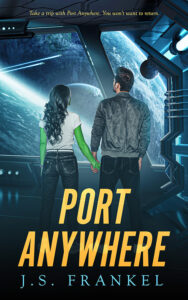
Long and Short Reviews welcomes J.S. Frankel who is celebrating the recent release of Port Anywhere. Enter for the chance to win a $50.00 First for Romance Gift Card! Competition hosted by Totally Entwined Group.

A restaurant in space, a waystation for all those who need a meal. When one of the guests turns out to be forbidden cargo, everything changes.
Rick Granger, seventeen, is the sole human occupant of Port Anywhere, a floating restaurant in space. His parents are dead, and he is aided by an alien called Nerfer—a pink alien that looks a lot like Spam. They journey throughout the galaxy, making a precarious living by offering meals in exchange for whatever their alien guests can pay.

As well, Port Anywhere, while powered by ion engines, has one unusual feature. It can suddenly jump from place to place, although Rick doesn’t know why. It simply happens.

His mundane existence changes when a warlike group of aliens led by a man named Kulida ask Rick to guard a possession of theirs. Upon further examination, Rick finds out that the cargo is a young alien woman named Merlynni from a planet called Kagekia, who carries a secret inside her—a mini galaxy.

The tiny galaxy was placed inside Merlynni by her father, a genius scientist, in order to hide it from hostile forces. As Port Anywhere continues its journey, Rick finds himself falling for Merlynni, and he will not give her up. When Port Anywhere shifts to various galaxies with various aliens in pursuit, they manage to escape time and again, but there comes a time for the inevitable showdown, and Rick has to use all his wits in order to save Merlynni and solve the riddle of the power she carries inside her.

Reader advisory: This book contains scenes of violence and murder.

Enjoy an Excerpt

Randorran Galaxy. Sometime around noon. Earth Year, 2134

“Is that griddle clean, yet?”

Nerfer’s call emanated from the storage room, a question that went past impatience but stopped just shy of outright anger. Deep and harsh, his voice sounded like it belonged to a giant, but he stood on the short side of one-hundred-sixty centimeters. His actual height was contentious at best, as he was essentially pink jelly encased in a clear plastic containment suit. But the commanding tone was unmistakable.

In days gone by, people would have called him Spam-In-A-Can. Perhaps calling him ‘crushed fruit in a suit’ would have been more appropriate. But after thinking about it…no. It wouldn’t have worked.

With a sigh, knowing he wouldn’t believe me, I answered, “Yes, it’s clean. So are all the other tables. Come see for yourself.” I doubted he’d take my word for it. Nerfer was notoriously difficult to please.

“I will. Give me a second.”

He could have a second—or ten. My journey to spotlessness on the bridge continued. The bridge itself took up a third of the total space, with a captain’s chair and a console in front of the main viewing window, an interstellar communicator, which sat on the console to the left of the captain’s chair, and helm controls to the right.

Behind the helm was the other two-thirds of the bridge. That was the restaurant. The glass that made up our main window to the stars was spotless, and it offered an incomparable view of the heavens.

If the view was incredible, so was the restaurant, in its own way. My late father had designed it after looking at countless vid-photos of diners from the mid-twenty-first century. For some reason, he’d had a fascination with that era.

Our restaurant had plush leather booths—ten in all—a counter with eight stools and a syntha-fridge that could synthesize any kind of food, but only in its raw form. I still had to cook it. We also had a combo grill-fryer where the food got prepared by me, Rick Granger, co-captain of Port Anywhere, our ship’s name.

This place was where I belonged, where my focus was. As the co-captain of this ship, I had a duty to guide our ship among the stars as well as to be on guard for anything that might threaten the safety of—

“Coming out,” Nerfer said, interrupting my dreams of a full captaincy.

The door to the storage room opened. It housed numerous old food crates and doubled as his sleeping quarters. He came toward me, his semi-solid body undulating in his containment suit as he moved along. From what he’d told me, he was a member of the Gliddod race. His people came from a distant galaxy, one so far away that no one really knew where it was.

He’d shown up here six months ago in a spacecraft that had fallen apart after he’d docked with ours, and he’d asked my father for a job. My father, being the decent person he had been, had given him the position of running this restaurant while he went off to attend to the daily mechanics of operating this ship. Oh, and he’d also made him co-captain.

Did that piss me off? There was an old saying—‘Did a one-legged duck walk in circles?’ In a private moment, I’d asked my father, “Dad, why’d you hire this guy? You don’t know where he’s been or if anyone’s chasing him or what. Weren’t you training me to be the captain and the head cook?”

“When it’s time, you’ll be both,” he’d answered.

Thanks for your confidence in me, Dad.

After a while, though, I had to admit that our new pink crewperson had proved to be an excellent cook, and after my father’s death from Bridorran Fever, Nerfer had also ended up being a more than capable captain. It still bothered me at times, though, being relegated to the ‘also-ran’ position.

In a quick, economical motion, Nerfer moved around to check each table. Finally, he finished his inspection with a grunt that sounded like a bubble popping underwater. “Good job, kid.”

Finally, a compliment. A pseudopod shot out from his suit—the suit was porous in a sense, and it allowed him to do that—and he pointed to a table. “Number six has a spot on it. We got Janoorians comin’ in soon, and they hate dirt.”

Compliment given, compliment withdrawn—and with that, he went back to the storage room. Fine, I’d clean the table—again. We had only ten, but he’d spotted a tiny imperfection one-fifth as large as my pinky fingernail on one of them. In days past, people had called it being anal. These days, people called it attention to detail.

Our vessel, an Earth-class freighter, had been converted from a freighter-slash-exploration vessel to an exploration-vessel-slash-interstellar restaurant. So, when we entered a new galaxy and if some alien life forms contacted us, once they found out we weren’t armed, they’d either drop in for a meal or tell us to keep moving.

Usually, they partook of a meal with us, we chatted, then they departed after paying us whatever they could. You could call it a precarious living, because we never knew who’d come our way. My parents had always believed in randomness, and my existence here was as random as it got.

We called our ship Port Anywhere, mainly because we went everywhere, to every galaxy and beyond. We had self-sustaining ion-conversion engines, and the great thing was that they left no radioactive residue upon the stars, unlike other ships. Recycling was cool. ‘Go green,’ the old saying went. We were in space, so, ‘go non-radioactive’.

Our journey had started two years before, just after I’d turned fifteen. We’d lifted off on a bright, sunny day in June from a flight field located near Salt Lake Flats, Utah. A sudden surge, the G-forces had pulled me back, and soon, we’d been in space.

After that, our voyage to wherever continued unimpeded. The ship didn’t have a wormhole device, not exactly. Unlike other, newer ships, it couldn’t go very fast, but it had a recyclable fuel supply, it was safe and from that point on, I’d learned almost everything there was to learn about spaceships and fixing them.

My parents were first-rate engineers as well as designers, and they’d willingly taught me everything I needed to know about the ship, save the engines. “They’re self-sustaining,” my father had once said. “All you have to do is keep the place clean.”

Of course, I learned about other things, such as basic repairs to the hull, space walking, electrical wiring and more, but, by and large, my parents handled things.

The first six months had been cool. Outside of my cleaning and service duties, charting the stars and training against battle droids had taken up most of my time. On occasion, we’d touch down on distant worlds, but like desert nomads, we were always on the move, except we moved among the stars and not sand, although the grains of the universe were always there.

On the surface, everything was wonderful—up until my mother had died from cancer a year ago, just after I’d turned sixteen. Modern science could cure a lot of things, but it still hadn’t gotten around to curing that.

The picture in my cabin showed a tall woman with long, flowing brown hair, a pretty face and a pleasant smile. My father had also been tall, around a hundred and eighty-two centimeters, with an aquiline nose, short brown hair and brown eyes, traits which I’d inherited, although I wasn’t quite that tall—yet.

In all honesty, I’d never thought much my looks. After all, there were no girls here to date, and the closest I ever got to female companionship of my age was watching old holo-vids. Decades back, they’d been called movies.

“I’m sorry about your mother,” my father had said to me after her funeral. He’d encased her in a metal coffin, we’d said our goodbyes then he’d pressed the button that ejected her into space. “She was a good person.”

Yes, she had been, and from that point on, he’d rarely spoken of her. Grief was a powerful thing. Still, we’d soldiered on, and our lives had continued among the stars…

“Rick, you wiping those tables down again?”

Nerfer had poked his head out of the storage room to ask me that question. I gave him the standard answer. “Yes, captain.”

His standard grunt came my way. “Fine.”

He moved to the captain’s chair while I finished doing the tables and gave the grill another touch-up job as well.

We’d been in the Randorran Galaxy for three days. It was the home to Janoorians, Melattans and Sillosians, among others. They were traders, they got along with each other, but they didn’t keep company very often. Something about a guild operating here…

“Rick!”

Nerfer’s voice—loud and stern—made me jump. I’d been spacing out—literally—and while it made me laugh silently, it also confirmed that I had to pay attention more. A good captain paid attention to everything. “What?”

“Check the computer. Company should be coming soon.”

Sure enough, the interstellar com-link device crackled to life. “This is Vadda, of the Janoorian people. We have a reservation. Your Captain Nerfer agreed to this.”

Captain Nerfer. Captain. What about me? However, I had to act professional. “Acknowledged. Co-captain Rick Granger speaking. How many in your party?”

“Three. We requested that you prepare one of our planet’s delicacies. We will bring the raw form of it. Can you make it to our satisfaction?”

If there was one thing I could do, it was cook. I checked our onboard computer’s database. They’d asked for tenlos, a plant of sorts.

“I’ll do my best, sir. Sending coordinates for docking procedures.”

“Acknowledged.”

The com-link fell silent. Nerfer swiveled around with a grunt. “Was that Vadda?”

“Yeah. They’re bringing tenlos aboard. That’s what they want for lunch.”

He nodded. His version of a nod was to bob back and forth, his semi-solid body making a swishing, squishy sound. “Good. You’d better let me handle it first, though. I know about tenlos. It’s alive.”

Nerfer had to be kidding. “Alive?”

Bob-bob. “Yep. You have to kill it first. After that, fast fry it with oil, then slice and dice it. Trust me. I been around,” he said in his usual not-quite-correct way.

Aw, whatever, already! I went to the airlock and waited. Vadda and his friends would be coming soon, and…there! Their ship, a small vessel maybe twenty meters in length, was inching its way over to the landing dock.

Seconds later, a tiny thump accompanied by a vibration indicated a successful docking procedure. I punched the airlock intercom. “When you’re ready, please enter the airlock for decontamination procedures.”

“Acknowledged,” a deep voice said.

The door on their side slid open and three blobs squiggled their way in. One of them carried a sack slung around its neck—or was that its waist? I couldn’t tell. The sack was wriggling. Nerfer would have to be right. Anyway, I started the decontamination procedure. Ten seconds later, a beep signaled that everything was clear.

Once the door opened, three black semi-solid puddles of ink roughly fifty centimeters in height and around sixty centimeters in circumference faced me. A low thrum of a voice spoke from the middle puddle-blob. “I am Vadda. You are the one we spoke with before?”

I nodded. Ordinarily, communicating with an alien species—weren’t we all?—would have been difficult. However, my father had designed a universal translator that operated on interpreting sounds and breaking them down into something understandable. The device was tiny, roughly the size of a pinhead. It was implanted behind my left ear.

“Uh, yes, sir. My name is Captain Rick Granger. I’ll be preparing your meal. This way, please.”

I gestured for them to follow me to the dining hall. They didn’t walk, just squidged along, sort of like a snail moving at a faster pace but leaving no slimy trail behind. Inside the restaurant, I waved my arms at the seats. “Any booth is okay.”

Vadda and one of his crew immediately went to the closest table to our position. The third member of the party, the one that carried a sack, went to the grill area where Nerfer was waiting. The sack was writhing furiously, and the puddle said in a high-pitched voice, “Be careful. The tenlos must be killed first by crushing its root.”

“Got it,” Nerfer said.

Two pseudopods shot out of him and took the bag. He opened it, and immediately, a gray plant around a meter long leaped out and hit the ceiling—literally. It hung there, waving numerous spindly branches around and screeching an unearthly sound.

Well, if I were about to be roasted or grilled, I’d scream, too. “C’mere,” Nerfer said, and his pseudopods quickly grabbed the plant and crushed its root. It gave one final shrill cry then let go.

“You’re on, kid,” Nerfer said as he tossed it on the griddle that already had a coating of oil on it. “Start ’er up!”

Showtime, and I went to the griddle to take out a knife and a spatula and start cooking the mess. A horrible odor came from it, and why couldn’t alien plants or meat smell decent like bacon and eggs…or grilled cheese? Rhetorical—they couldn’t.

While I suffered through a stink that was a combination of wood alcohol and crap, the Janoorians went wild over the odor, undulating their squishy bodies this way and that. “Ah, the young man is a master chef,” one of them said. “He knows our tastes!”

They could have their tastes and keep them. Once it was done, it resembled fried rocks. I divided the portions just so, slid them onto plates then served our guests. Did they use utensils?

No, they simply bent over the mess and ingested it…noisily. Once they’d finished, Vadda leaned back. “A fine meal! The tenlos is a foul plant on our world. It attacks our people from time to time, so please, do not feel bad for killing it.”

I didn’t feel bad for cooking it up. I would have felt bad, though, if I’d had to eat it. Vadda then got up and pointed to the door. “We are sorry not to spend more time here, but we must be on our way. We are delivering cargo to another sector in the galaxy.”

“Not a problem,” I said, attempting to keep my stomach’s contents inside.

His friends also rose, getting ready to leave. Vadda slid a pseudopod inside his body, took out a red jewel and handed it over. “Take this as payment, please. Should you visit this sector of space again, we will most certainly partake of a meal with you.”

Oh, please don’t.

But I said nothing and led them to the airlock. While I waited for it to pressurize, I asked him about the jewel.

“It is called energa,” he said.

Energa? “What does it do, exactly?”

“It has the property of reflection and is considered valuable on our world. Please use it as you see fit.”

Reflection? Maybe it was a mirror. It was shiny, anyway, and I bowed, out of respect. “Thank you.”

They departed, and once they were free of the ship, I checked out the jewel. It sparkled, but that was about it. Out of curiosity, I walked into a storage room nearby, found a small hand-laser and did my best to slice off a tiny piece. The beam simply deflected away and burned a hole in the door. “Oh, so that’s what it does.”

Interesting…and a call that came over the ship’s intercom interrupted my thoughts. “Prepare to shift. Prepare to shift.”

Why now? The computer never gave a reason, although the sensors detected another vessel approximately four thousand kilometers away, its purpose, unknown. No communication came from it, so…

“Shift occurring. Shift occurring.”

With all haste, I ran to the restaurant where Nerfer was in the process of putting all the dishes and cutlery away. “Get ready,” he said. “Shift’s in forty-five seconds.”

“Right.”

I parked my butt in a booth, wrapping my legs around the table support. The shift was simply the interspatial move of this restaurant-vessel from one quadrant of space to another. I had no idea why it happened, and neither did Nerfer. It simply did. After my father had died, the shifts had begun.

And when we shifted, talk about massive! The energy of the movement flung us far and wide, and if I weren’t sitting down, I’d end up on my back or head at the far point of any room I was in.

Good thing we had our interstellar computer. It held all the information on the various galaxies we’d visited thus far. Our ship had no weapons, but it had powerful sensors that could map out any planet’s dimensions and details almost instantaneously, and while it couldn’t tell us about the inhabitants’ culture, it gave the basics on what to expect. It could also translate any language instantly.

Still, face-to-face communication had to be done, and in my almost two years on this interstellar barge—a flying brick that was one-hundred-twenty meters in length by seventy-five meters in width—I’d seen sludge, rock-people, lizards and other life forms that were too difficult to describe. I’d spoken with them all, and it was interesting to learn their ways. But I still missed Earth.

Nerfer’s race—so he said—could learn languages much faster than humans could, within a couple of hours. Very useful for him…

“One,” the computer said, bringing me back to reality.

Then it came, that great heave from here to wherever. I kept my head down on the table and waited it out. “Hey, Nerfer, how are you doing?”

“Still in one piece.”

When we stopped shaking, I asked the computer for more information.

“We are currently in the Madlia Galaxy,” it said in its tinny voice. “Scanning. We are orbiting a planet known as Rattan One.”

“Display information on the planet.”

Whir…click. “Displayed.”

A hologram popped up with the pertinent information. The planet was similar in size to Earth, with approximately fifty percent of its surface covered by water. Oxygen-nitrogen atmosphere, suitable for breathing. Rich vegetation.

As for the people, they were around two meters in height, slender yet muscular, with oversized hands and feet. Hairy all over, they resembled the cavemen on Earth that I’d studied when I had been younger. Two mouths, one on top of the other. Tiny ears. A slit for a nose. Gray-skinned. In a word, ugly. I wondered if they were warlike and if our entrance into space would provoke them…

“Unidentified vessel, respond.”

The crackling of the interstellar com-link and the voice—deep, raspy, and unfriendly—made me jump. “This is Port Anywhere,” I answered.

“What is the nature of your vessel and your visit?”

“We’re a, uh, a restaurant ship. My name’s Rick Granger, and I’m in charge of—”

“You are in orbit around our planet. We have the right to inspect any alien spacecraft or repel it if we wish.”

Jerk. If I’d had a space cannon, I would have decimated that slime, but we had nothing to defend ourselves with. “Understood,” I answered, striving to enhance my inner calm. “I’ll send the coordinates for our docking site.”

“Does your ship not have a landing bay?”

It did, but it had only enough room for one of our ships, a reconnaissance vessel. “We do, but it’s probably too small to accommodate one of your ships.”

Silence…then, “Very well. Send your coordinates.”

The voice cut out, and I dutifully sent the coordinates to our—ahem—hosts. Nerfer was hard to read, mainly because he didn’t often form expressions. He invariably relied on his voice to make his thoughts and intentions known, but now, his mushiness formed itself into a frown and his voice was full of grave misgivings.

“Rattanians don’t take no for an answer. Deal fairly with them and they’ll be nice, but if you cross them in a deal, then you won’t be worth vellora spit.”

In space, vellora were akin to maggots, the lowest of the low. “I’ll be careful.”

He bobbed back and forth. “Good. Did they tell you what they wanted to eat?”

“No, they only wanted to look around.” That was what bothered me.

Nerfer grunted. “Fine, they can look around, for all I care.”

Yeah, that reminded me. “How do you know everyone, Nerfer? You never told me, and you’ve been in charge here for six months.”

His frown deepened. “My world no longer exists,” he said after a time. “A plague hit us. It broke down our cellular matrixes.”

“Which means…what?”

“It means we dissolved into organic ooze. There is no treatment, no cure.”

Geez, no wonder he was impatient and angry much of the time. Even though I hadn’t seen Earth since I’d been just past fifteen, at least I had a home. He didn’t. Nerfer continued in a voice devoid of self-pity.

“I got out, just in time. After that, I became a courier. I delivered goods and sometimes arms to other worlds. Had my own ship, did well, but then I pissed off a warlord and he blew my ship out. I managed to make it here, and…”

The com-link crackled. “Alien vessel, this is Commander Kulida, leader of the Rattanian space forces. We are nearing your space dock.”

Nerfer shut down his bio, formed a finger and punched the intercom-link button. “Understood. Our representative will meet you at the airlock. You are welcome here.”

He clicked off, and had he had eyes, he probably would have rolled them. Instead, he only muttered, “Welcome like hell. I don’t like this one bit. Kid, you be careful.”

Kid, it was always ‘kid’. I’d turned seventeen about a month before, and he still thought of me as an infant. It was enough to make me scream in frustration.

A few seconds later, a dull thud signaled that Kulida’s ship had docked with ours. I ran to the airlock and punched in the command for the airlock doors on the visitor’s side to open. Three tall beings wearing gray containment suits entered. Two of them carried a large metal crate. They looked around the eight-by-eight-meter room with interest.

There wasn’t much there, only the walls and some shodokutan lights which used concentrated light to destroy any possible pathogens from alien races. I pressed the button to start the decontamination process. Their world may have been similar to Earth, but pathogens were pathogens.

“Activating decontamination procedures, Captain Kulida,” I said. “Just a few seconds.”

“Acknowledged,” he responded.

After ten seconds, the process finished, and the readout showed no pathogens. I opened the door to my side, and three massive men stepped out. “Thank you for allowing us aboard your vessel,” said the person who didn’t have his hands on the crate.

He took off his helmet to reveal a gray skull of a head with deep-set black eyes and a visage so gaunt that it appeared that he was suffering from malnutrition. Perhaps everyone on his world looked like that.

With a sniff, he examined the ceiling of the hallway then turned his gaze upon me, as though he were viewing a particularly ugly species of insect. “I am Commander Kulida. I come bearing cargo. We need to talk.”

About the Author: J.S. Frankel was born in Toronto, Canada, a good number of years ago and managed to scrape through the University of Toronto with a BA in English Literature. In 1988 he moved to Japan and started teaching ESL to anyone who would listen to him. In 1997, he married the charming Akiko Koike and their union produced two sons, Kai and Ray. J.S. Frankel makes his home in Osaka where he teaches English by day and writes by night until the wee hours of the morning.


You can check out his blog and follow J.S. on Facebook and Twitter.

Blog | Facebook | Twitter | Goodreads | First for Romance Author Page

Buy the book at your favorite online venue or First for Romance.

a Rafflecopter giveaway