Treachery by Shirley Bigelow Dekelver


Treachery by Shirley Bigelow Dekelver
Climate of Fire Book 2
Publisher: BWL Publishing Inc.
Genre: Young Adult (14 – 18 y.o.), Sci-Fi/Fantasy, Romance
Rating: 4 Stars
Reviewed by Astilbe

It is 2046, a year since Vancouver was devastated by an earthquake and tsunami. Taylor West, Carlie Fleming, Mai-Li Wong, and Willie Arbuckle, four young adults, and three children, twin brothers Rusty and Eddie Coleman, and Debbie, who has Downs Syndrome, lived in constant fear of the violent gangs. Making a life-saving decision they leave Little Mountain and walk to the Interior, hoping to find a better life.

The journey is fraught with unimaginable hardship and danger. Surviving a firestorm in the Wastelands, they clash with the Desert Rats, and lose one of their own. Heartbroken they continue their trek, finding an old, abandoned cabin near Mount Davis. Winter is rapidly approaching, and they decide to delay their journey until Spring. Taylor admits to Carlie he has feelings for her, but she rejects his advances, as she is unable to accept Rusty’s death. Willie is caught stealing food and is banished from the group. Realizing he might seek revenge; Taylor decides they cannot stay in the cabin, they must leave immediately.

Their progress is slow, the snow is deep and the steep mountain trails take their toll on the younger children. They arrive at Blakeburn, a deserted mining town, and meet Pete Johnson, a trapper and prospector. Pete is the Chief of the Similkameen band, who live in harmony with the Chinese people in Blackfoot, their destination. Relationships are tested time and again. Will they remain strong and what will shatter?

Love is stronger than fear.

I appreciated the character development in this book. Yes, the characters still sometimes made impulsive and illogical decisions, but they also showed signs of accepting the dangerous new world they lived in and of thinking ahead at times in order to have access to the food, shelter, and supplies they’d need to survive in it. Practice leads to progress, so I was pleased with how they’d matured since I first met them.

It would have been helpful to either have more attention paid to the romantic subplot or to not include it at all. It’s not something I thought the main storyline needed, at least at this point, and I was surprised the characters involved in it went in that direction due to the much more pressing conflicts and basic human needs they were struggling with. I would have liked to have stronger reasons to root for those two individuals to end up together. They were both interesting people on their own, I simply needed more information about why they’d be a good romantic match and why this particular moment in the timeline was the best time to go there instead of taking care of more urgent matters like having enough food and a warm, safe place to live first.

With that being said, I did enjoy seeing the characters become a found family and work together for the common good. It takes a lot of effort to look after children and people with intellectual disabilities in a setting like this, so I appreciated the descriptions of how everyone was kept (more or less) clean and fed under such difficult circumstances. That’s not something that’s always covered in this genre, but it’s one of those things I always hope to find in post-apocalyptic fiction as it would be such an important matter if something similar were ever to happen in real life.

This is the second instalment in a series that should be read in order for plot and character development reasons.

Treachery: Climate of Fire Book 2 was full of intrigue.

Movie Review: Shredder Orpheus

Shredder Orpheus
Writers: Robert McGinley
Director: Robert McGinley
Starring: Robert McGinley, Megan Murphy, Gian-Carlo Scandiuzzi, Vera McCaughan
Publisher: Boom! Cult, Inc., Image Network Inc.
Genre:SciFi/Fantasy, Horror, Historical
Rating: Stars 3 Stars (6 Stars on IMDB)
Reviewed by Astilbe

Skateboarder named Orpheus and friends go to Hell to stop television signals that are brainwashing America.

True love makes anything possible, right?

The retelling of the Orpheus and Eurydice legend made me smile. Anyone who isn’t already familiar with this Greek myth may want to give it a quick google beforehand so they’ll know the basic plot, but viewers who skip that step will be able to figure things out later on in the film once the plot speeds up. As someone who was only somewhat aware of the original, I thought it was cool to see it reinterpreted on the big screen but didn’t have any strong opinions about what that should look like. There is definitely something cool about seeing how famous old stories can be retold to new generations in ways that feel more modern, and I hope to watch more movies like this in the future.

I struggled with the slow pacing of this film, especially given how long it took some subplots to begin to influence each other. Yes, filming styles were different 30+ years ago, but I still found myself wishing that the fantasy elements of the storyline had been developed more deeply so it would be easier for me to figure out what is going on with those characters. There was room to do that here, and it would have made for a stronger tale in my opinion.

With that being said, the plot was so surreal and dreamlike that the portions of it I had trouble putting together at first ended up making much more sense later on. This may work best for viewers who can go with the flow and enjoy the ride. It may be confusing at times just like trying to explain what happened in a disjointed dream after you wake up and realize that dream you didn’t realize how odd certain moments were, but figuring out what certain scenes may have meant afterwards can be quite rewarding. I especially liked comparing the earliest scenes to what was revealed about them close to the end when certain themes finally wove together and worked in my mind.

Shredder Orpheus kept me guessing what might happen next.

IMPORTANT NOTE:

The brand-new novelization of SHREDDER ORPHEUS is available from Encyclopocalypse Publications!

SHREDDER ORPHEUS is now available to rent and/or own digitally at BOOM! CULT, and on a limited edition Blu-ray available exclusively at Vinegar Syndrome.

Black as Hell, Strong as Death, Sweet as Love – A Coffee Travel Guide by Steven P. Unger


Black as Hell, Strong as Death, Sweet as Love – A Coffee Travel Guide by Steven P. Unger
Publisher: Robert D. Reed Publishers
Genre: Non-Fiction, Contemporary, Historical
Rating: 5 Stars
Reviewed by Astilbe

BLACK AS HELL, STRONG AS DEATH, SWEET AS LOVE: A Coffee Travel Guide, is the first and only book to trace coffee consumption from its origins in prehistory to becoming the world’s second-most-valuable commodity after oil—and to pair this history with replicable, affordable Coffee Experiences that provide a unique approach and added value to the readers’ destinations, no matter how many times they’ve been there before. This book is a multi-genre travel book with unique historical insights that immerse the reader in the culture of a country or city through the lens of the destination’s deep relationship with coffee. No other travel book has ever provided the kind of total immersion into a country or city—through histories, travel directions, one-of-a-kind photos, and recipes—that BLACK AS HELL, STRONG AS DEATH, SWEET AS LOVE: A Coffee Travel Guide, delivers in every chapter.

Coffee makes everything better.

Some of my favorite passages in this book were the ones that described how various cultures read people’s fortunes based on how the coffee grounds settle in the bottom of their cup. This was something I’d only ever heard about being done with tea leaves, so I was intrigued to find out what rituals and cultural expectations were associated with this form of predicting the future.

I also loved learning about what has been added to coffee both historically as well as in our current time. Milk and sugar were the most common answers, of course, but human beings are far too creative to stop there. As someone who prefers sweeter and milder doses of caffeine, it was interesting to read about the other options out there and how they’re ground up, dried, frozen, baked, or otherwise prepared for the perfect cup of joe.

Mr. Unger achieved the perfect balance of giving readers an overview of the history and cultural mores of coffee from all over the world while also keeping the pacing moving forward steadily. There were bibliographies provided at the end of each section for readers who, for example, might want to learn more about how coffee is served in Ethiopia or Hawaii in particular. This was a great way to share deeper information with readers who wanted it while also sticking to the highlights for those who preferred to read a little bit about every region featured here.

Black as Hell, Strong as Death, Sweet as Love – A Coffee Travel Guide made me want to run to the nearest coffee shop. Yum!

Paranormal Jelly: An Anthology of Whimsical Narratives Regarding the Comical Facets of the Occult by Zwahk Muchoney


Paranormal Jelly: An Anthology of Whimsical Narratives Regarding the Comical Facets of the Occult by Zwahk Muchoney
Publisher: Self-Published
Genre: Mystery/Suspense/Thriller, Sci-Fi/Fantasy, Paranormal, Contemporary
Rating: 3 Stars
Reviewed by Astilbe

Paranormal Jelly blends the bizarre with the everyday in the early internet era of 1996. Middle-aged author Albert runs a popular website, sharing tales of eldritch horrors, baby Sasquatches, cigarette-smoking ghosts, and dark cultists. A skeptic at heart, he dismisses it all as fiction—until reality starts to blur. Cryptids and hauntings become alarmingly frequent, always just out of the reporter’s sight, but impossible to ignore. As Albert struggles to document these strange events, he’s drawn into a web of the supernatural that threatens his very existence.

Both skeptics and true believers are welcomed here.

I loved the playful and humorous tone of Albert’s adventures. The fantasy and science fiction themes were subtle in some places, but that only made those scenes even more exciting once they popped up again and made me look at what just happened in a new light. It was a nice contrast to the more skeptical characters who didn’t always believe the stories about ghosts, cryptids, aliens, and other creatures they heard.

As much as I liked reading about the various characters in this novella, there were so many of them that only the protagonist was given a chance to become more well rounded. Even then, I didn’t feel like I got to know Albert as deeply as I would have liked to due to the relatively short length of this piece and how much was going on with the plot. With stronger character development, this could have been a four or five-star work as the storyline and themes themselves were fantastic.

Some of my favorite scenes were the ones that provided scientific explanations for why things like orbs sometimes appear in photos and why certain types of people are more – or less – likely to believe in conspiracy theories and the paranormal in general. There are many different reasons why strange things happen and why people can have a wide variety of responses to the same event. I thought these passages treated both believers and skeptics fairly and assumed the best of everyone. That makes these sorts of stories so much more interesting to read as I knew the author had good intentions and wanted everyone to think critically about what they’ve read, heard, or maybe even seen with their own two eyes.

Paranormal Jelly: An Anthology of Whimsical Narratives Regarding the Comical Facets of the Occult kept me guessing.

8 Canterbury Tales by Albert Seligman (Editor)


8 Canterbury Tales by Albert Seligman (Editor)
Publisher: Dulace Books
Genre: Young Adult (14 – 18 y.o.), Sci-Fi/Fantasy, Historical
Rating: 5 Stars
Reviewed by Astilbe

What the Canterbury Tales Are

The Canterbury Tales are one of the great classics of all literature. They were written by Geoffrey Chaucer, poet, warrior, diplomat and royal pensioner, about 1387, and are famous for the pictures they give of life in the 14th century. The tales were supposed to have been told by various members of a pilgrimage to Canterbury Cathedral in England to while away the time. John Erskine, celebrated author of The Private Life of Helen of Troy, now relates these tales delightfully for the readers of The American Weekly, and Edmund Dulac, famed English painter and etcher, makes them vivid with his incomparable art.

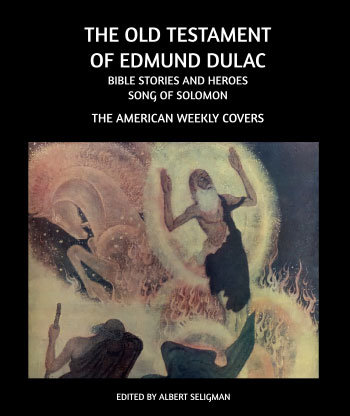
These eight illustrations were published in The American Weekly magazine in 1942. John Erskine provided his interpretation of the Tales and his essay about the Canterbury Tales from his 1928 The Delight of Great Books is included.with additional illustrations. There is a further reading section which also includes illustrated editions from the early nineteenth century to the present.

The 8 Canterbury Tales included are-
The Student’s Tale of Patient Griselda
The Knight’s Tale of Emily’s Lovers
The Miller’s Tale of the Carpenter’s Wife
The Squire’s Tale of Canace and the Talking Falcon
The Wife of Bath’s Tale of the Amorous Knight
The Merchant’s Tale of the Doting Husband
The Man of Law’s Tale of What Happened to Constance
The Second Nun’s Tale of Saint Cecilia

All the original artwork for the covers has been restored, and a crop of each image follows the tales. This was a difficult undertaking for Dulac, who moved out of London due to the bombing during the war. The illustrations had to be sent by ship to America, and avoid Axis warships and submarines looking to sink any Allied vessel.

Dulac never before tried to illustrate either King Arthur, his 1940 American Weekly series, or Canterbury Tales, unlike many of his famous contemporaries. I would speculate that Hearst approved these two series to rally the Americans to help the English during their hour of need by showcasing two of their most well known and liked classics.

The classics are for everyone.

I enjoyed the author’s commentary on Chaucer’s work in both the introduction as well as sprinkled through the later sections. It felt like sitting in a university literature class and hearing what the professor thought of these famous stories. Sometimes he had sharp takes on certain characters or themes, and his strong opinions about them echoed in my mind as I read them for myself. There is definitely something to be said for knowing in advance what you’re getting into before diving into this collection.

I was surprised to learn how often these stories have been marketed to kids and teenagers over the years. Some sections showed rare pages from vintage youth-friendly magazines that printed them with gorgeous illustrations of the most important scenes. This wasn’t something I was expecting to find, but it made me read the sometimes-violent passages in a new light as I imagined what sorts of lessons young readers might be expected to learn from them. This is one of many reasons why I’m always excited to see new submissions from Mr. Seligman as he has consistently taught me all sorts of things about literature, art, and history that I was not previously aware of.

One of the things I liked the most about the Canterbury tales themselves were the glimpses they shared with the reader about medieval life. Yes, human nature has remained the same, but many social conventions and cultural expectations of how someone should behave have not. This was especially interesting when it came to things like explaining why some people were poor or why certain sexes or social classes were expected to behave in different ways than others were.

8 Canterbury Tales was a well-rounded introduction to these famous stories.

Mountain Interlude by S.V. Brosius


Mountain Interlude by S.V. Brosius
Publisher: Self-Published
Genre: Romance, Paranormal, Contemporary
Rating: 3 Stars
Reviewed by Astilbe

Can broken hearts mend if they are frozen in time?

Deep in the mountains of Colorado stands an old house shrouded in mist. A lonely, divorced woman will come face to face with the attractive man who owns the property. She will find herself in a world of paranormal mystery: a place where the lost are taken care of, the injured are healed, and time stands still.

Healing is for everyone.

Maizie’s character development was strong and made me want to spend even more time with her. She was an intelligent, resourceful person who could quickly solve problems if she felt threatened or confused. This is something I’m always happy to come across in stories, especially ones involving a woman driving alone in the middle of nowhere who has car trouble and needs to seek help. That’s a situation that just about any woman would feel rather vulnerable in, so it was a relief to meet a character who took her predicament so seriously.

It was never quite clear to me what the limitations of the paranormal elements of the storyline were. They seemed to wax and wane depending on what Maizie and Tony were currently doing, but it was never entirely clear to me if this was because their moods were influencing the spirit world or if this were a coincidence. If more attention had been paid to the logic of how this all worked, I would have happily given this tale a higher rating as it was well-written and memorable.

I must tip my cap at the author for their creative and thought-provoking ending. It was not at all what I expected it to be, but it fit the tone of this tale perfectly and made me wish for a sequel. There’s definitely something to be said for stories that play around with the audience’s expectations in order to keep their genre fresh and interesting.

Mountain Interlude was full of surprises.

Movie Review: Shiver Me Timbers


Shiver Me Timbers
Writers: Paul Stephen Mann, E.C. Segar
Director: Paul Stephen Mann
Starring: Murdo Adams, Stephen Corrall, Paul Dewdney
Publisher: Gravitas Ventures
Genre: Sci-Fi/Fantasy, Horror, Historical
Rating: 3 stars (6 stars on IMDB)
Reviewed by Astilbe

In 1986 Northern California, Olive Oyl, her brother Castor and friends, go on a camping trip to see the meteor shower with Halley’s comet. But the night turns into horror as a meteor transforms Popeye, into an unstoppable killing machine.

Comets are nothing to mess around with.

I must admit that Popeye the Sailor Man is just about the last character I’d ever associate with the horror genre, so I was intrigued to see what the writers and director were going to do to make him scary. It was funny to see how they used his catchphrases and habits in news ways to keep the audience entertained. He made me laugh and shrink back in fear at the same time which is exactly the reaction I hoped I would have.

While I didn’t need a lengthy explanation of why Popeye appeared, I did find myself wishing for more plot development here. The reason given for his murderous escapades never quite made sense to me, and trying to figure it out was a distraction from both the horrifying and the comical moments in this film. I would have chosen a higher rating if this wasn’t the case.

It isn’t necessary to be familiar with 1980s slasher flicks in order to enjoy this homage to them, but viewers who have seen at least one or two horror films from that decade may notice some cool throwbacks to the way things were filmed a few decades ago. Without giving away spoilers, I’m specifically thinking of the way rural settings were sometimes used to amp up the suspense back then and how isolation and fear could lead a character to make impulsive decisions that they might not have chosen if, say, they’d been in a city surrounded by other people.

Shiver Me Timbers was creative.

Bright Green Futures: 2024 by Susan Kaye Quinn, Editor


Bright Green Futures: 2024 (Solarpunk Anthology) by Susan Kaye Quinn (Editor)
Publisher: Self-Published
Genre: Sci-Fi/Fantasy, LGBTQ, Romance
Rating: 5 Stars
Reviewed by Astilbe

SHORT STORY COLLECTION
The Bright Green Futures: 2024 anthology is a collection of short solarpunk stories from guests of the Bright Green Futures podcast, where we lift up stories to build a better world. These hopeful climate-fiction stories include clicky space centipedes, sentient trees, a flooded future Rio de Janeiro and characters trying to find their place in a climate-impacted world. Each story imagines a way for us to survive the future, together.

Bright Green Futures: 2024 contains six short stories plus a bonus prose-poem.

The Doglady and the Rainstorm by Renan Bernardo
What Kind of Bat is This? by Sarena Ulibarri
Centipede Station by T. K. Rex
A Merger in Corn Country by Danielle Arostegui
Ancestors, Descendants by BrightFlame
The Park of the Beast by T. K. Rex
Coriander by Ana Sun
Good times are on the way.

Joseana was healing from a tragedy in “The Doglady and the Rainstorm.” I loved the world building in her tale and would have happily read something full-length about how this character navigated the extensive flooding in Rio and dealt with her painful memories of the past. Her love of dogs was another nice detail that added depth to the plot and gave her a good reason to face her fears when something unexpected happened.

“Centipede Station” showed what happened when Pebble and Moss woke up from cryosleep much later than they had intended to. The planet they had arrived at didn’t fit their expectations either due to the strange plants and animals they found living there. I enjoyed seeing their reactions to every plot twist as they once again had to adjust their expectations of what their lives would be like. There’s something to be said for characters who are willing to adjust to anything that comes their way, especially given how carefully they’d planned their journey before it began. Yes, I know I’m being a little vague here, but I want other readers to be just as delighted as I was once they figure out what’s going on.

Every homeland evolves over time. As Aster explored the country her great-grandmother left as a child in “Coriander,” I took note of the differences between how it had been a few generations ago versus how it was by the time the protagonist was able to visit. The nostalgia in this piece was strong, but I also liked seeing how the characters had adapted to climate change and the way it affected which types of food were still available for the average person. Science fiction doesn’t talk about food enough for my tastes, so I was quite happy to dive into the topic here.

Bright Green Futures: 2024 (Solarpunk Anthology) overflowed with hope for the future which is exactly what I needed to read.

Numbered Love – A Story from American Buddha by Maysam Yabandeh


Numbered Love – A Story from American Buddha by Maysam Yabandeh
Publisher: Self-Published
Genre: Young Adult (14 – 18 y.o.), Sci-Fi/Fantasy, Romance, Contemporary
Rating: 3 Stars
Reviewed by Astilbe

Nam never stopped thinking about the girl who once held his heart. For thirty years, he kept her memory alive through ancient romantic tales from the Far East. But when he returns to America to find her, his hopeful search unravels into a journey full of unexpected turns as he confronts the realities of love in modern times.

There’s nuance to everything in life, even love.

The plot twists kept me on my toes, especially when it came to the relationship between Nam and Livia, his young friend who promised to fall in love with him once they both grew up. Just when I thought I’d discovered the most unusual places this childhood vow took these characters, they ended up in a slightly to dramatically stranger place than they’d been just a moment before. I’d like to tip my cap to the author for taking these sorts of risks as they make reading – and reviewing – so much more fun!

It would have been nice to have a deeper exploration of Nam’s personality as he didn’t feel well-rounded to this reader. He came across as someone who was unaware of how sexist he was but who would have been mortified and possibly changed his ways if he were better at noticing his own flaws. His intelligence and willingness to work hard were easy to spot, but I needed more details about him in order to sympathize with the double standards he set when it came to how men should behave versus how women should behave.

With that being said, I enjoyed the sections of this short story that discussed what Buddhism has to say about suffering, the consequences of one’s actions, and how people should live. There were several nuggets of wisdom there that I can’t go into detail here for spoiler reasons but that made a lot of sense to me. It’s always nice to walk away from characters with something to ponder over.

Numbered Love was a wild ride.

Humdrum by Mitchell Brockman


Humdrum by Mitchell Brockman
Publisher: Self-Published
Genre: Suspense/Mystery/Thriller, Contemporary
Rating: 4 Stars
Reviewed by Astilbe

How long can someone endure the silence? For David, the answer’s not long enough.

In the hum of an office filled with laughter and camaraderie, David Clark exists on the edges unseen, unheard, and trapped in a cycle of quiet isolation. Nights in his empty apartment feel endless, and the world outside his window moves on without him.

When a coworker’s kindness cracks open the walls he’s built, and a sudden tragedy shakes his fragile existence, David is forced to confront the silence he’s lived with for too long. As his carefully guarded life unravels, he must decide: will he take the risk to finally connect, or retreat further into the safety of solitude?

Everyone carries their own burdens, some more quietly than others.

One of the things I liked the most about this book was how thoroughly it explored the emotional pain and loneliness of mental illness, especially for people who don’t have strong support systems to help them cope with their worst days. David was plagued by thoughts and feelings that overwhelmed him with anger, paranoia, grief, and fear. It was difficult for him to describe this cascade of emotions and even harder for those around him to understand why he reacted so negatively to what most people would interpret as friendly banter or, at worst, genuine misunderstandings.

I would have liked to have learned more about David’s past, from his childhood to any family history of mental illness that he might have been aware of. Both genetics and adverse life experiences can trigger the sorts of symptoms he dealt with, and I think it would have been helpful for the audience to have a deeper understanding of who he was as a character and how long he’d been struggling with his dark thoughts and feelings. Was this a recent change in his mental health, for example, or something he’d been dealing with since early childhood?

Let’s see how much I can share about the ending without giving away any spoilers. The shift in tone was surprising, but I appreciated the points it made about what could be learned from David’s experience and how the storyline would be moving forward from that point forward. I could close my eyes and imagine a few different directions things could be headed, all of which matched what I’d previously read and made me wonder if those possibilities were the closest to the author’s assumptions about the future. It’s nice when readers are given this sort of opportunity!

Humdrum was thought provoking.