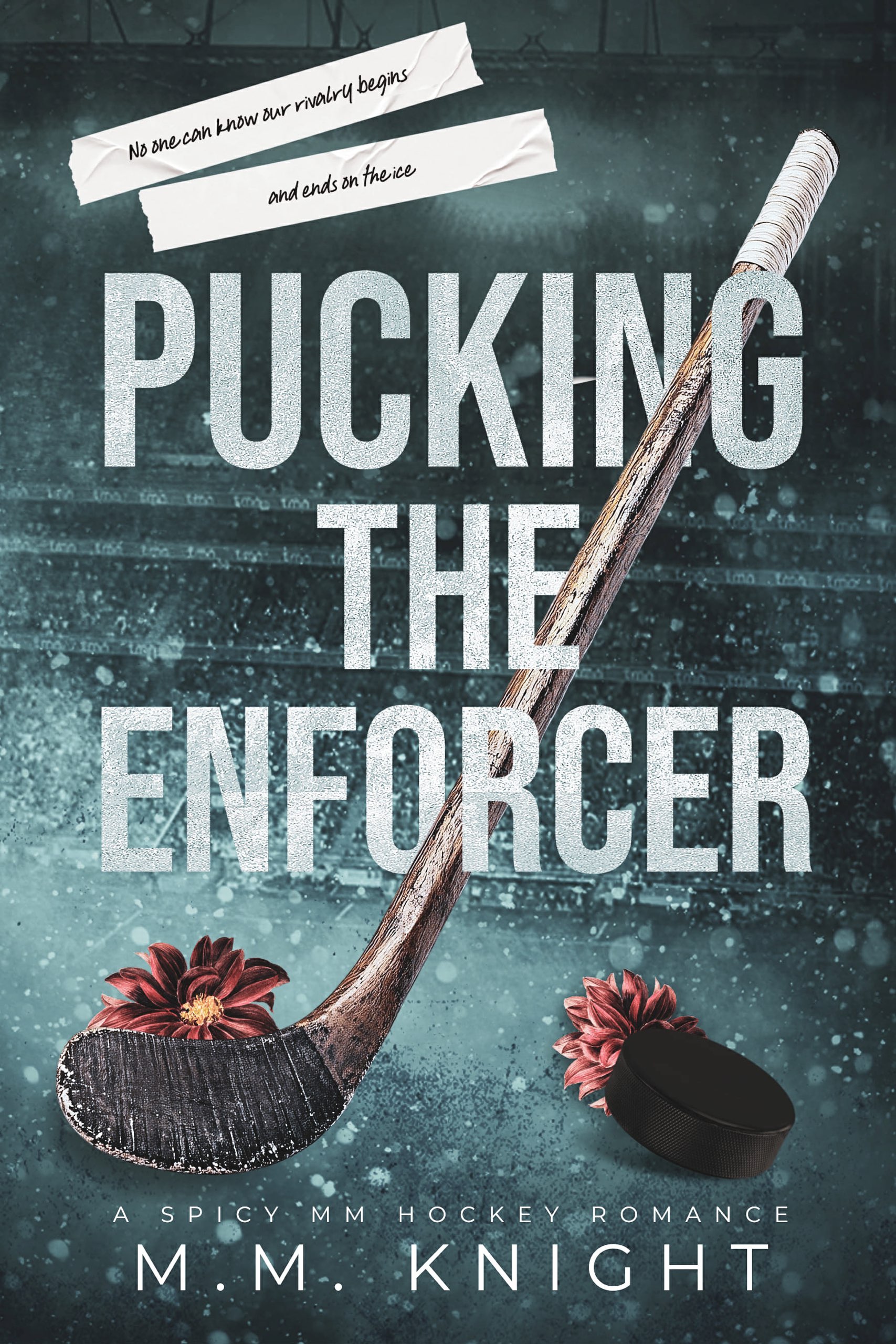
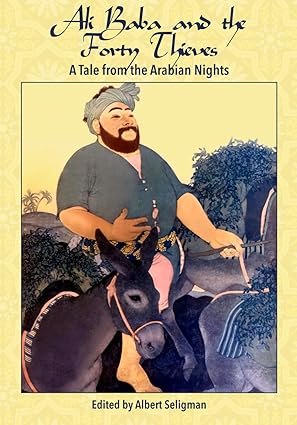
Ali Baba and the Forty Thieves by Author: Anonymous and Albert Seligman (Editor)


Ali Baba and the Forty Thieves by Author: Anonymous and Albert Seligman (Editor)
Publisher: Dulacebooks
Genre: Sci-Fi/Fantasy, Historical
Rating: 5 Stars
Reviewed by Astilbe

The story is about two brothers whose father died and left them little. Ali Baba married a poor woman and lived frugally, but Cassim married a woman who soon inherited a fortune and lived in luxury. One day while Ali Baba was in the forest cutting wood to sell he saw a great cloud of dust approaching and the sound of many riders. He feared for his life, so he hid his three donkeys and hid himself in a tree. The band of forty riders and their leader stopped in front of a cave. When the leader said “ Open Sesame” the door of the cave magically opened. The whole troop went inside while Ali Baba stayed hidden. When he was sure they had gone, he approached the cave door and said “ Open Sesame” himself as the cave door magically opened to his command. Inside the cave he saw vast riches and golden coins, which he liberally took for himself and returned home with his donkeys, remembering to properly close the cave door with the “Shut Sesame “ command.

His wife was astonished at all the gold coins he brought home and wanted to count them before Ali buried them in his yard. As there were too many to count, she borrowed a measuring cup from her sister-in-law. She was curious as to what they might have to measure something, so she cleverly put some suet on the bottom to see what would stick. After the cup was returned with a gold coin stuck to the bottom, she called her husband Cassim to tell him what happened.

Cassim went to Ali’s house and demanded to know how he got a gold coin, and Ali told him everything, including the magic password. Cassim was very greedy, so the next day he set out with many donkeys to find the cave and removed as much treasure for himself as possible. In his haste, he forgot the magic words to open the cave and was trapped inside when the robbers returned. They killed him and cut his body in pieces.

When Cassim didn’t return, Ali feared the worst and returned to the cave to find him. He found his brother’s body and returned to town. He knew the robbers would find out if anyone had been murdered in such a fashion, so they sewed Cassim’s body back together and pretended he died a natural death.

The robbers sent scouts to town to determine if anyone had died and discovered Ali Baba’s house. The captain of the robbers disguised himself as an oil merchant and hid his band in leather jars planning to murder all the household. When Morgiana, Ali Baba’s clever slave girl discovers the ruse, she murders all the robbers. The captain flees, but soon returns in another disguise to take his revenge. Again she discovers him, plunges a dagger into his heart and saves her master.
Moderation is the key to survival.

I once again loved the way this tale transported me to a time and place in the past that I would otherwise know very little about. This is part of the reason why I continue to give new instalments in this series such high ratings. It’s not always easy to make a reader feel immersed in what they’re reading, much less give them a taste of what life was like for some people in the far east over eleven hundred years ago, but Mr. Seligman had all sorts of intriguing ways to close that gap for his modern audience that new fans should discover for themselves.

Many old legends are sanitized for modern audiences, so I appreciated the fact that not every character remained safe from harm and that there were choices made here that are less common in modern adaptations. That is to say, this is something I’d particularly recommend to readers who enjoyed the older versions of fairy tales before The Brothers Grimm began collecting and softening up their sharp edges for younger audiences.

It’s not necessary to know anything about the plot in advance, but readers who do might notice some interesting twists that often seem to be left out of more recent translations of Ali Baba’s life. I thought I knew exactly what to expect going in, but I was still pleasantly surprised by a few things I didn’t realize were part of this universe in at least some retellings. The editor excels at this sort of thing which is yet another reason why I try to read as much of his work as I possibly can. There’s nothing like learning new facets of old favorites thanks to fairly recently uncovered versions of them.

This is part of a series that does not have to be read in any particular order.

Ali Baba and the Forty Thieves was a fantastic and beautifully illustrated adventure.
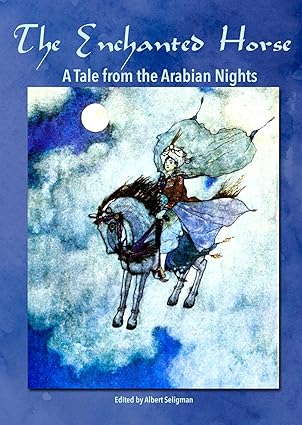
The Enchanted Horse (A Tale from the Arabian Nights) by Albert Seligman


The Enchanted Horse (A Tale from the Arabian Nights) by Albert Seligman
Publisher: Dulacebooks
Genre: Young Adult (14 – 18 y.o.), Sci-Fi/Fantasy, Historical
Rating: 5 Stars
Reviewed by Astilbe

The Enchanted Horse, also known as ‘The Magic Horse’ or ‘The Ebony Horse’, is one of the most loved of all the Arabian Nights tales. It is also an early example of stories about flying machines, which have been contemplated since stories were first recorded.

The Tale begins with a Persian king who has a son and three beautiful daughters. During a New Years’ festival, three sages bearing gifts present them to his majesty. One is a golden peacock which kept the time of day by fluttering his wings. Another was a trumpet which would blast if an enemy approached. The third, and best of all, was an ebony horse, whose rider could ascend into the clouds and ride anywhere on the earth in an instant.

The King greatly desired to own the magic horse, but wanted to verify that not only the sage could command it, so his son, Prince Firouz, took to the saddle and took off. He didn’t know how to control the horse, so he rose into the sky and was not seen afterward. The sage was thrown into the dungeon.

He finally gained control and descended into a strange land, where, naturally, he meets the beautiful Princess of Bengal. Her father was not too keen on a sudden relationship, but the Prince said he would prove his worth by fighting the king’s entire army at once.

The army was unprepared for an aerial assault, and the Prince and Princess escaped together and returned to his own kingdom triumphant. Prince Firouz hides her in the summer palace while he visits his father and prepares for her entrance. But here the story takes a bad turn. The sage is released from jail, but demanded the king’s daughter in marriage in return for the magic horse. He manages to escape, but with the Princess of Bengal as his prisoner instead . The sage forces her to mount on the magic horse and they fly to a far away land.

He immediately begins mistreating her, but is seen by a hunting party of the Sultan of the land where they landed. He imprisons the sage and decides to marry the beautiful Princess of Bengal himself. She doesn’t like the idea, preferring her young Prince Firouz, and feigns madness to delay the wedding.

Meanwhile, Prince Firouz is roaming the land looking for his Princess, and hears rumors of a flying horse and a mad Princess. He disguises himself as a doctor, and offers to cure the Princess. She recognizes him immediately and they devise a plan of escape. He tells the Sultan that he can cure her and destroy the spell she is under by lighting a great fire. In the confusion, he escapes with the Princess and the magic horse and returns to his own land.

And they live happily ever after, and he eventually ascends to the throne.

This Tale is illustrated with the finest artwork of the 19th and 20th century. Illustrators include Edmund Dulac, William H Robinson, Thomas H Robinson, Eric Pape, William Harvey, HJ Ford, Frances Brundage, John Hassall, George Sopor, AB Houghton, AD McCormick, Helen Stratton, Anne & Janet Johnstone, Walter Paget, René Bull, Monroe S Orr, JD Batten and JC Clark.

Adventures can be found anywhere.

This tale was originally told at a time when women had few rights, so some scenes were completely at odds with how I’d expect female characters to be treated in a contemporary times. While some of those moments were hard to read due to those individuals having virtually no say in the course of their own lives even when it came down to something as simple as where to live or whom to marry, I’m glad they were left in because of how important it is not to sugarcoat the past. The historical genre is at its best when it acknowledges such things in my opinion.

The plot twists were imaginative and kept me guessing. I especially appreciated seeing how certain personality flaws of some characters were used to push the storyline forward while also giving those individuals a chance to reconsider their ways. This is exactly what legends and fairy tales are supposed to do, and it was a great deal of fun to see how that trope played out this time as the characters were faced with one surprise after another.

There’s something to be said for an ending that fits the tone of a piece perfectly. I chuckled as I read it and thought it couldn’t have been done better. Not only were all of the most important plot threads tied up neatly, the fates of the main characters matched both their personalities as well as their stations in life. Given how important social rank was in this society, it made total sense for it to also affect that final scene the way that it did. I know I’m being a little vague here, but this truly is one of those times when readers should have a few hints as possible about what is to come so hopefully they can be just as entertained as I was.

The Enchanted Horse – A Tale From the Arabian Nights made me yearn for a sequel.

Scheherazade (A Tale from the Arabian Nights) by Albert Seligman


Scheherazade (A Tale from the Arabian Nights) by Albert Seligman
Publisher: Dulacebooks
Genre: Young Adult (14-18 y.o.), Sci-Fi/Fantasy, Historical
Rating: 5 Stars
Reviewed by Astilbe

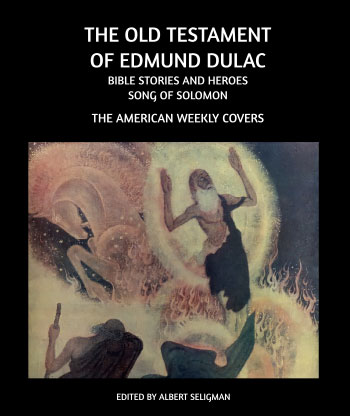
Dulacebooks’ new Arabian Nights series presents these tales decorated with the illustrations from the original editions of the Victorian and Golden Age. Over fifty different illustrators’ versions of these stories are reproduced here, fully restored and many in full color. These are the finest examples of the artists and illustrators of the Arabian Nights, including-

Arthur Rackham, Edmund Dulac, Kay Nielsen, René Bull , Maxfield Parrish, William H Robinson, Thomas H Robinson, Charles Robinson, Thomas Mackenzie, Walter Crane, Louis Rhead, Helen Stratton, Virginia Frances Sterrett, Elizabeth Mackinstry, John Gilbert, HJ Ford, Edward J Detmold, Eric Pape, AE Jackson, Willy Pogany, Milo Winter, Monroe S Orr, Charles Folkard, Walter Paget, William Stang, JD Batten, Frances Brundage, Gustav Dore, FOC Darley, William Harvey, the Brothers Dalziel, and many others.

The first book in the series is how the 1001 nights begin, with Scheherazade and her sister weaving the tales to her new husband Schahriar, the Sultan. The Tales in this edition are:

The Sultan and his Vow

The Fable of the Ass, the Ox, and the Laborer

The Story of the Merchant and the Genie

The History of the First Old Man and the Hind

The History of the Second Old Man and the two Black Dog

Words are one of the most powerful weapons that exist.

One of the many reasons why I’m always excited to read Mr. Seligman’s latest work is that it gives me the opportunity to explore older or ancient cultures and other pieces of the past that are rarely if ever covered in the average history class. I loved reading these legends and stories and poring over the beautiful artworks that were created to illustrate important scenes in them. One can learn so much about a culture by pay attention to the values shared in their literature and how their characters respond to the usual, and in some cases not so usual, challenges in life.

The relationships between the various characters were nuanced and fascinating. As the social conventions of this culture were rarely if ever spelled out clearly, I had to read between the lines to understand why certain characters behaved the way they did or what they hoped to accomplish by telling stories that often ended with cliffhangers until it was time to share the next instalment in that series.

I also adored the story within a story format of this piece. The beginning and end described a character who decided to tell these tales in an attempt to convince his daughter to change their mind about a potentially deadly life decision. Other readers should find out for themselves exactly what that choice was, but I thought it was a clever way to explain why someone would suddenly want to tell so many old legends in a row.

Scheherazade – A Tale From the Arabian Nights was truly magical.