Charlie-Man by Thomas Cullen


Charlie-Man by Thomas Cullen
Publisher: Brandylane Publishing
Genre: Young Adult (14 – 18 y.o.), Historical
Rating: 5 Stars
Reviewed by Astilbe

It’s August 1994, and Charlie Stewart begins his final year at St. Mark’s Episcopal School, a prestigious all-boys school in Richmond, Virginia. Charlie, an undistinguished student by St. Mark’s standards, faces tough odds as he seeks to rekindle his relationship with Katy Hendricks, a beautiful tennis star, and gain admission to a highly selective state university.

Through it all, Charlie relies on Beau Miller, his best friend and the top student athlete in their class. Despite Beau’s movie-star looks and infectious charm, he has a darker side, which becomes more apparent as the year progresses.

Charlie endures his trials with wry determination and ultimately emerges with a renewed sense of purpose. This is a heartrending but hopeful story of one boy’s journey toward manhood in the American South.

Innocence never lasts forever.

Mr. Cullen had a smooth writing style that I deeply enjoyed reading. He seemed to intuitively know precisely how many details to share about a scene to make it come alive in my imagination without ever slowing down the pacing of the plot in the process. I especially enjoyed his descriptions of the various locations in Richmond, Virginia where Charlie and his friends experienced their final year of high school. They were as vivid as they were achingly honest.

One of the things that puzzled me about Charlie for the first half or so of this novel involved his muted reactions to things like his father’s death or his traumatic experiences at summer camp that I would have expected him to have much strong feelings about. Figuring out why these scenes were written this was what propelled this to a five-star read for me. The author knew exactly what he was doing here, and a few twists later on in the storyline not only explained why Charlie behaved the way he did but gave me an opportunity to get to know this character on a much deeper level than I previously had.

I also loved the complex friendship between Charlie and Beau, especially as it related to Beau’s character flaws impacted both of these teenagers. One of the most challenging parts of growing up can be seeing how childhood friendships permanently change as everyone involved in them transitions into adulthood and begins making choices that cannot always be undone. These were the moments that made me wonder if this was a memoir in disguise due to how skillfully Charlie’s mixed emotions about his oldest and closest friend were woven into the storyline. They genuinely felt real to me.

Charlie-Man made me yearn for more.

Eden by Hadley Coull


Eden by Hadley Coull
Publisher: Self-Published
Genre: Sci-Fi/Fantasy
Rating: 3 Stars
Reviewed by Astilbe

‘How can we build such an ugly world, when life is so beautiful?’

London, 2063. As the Earth burns, the wealthy retreat into Eden, a dazzling mixed-reality simulation.

Max Fisher lives in a world of beauty and possibility, where painful memories can be overwritten by code. But something falters. Fragments of another reality begin to seep through, and the stories he believes in begin to unravel.

Eden is a work of speculative fiction scribbled in grief and glow, a story of our descent into images, and a meditation on love and tenderness in a dying world.

Perfection always comes with a price.

My favorite scenes were the ones that explored the reality of relying so heavily on technology and what we would refer to as the Internet for entertainment and socialization purposes. This is one of those topics that can be approached from multiple perspectives, and the author did a good job of providing nuanced and fair arguments for what they appear to think about this issue. If this were something I was discussing in a book club, the way the various characters approached cyber life would be the first thing I’d want to bring up due to how differently they all thought about it and how those reactions affected the storyline later on. Kudos for providing so much food for thought!

I struggled with the slow pacing of this novel. The main characters spent a good deal of time talking about their feelings which, while of course vitally important for character development, sometimes got in the way of developing the plot just as thoroughly. It will be interesting to see if readers who are well-versed in literary fiction feel the same way as I know that’s a common writing style for that genre and do hope it encourages some of them to check out other science fiction tales as well if they don’t already do so. There is definitely something to be said for mixing genres like this, but I simply wish a little more attention had been played to fleshing out the plot as it didn’t always have sufficient space to grow in my opinion.

On a positive note, there was a plot twist later on that reframed many of the things I believed I knew about the characters. While I can’t go into detail about exactly what that surprise involved due to how massive it was, I loved the way the author revealed it and thought it added a great deal of depth to the protagonist’s life in particular.

Eden was thought provoking.

A Friend for Hope by Amie White


A Friend for Hope by Amie White
Publisher: Noctilune Publishing
Genre: Children’s (0 – 6 y.o.), Contemporary
Rating: 4 Stars
Reviewed by Astilbe

Nine-year-old Zoe Meadows is the new kid in Ivy Creek. For homeschooled Zoe, every day starts the same: breakfast, then to the living room where Miss Ellis awaits. Only today, Zoe can’t focus—not when she notices neighborhood children playing outside, children she’s yet to meet. Watching all this unfold, Zoe’s parents decide it’s time for a companion—the furry kind, to be precise.

Everything changes when Zoe meets Hope at the dog shelter for the first time. The two girls form an inseparable bond over the following months and find in each other the one thing they both craved for a long, long time: a forever friend.

Loneliness isn’t forever.

Zoe was a sweet and kind protagonist. Many of the picture books I’ve reviewed have focused on more extroverted and sometimes noisy children for a variety of reasons, so it was refreshing for me as a reader to have someone leading the storyline who was a gentle and quiet soul. There’s something to be said for including all sorts of different personality types in fiction, after all!

I did find myself wishing that the plot had explained why Zoe didn’t seem to spend much time with people her own age since homeschooled children can still participate in all sorts of classes and extracurricular activities that will introduce them to potential friends. My first thought was that maybe she was immunocompromised or had some other serious health problem that made socializing in large groups unsafe for her. While I don’t know if this is what the author was intending to hint at, I would have loved to know more about her backstory and would have chosen a full five-star rating if the narrator had told us why adopting a dog was a better option for the main character than socializing with other children.

With that being said, I thought the adoption of Zoe’s new pet was a heartwarming chapter in her life. I especially appreciated the fact that Hope needed some time to warm up to the family after the stress of being abandoned and living at the noisy animal shelter for so long. This was a great reminder that how a new pet behaves at the shelter or at home for the first little while isn’t always the same as how they’ll act once they feel safe and loved.

A Friend for Hope was charming.

TV Review: Pluribus (Season 1)


Pluribus (Season 1)
Writer: Vince Gilligan
Director: Vince Gilligan
Starring: Rhea Seehorn, Karolina Wydra, and Carlos-Manuel Vesga
Publisher: Apple TV, Sony Pictures Television
Genre: Sci-Fi/Fantasy, Suspense/Mystery/Thriller, LGBTQ, Contemporary
Rating: 3 Stars (6 Stars on IMDB)
Reviewed by Astilbe

In a world overtaken by a mysterious wave of forced happiness, Carol Sturka, one of the immune few, must uncover what’s really going on – and save humanity from its artificial bliss.

Permanent happiness might come with a catch.

I loved how this show dealt with the practical aspects of such a monumental change to human society. At first glance, the alien virus seemed like it would usher in a utopian future for humanity due to the immediate end of crime, violence, pollution, and anything else that could possibly harm any form of life on Earth. While I don’t want to give away spoilers about what the possible downsides of such a world might be, I thought the writer did an excellent job of including plot twists to explain why Carol was so scared by this change and what compelled her to dig more deeply into this peaceful invasion.

Some of the later episodes in this first season were repetitive due to how often Carol’s anger management issues interfered with her desire to figure out why nearly every human on Earth had been infected by that alien virus. While having such a complex and flawed protagonist was otherwise great, I did find myself wishing that she’d break out of the cycle of feeling her anger building, exploding at someone near her, and then either sweeping her actions under the rug or, as her tale progressed, maybe apologizing instead. Here’s hoping that future seasons give her more opportunities to react to The Others as she calls them in some new ways as I’d love to see the pacing pick up in the future.

On a deeper note, I also enjoyed this tv show’s subtle criticisms of topics like AI, conversion therapy, and conformity in general. The arguments were nuanced and left plenty of space for discussion regardless of whether or not viewers agreed with the points the writer made. This sort of thought-provoking storytelling that kept me interested even when I struggled with how slowly some scenes moved along.

Pluribus was intelligent science fiction.

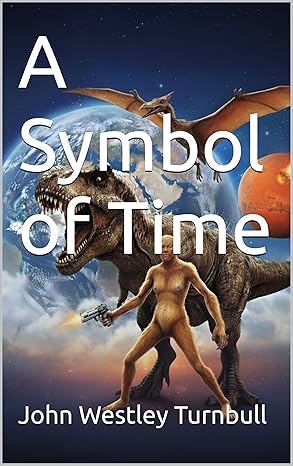
A Symbol of Time by John Westley Turnbull


A Symbol of Time by John Westley Turnbull
Publisher: Self Published
Genre: Sci-Fi/Fantasy, Historical
Rating: 3 Stars
Reviewed by Astilbe

Survival requires sacrifice. But what if the price is an entire world?

Their home is cold and dying, choked by the toxins of their own progress. Now, an advanced alien species looks toward the Third Planet—Earth—with hope and fear. They see a fertile paradise, but one that is hostile, hot, and dominated by massive, predatory reptiles.

The choice is stark: die in the heat, or remake this new world in their own image.

As they descend to alter the climate and purge the planet of its prehistoric masters, they set in motion a chain of events that will echo through geological time. A Symbol of Time weaves palaeontology and astronomy into a chilling tale of survival. As the new masters of Earth terraform the planet, the question remains: does high intelligence inevitably carry the seeds of its own destruction?

Nothing is more important than survival.

The world building was thorough and kept my interest levels high. I especially enjoyed gradually discovering the many physiological and psychological differences between this species and our own. Their expectations about everything from relationships to how to organize a society created challenges for them on the Third Planet that were as unique as they were critical to understanding later plot twists. Exploring a familiar subject through the perspective of a species so unlike my own is one of the reasons why I love science fiction so much, and there were certainly many opportunities to do so here.

It would have been helpful to have stronger character development, especially for Elthyris and the other protagonists. Sometimes I struggled to keep track of all of the secondary characters due to how many of them were introduced and how little I knew about them as individuals. Had this not happened, I would have happily chosen a much higher rating as there were so many other things I loved about this book.

There were multiple times when plot twists caught me by surprise. It was a great deal of fun to be surprised so often, especially given how many different types of twists and turns were shared with the audience. Various types of threats were included, none of which I can go into detail about here other than to say that they ranged from interpersonal conflicts to accidents to environmental issues that these characters couldn’t have predicted would happen in advance.

A Symbol of Time was an adventurous and imaginative read that made me want to hear more from Mr. Westley Turnbull.

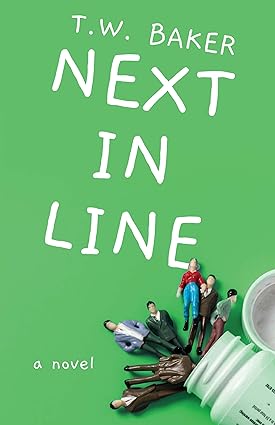
Next in Line by T.W. Baker


Next in Line by T.W. Baker
Publisher: Atmosphere Press
Genre: Contemporary
Rating: 3 Stars
Reviewed by Astilbe

Welcome to Mortar and Pestle RX, where prescriptions are filled, patience is tested, and absolutely nothing goes according to plan.

Meet Mic, Janice, Monika, Bronco, and Sammy—five pharmacy employees held together by caffeine, sarcasm, and the thinnest thread of professionalism. Whether they’re dodging irate customers, surviving corporate chaos, or staging passive-aggressive Post-it note wars, this band of lovable misfits is just trying to make it to closing time without strangling each other.

A sharp-witted satire of customer service culture and workplace dysfunction, Next in Line is for anyone who’s ever worked retail, waited in line too long, or wondered if the pharmacist was secretly judging them (spoiler: they were).

Sometimes irritation is a gift.

The most memorable scenes were the ones that described how the pharmacy crew bonded over their hectic and occasionally wacky workplace. Having warm and strong relationships with coworkers can make this type of often low-paid, unappreciated job so much easier on an employee’s mental health. There is nothing like an inside joke or a friendly offer to help clean up a customer’s mess to soothe the soul, so I nodded along as all of the main characters gelled together and faced the best and the worst of what they were about to experience as a close-knit team.

I struggled with the repetition, especially given the limited character development. Many chapters seemed to follow a similar pattern of introducing a new customer who had a troubling habit or personality trait and then explaining why he or she behaved that way. It would have been more meaningful for me to meet a few memorable customers and then gradually learn their difficult backstories as the pharmacy employees interacted with them over weeks or months. This is something I’m saying a reader who adored the concept of this tale and would have loved to give it a full five-star rating.

However, this captured the frustration, drudgery, and occasional joy of working in the customer service industry beautifully. People are fascinating and there is so much more to learn about humanity by observing folks when they’re impatient, in pain, frightened, bored, or otherwise not functioning as they normally might on a better day for them. This is a topic I wish was covered much more regularly in fiction as there are so many opportunities waiting for clerk and customer like to grow as individuals when characters are forced to serve a long line or to wait in one.

Next in Line has piqued my interest about what this author will write next.

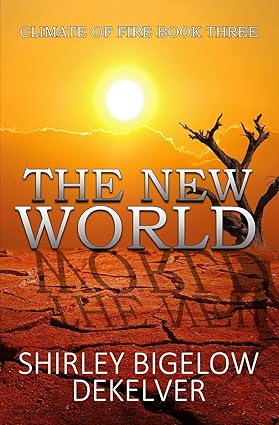
The New World by Shirley Bigelow Dekelver


The New World by Shirley Bigelow Dekelver
Climate of Fire, Book Three
Publisher: BWL Publishing Inc.
Genre: Young Adult (14 – 18 y.o.), Sci-Fi/Fantasy, Romance
Rating: 4 Stars
Reviewed by Astilbe

It is 2047, two years since Vancouver was devastated by an earthquake and tsunami. Taylor West, Carlie Fleming, and Mai-Li Wong, and two children, Eddie Coleman, and Debbie Ross, fear retaliation from Willie Arbuckle who they banned from their group for stealing food and threatening Carlie. They leave their winter sanctuary and continue their journey to the Interior and arrive at Blackfoot and are welcomed by the Chinese and the Similkameen Band.

Chief Pete Johnson and Mai-Li, now ruler of the Chinese, tell Carlie she must exonerate Willie, as there’s no room in Blackfoot for resentment and malevolence. Taylor tells Carlie he loves her, but before they can be together, she must confront Willie. Without informing her, he leaves with Pete on an expedition. Unable to forgive Willie, Carlie is banned from Blackfoot. She returns to the cabin and Lance, Pete’s grandson, goes with her. He talks about the culture and traditions of the Similkameen people and confesses he has feelings for her.

Taylor and Pete arrive at the cabin; Lance must return to Blackfoot to undertake leadership of the Band. Carlie refuses to return and is left on her own. She discovers an interest in wildfires and while exploring one day, is captured by Lars, a violent man from Taylor’s past who has a grudge against him. She escapes and is injured when she falls from an embankment. Will help arrive in time, will she find the strength to absolve Willie, and find peace and contentment with the man she loves?

Letting go of the old ways is the only way to survive.

The foreshadowing was handled nicely. While Carlie continued to make some decisions that she really should have thought twice about given everything that had already happened to her, I liked the way Ms. Bigelow Dekelver used those lapses in judgement to push the storyline forward. Everyone makes mistakes, after all, and there is something to be said for seeing what happens when someone had advanced warning that certain choices aren’t the best ones but insists on taking that route anyway.

Just as I mentioned in my review of the second instalment, Treachery, I once again found myself wishing that the romantic subplot had either been given more space to grow or left out of the tale entirely. I was happy to see a little more attention paid to it this time around, but it still didn’t have enough development for this reader’s tastes. This was especially true due to how many other conflicts Carlie was juggling simultaneously. She had such limited free time even before romance came into play. Of course I wanted her to find true love and live happily ever after, but at this point in her life she didn’t seem to have much energy to devote to a longterm relationship.

One of the things I’ve consistently appreciated about this series is how much effort it puts into describing what life would be like if society as we knew it disappeared. That is to say, Carlie and every other survivor had to adapt to a world where there were no stores left to buy essential things like medicine, food, or clothing. The social safety net that still existed in this universe relied upon small groups of people taking care of each other and sharing what little they had which meant that something as ordinary as falling off of a horse could have much more serious consequences than it would in the before times when doctors and hospitals still existed.

This is the third book in the Climate of Fire series that should be read in chronological order for plot and character development reasons.

The New World made me hope that we’ll someday have a fourth instalment!

The Stars Must Wait by Carmelo Rafalà


The Stars Must Wait by Carmelo Rafalà
Publisher: Guardbridge Books, Scotland
Genre: Sci-Fi/Fantasy, Historical, Contemporary
Rating: 3 Stars
Reviewed by Astilbe

Carmelo Rafalà writes stories that are profound, surprising, and beautifully realised. He imagines fantastic worlds and protagonists of immense complexity, subtlety and depth. His stories do not give easy answers, but stimulate and absorb the reader.
In this collection of science fiction and fantasy stories you will find:

A zealous convert, a woman of rumour and myth, and a dangerous pilgrimage across pirate filled seas.
A warrior travels to a far land to mourn and put his violent past behind him, but strange gods of an even stranger people intrude.
Abandoned in the Ozarks, sisters face a malevolent presence reaching out from the darkness.
Two friends struggle with their strained relationship, but reconciliation may literally require other realities. These are stories of identity and belonging, and our deep-seated desire to control our own narratives.

Everyone deserves to tell their own tales.

Lord Banning had spent nearly his entire adulthood in battle, and now that he was growing older it was time for him to reflect on his choices in “Heart of the City, Heart of the Sea.” The character development in this piece was what drew me so deeply into it. Some of Lord Banning’s decisions were difficult to understand until I got to know him better and discovered a few of the secrets surrounding his life. I only wish I could know what happened to him next.

I did struggle to connect to with some of the short stories in this collection due to some confusion I had about their world and character building. “The Clarity of Ice” was one such example of this. Performing what were essentially farming and terraforming duties while in outer space was a unique way to introduce Karlyn to the audience, but I struggled to understand what motivated her to choose this career and what she hoped to gain from it. I also had some trouble understanding the project she was working on, especially when she made references to possibly bio-engineering humans to better suit certain environments. Had this scene and similar ones in other tales been given more detailed explanations, I would have happily chosen a higher rating as I thought Mr. Rafalà had a vivid imagination and a fresh take on some common tropes in this genre.

My favorite instalment was “Slipping Sideways” which explored Džemo and Leo’s grief after the death of their friend Rachel. The science fiction spin to such a common but heartbreaking part of life made me smile. I’ve often wished for the same solution that these characters talked about as they mourned her passing, and I thought the ending fit the themes beautifully. This was a short piece which only made it all that more powerful.

The Stars Must Wait was memorable.

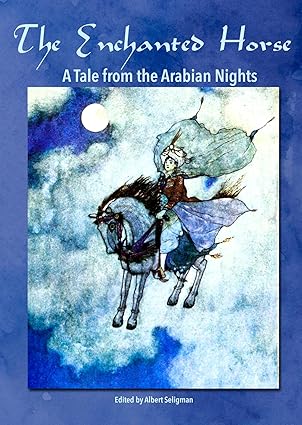
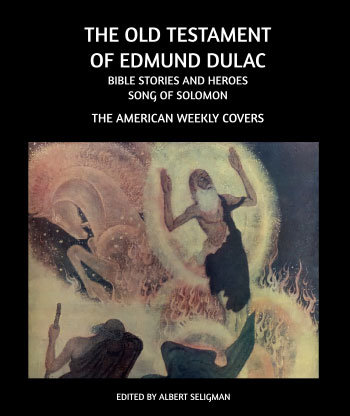
The Enchanted Horse (A Tale from the Arabian Nights) by Albert Seligman


The Enchanted Horse (A Tale from the Arabian Nights) by Albert Seligman
Publisher: Dulacebooks
Genre: Young Adult (14 – 18 y.o.), Sci-Fi/Fantasy, Historical
Rating: 5 Stars
Reviewed by Astilbe

The Enchanted Horse, also known as ‘The Magic Horse’ or ‘The Ebony Horse’, is one of the most loved of all the Arabian Nights tales. It is also an early example of stories about flying machines, which have been contemplated since stories were first recorded.

The Tale begins with a Persian king who has a son and three beautiful daughters. During a New Years’ festival, three sages bearing gifts present them to his majesty. One is a golden peacock which kept the time of day by fluttering his wings. Another was a trumpet which would blast if an enemy approached. The third, and best of all, was an ebony horse, whose rider could ascend into the clouds and ride anywhere on the earth in an instant.

The King greatly desired to own the magic horse, but wanted to verify that not only the sage could command it, so his son, Prince Firouz, took to the saddle and took off. He didn’t know how to control the horse, so he rose into the sky and was not seen afterward. The sage was thrown into the dungeon.

He finally gained control and descended into a strange land, where, naturally, he meets the beautiful Princess of Bengal. Her father was not too keen on a sudden relationship, but the Prince said he would prove his worth by fighting the king’s entire army at once.

The army was unprepared for an aerial assault, and the Prince and Princess escaped together and returned to his own kingdom triumphant. Prince Firouz hides her in the summer palace while he visits his father and prepares for her entrance. But here the story takes a bad turn. The sage is released from jail, but demanded the king’s daughter in marriage in return for the magic horse. He manages to escape, but with the Princess of Bengal as his prisoner instead . The sage forces her to mount on the magic horse and they fly to a far away land.

He immediately begins mistreating her, but is seen by a hunting party of the Sultan of the land where they landed. He imprisons the sage and decides to marry the beautiful Princess of Bengal himself. She doesn’t like the idea, preferring her young Prince Firouz, and feigns madness to delay the wedding.

Meanwhile, Prince Firouz is roaming the land looking for his Princess, and hears rumors of a flying horse and a mad Princess. He disguises himself as a doctor, and offers to cure the Princess. She recognizes him immediately and they devise a plan of escape. He tells the Sultan that he can cure her and destroy the spell she is under by lighting a great fire. In the confusion, he escapes with the Princess and the magic horse and returns to his own land.

And they live happily ever after, and he eventually ascends to the throne.

This Tale is illustrated with the finest artwork of the 19th and 20th century. Illustrators include Edmund Dulac, William H Robinson, Thomas H Robinson, Eric Pape, William Harvey, HJ Ford, Frances Brundage, John Hassall, George Sopor, AB Houghton, AD McCormick, Helen Stratton, Anne & Janet Johnstone, Walter Paget, René Bull, Monroe S Orr, JD Batten and JC Clark.

Adventures can be found anywhere.

This tale was originally told at a time when women had few rights, so some scenes were completely at odds with how I’d expect female characters to be treated in a contemporary times. While some of those moments were hard to read due to those individuals having virtually no say in the course of their own lives even when it came down to something as simple as where to live or whom to marry, I’m glad they were left in because of how important it is not to sugarcoat the past. The historical genre is at its best when it acknowledges such things in my opinion.

The plot twists were imaginative and kept me guessing. I especially appreciated seeing how certain personality flaws of some characters were used to push the storyline forward while also giving those individuals a chance to reconsider their ways. This is exactly what legends and fairy tales are supposed to do, and it was a great deal of fun to see how that trope played out this time as the characters were faced with one surprise after another.

There’s something to be said for an ending that fits the tone of a piece perfectly. I chuckled as I read it and thought it couldn’t have been done better. Not only were all of the most important plot threads tied up neatly, the fates of the main characters matched both their personalities as well as their stations in life. Given how important social rank was in this society, it made total sense for it to also affect that final scene the way that it did. I know I’m being a little vague here, but this truly is one of those times when readers should have a few hints as possible about what is to come so hopefully they can be just as entertained as I was.

The Enchanted Horse – A Tale From the Arabian Nights made me yearn for a sequel.

The Wild Dogs of Kumamoto by Luc Jorgart


The Wild Dogs of Kumamoto by Luc Jorgart
Publisher: Self-Published
Genre: Young Adult (14 – 18 y.o.), Contemporary
Rating: 3 Stars
Reviewed by: Astilbe

The Wild Dogs of Kumamoto is a gritty, emotionally intense coming-of-age novel that follows Ryuji Nagata, a rebellious teen from the quiet Iki Island, who is uprooted from his home and sent to a boarding school in Kumamoto City. Behind his tough exterior lies a troubled soul; haunted by family trauma, bullying, and a desire for freedom. His father is in prison for vehicular manslaughter, and his mother remains emotionally distant.

At school, Ryuji is quickly targeted by a group of bullies who physically and emotionally torment him. Even attempts to seek help from teachers fail him. His only escape becomes a cabaret bar, Club Avon, where he finds an unlikely guardian in Nana Hirose, the sharp-witted and compassionate bar owner who sees through his pain. But true change doesn’t come until he crosses paths with a member of the Kumamoto Wild Dogs, a feared bosozoku gang.

Change is always possible.

The realistic dialogue made me feel as though I were eavesdropping onto the characters’ conversations. This is something I always appreciate as well-written dialogue can be a great way to get to know the characters on a deeper level. For example, Ryuji wasn’t something who liked talking about his feelings very often, and it showed in his brief responses to many of the questions he was asked. I also thought the conversations with this characters’ mom and grandparents were well worth paying close attention to given how important they were for what happened later on in the storyline.

It would have been helpful to have more plot development in this book. Ryuji grew and changed as a person, but there wasn’t as much time spent exploring the catalysts for his growth as I would have preferred to see. This made it tricky for me to remain invested in his life as I didn’t have a lot of context to help explain why these changes were happening or what the protagonist thought of them.

My favorite portion was the ending due to some intriguing plot twists involving the main character’s future that happened in those last few chapters. While I can’t go into detail into where life would lead him to next, the author’s willingness to take risks here was easy to take note of and is something I think should applauded. There is definitely something to be said for storytellers who remain playful and creative while they’re writing.

The Wild Dogs of Kumamoto was thought provoking.