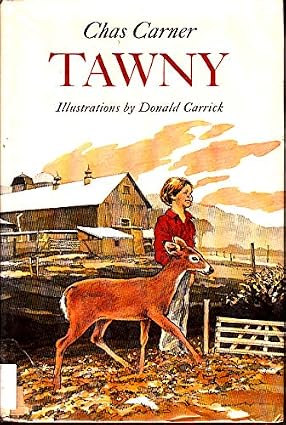
Tawny by Chas Carner
Publisher: Scholastic and Macmillan
Genre: Middle Grade (8 – 12 y.o.), Historical
Rating: 5 Stars
Reviewed by AstilbeTrey and Troy Landry are 12-year-old twin brothers growing up on a New Hampshire farm. Even though Troy is the impulsive trouble maker, and Trey the more dutiful and introverted one, they share an incredibly close bond.
One day Troy is accidentally killed by hunters poaching deer on the farm. Trey is devastated and channels his grief into caring for an injured deer, which he names “Tawny.”
As their friendship deepens, however, Trey finds it harder and harder to release Tawny back into the wild.
What he learns in the process of letting go—about loss, love, and the healing power of nature has even more relevance for youth today than when this critically acclaimed novel was first published.

Grief has many faces.
Mr. Carter had a smooth and descriptive writing style that was a joy to read. I especially liked the passages in this novella that talked about the rhythms of life on a farm and how one season of the year would gradually give way to the next. As someone who had spent his entire life on that same property, Trey was so accustomed to what every month felt like that he didn’t quite seem to realize how special they were, but his descriptions of his childhood were still beautiful and showed me so much about his personality and the empathic and patient man he would become in a few short years as a result of his rural childhood.
It was the passages dealing with Trey’s grief over the death of his twin brother that ultimately convinced me to choose a five-star rating. Many stories that deal with death and loss focus on how it feels immediately or, at most, several months later, but healing can require a much longer period of time than that and sometimes involves old pain returning in quiet moments when the outside world might assume someone is doing much better now than they actually are. I loved the scenes later on that explored how Trey dealt with these feelings while also going about his usual routine of school, chores, and looking after Tawny as she healed from her injury.
The many cultural difference between the 1950s and modern times also piqued my interest. For example, Trey and Troy were taught how to drive at age eight and, a few years later, were doing potentially dangerous chores on the farm like helping cows to deliver their calves or shooting guns. Many children in the Western Hemisphere today would not allowed to participate in these activities, so it was fascinating to see how much more freedom and autonomy people that age had a few generations ago.
Tawny was heartfelt and bittersweet. It made me want to read more from this author!










Speak Your Mind