Writing the First Chapter by Emma Dakin – Guest Blog and Giveaway

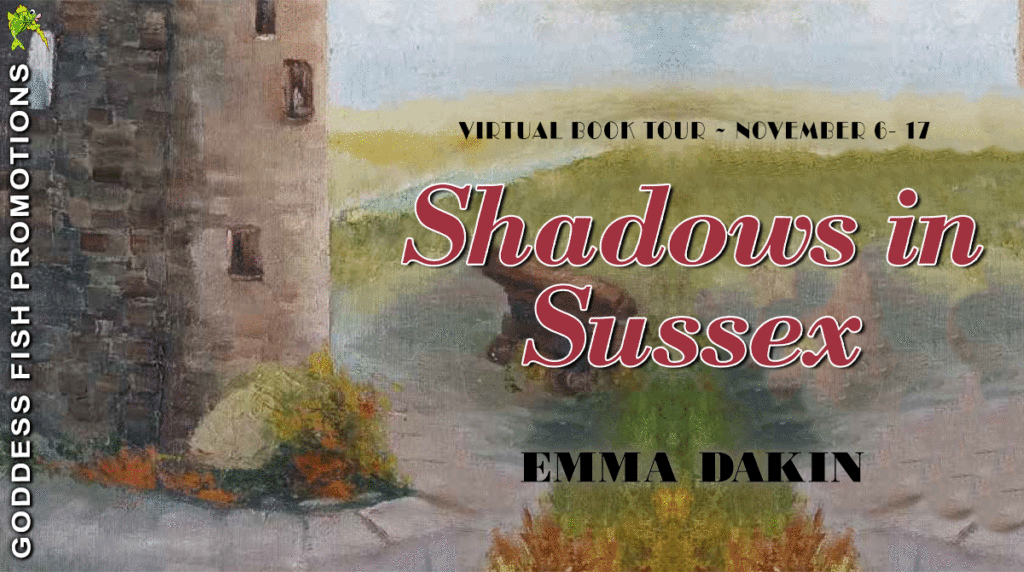
This post is part of a virtual book tour organized by Goddess Fish Promotions. Emma Dakin will be awarding a $20 Amazon/BN GC to a randomly drawn winner via rafflecopter during the tour. Click on the tour banner to see the other stops on the tour.

Writing the First Chapter

It’s hard to entice the reader into the book without overloading them with information. I have so much information: back stories, clues that are important, a description of the setting that can set the mood. It all seems important, and it is. But if I unload that information as if I’m giving directions to the reader, they will close the book. Occasionally, I’m lucky and think of a way to start my story that begins with action and weaves setting, character and clues into that action. Usually, I write out all the information before the action starts. Pages of “information”. Then, I cut and paste those preliminary pages into a different file, and start over at the point where the action begins and proceed from there.

The first line needs to engage the reader. I’m fond of Dick Francis’s first lines: “You are a spoilt bad-tempered bastard,” my sister said, and jolted me into a course I nearly died of. (Flying Finish) and “I stood on the outside of disaster, looking in.” (In the Frame.)

I enjoy those first lines and even enjoy my own first lines: “I had expected my hostess at the tea party to be boring. I hadn’t expected her to be dead.” (Hazards in Hampshire).

A line like that puts you into the center of action immediately. It also tells you a little about the setting. While Claire is observing the body and considering what she should do, she can reveal to the reader who she is, where she is, and what problems she has at the moment. This is more effective and more interesting that telling the reader that Claire has just moved to this English village and doesn’t know the villagers well, that she is in her forties, has inherited money, but works as a tour guide. The readers will learn all that as they follow her immediate problems with a dead body.

Every first chapter doesn’t have to start with a body, although that will certainly grab the reader’s attention. If the story starts more quietly with only a minor problem, you need to move quickly into a major one, or at least, one that is major to your protagonist.

Crime in Cornwall starts: “The walls were shaking again. The noise level from the neighbor’s back garden rose like the roar of a football crowd and had reached that stage of raucous shouts mixed with wild music that made sleep impossible.”

The first paragraph establishes where the protagonist lives and her personal circumstances. It places her in an English village and highlights the problem with her neighbors. The body appears at the top of the third page.

While it is important to know the back story of your characters and the clues that the reader needs, it is not necessary to put them all into the first page. Trust yourself to sprinkle them in as you go. Readers are intelligent. They will pick up what they need to know.

Claire Barclay and her band of tourists are full of enthusiasm for her trip to Sussex and Kent, the beautiful southeastern part of England. A tragic death of a young man the son of the guest house manager sends Claire into comforting mode and makes it more difficult for her provide a bright and care-free holiday. Laura was not surprised at her son’s death as he had been a drug user and she expected he had taken contaminated drugs, a common fate. But the police lab said otherwise. He was murdered. Claire’s fiancé, Detective Inspector Mark Evans, investigates, so Claire is involved and privy to much information. Too much. In spite of her busy life with demanding guests, she discovers the motive for the murder and finds herself in danger.

A fun tour of Sussex with the extra treat for mystery lovers as Emma Dakin ties places to favorite books. —Rhys Bowen (NYT bestselling author of the
Molly Murphy and Royal Spyness series

If you are looking for a cozy crime novel that evokes a wonderful sense of place – look no further. Emma Dakin skilfully weaves a new mystery into a fascinating and informative tour of Southern England featuring heroine and literary tour guide, Claire Barclay, and a host of interesting characters.
—Julie Wassmer, Author of The Whitstable Pearl Mysteries

This engaging story will appeal to traditional mystery-lovers who like their murders set against the authentic backdrop of quaint English villages.
—Clara Benson, USA Today bestselling author of the Angela Marchmont Mysteries

Enjoy an Excerpt

Approaching the small town of Rye, I marked the route to Canterbury and the road to Hastings where I’d take my guests later in the week, I didn’t know this area well but had done two quick reconnaissance trips earlier. Jacqueline Winspear set her books near here in the war years. Her descriptions had given me a sense of familiarity with the green land around me, but the miles of delta before the sea surprised me. Rother Manor, our guest hotel, was large, but not, I was sure, large enough to have ever been a manor house. The name was probably applied to the house recently to attract tourists. The common meaning of ‘manor’ was a large house on a huge estate, but sometimes it just meant a large house. Mark told me that his colleagues sometimes called their police district their manor. I ruminated on the application of the word. I tended to do that. I’d not brought guests here before, but it looked ideal, sufficiently old to satisfy the North American appetite for a romantic setting but not so old it was decrepit. Laura Wright, the manager, had seemed organized and experienced.

I loved trying out new guest hotels and the whole experience of taking a tour to the sites of mystery novels. The tourists shared my itch for mysteries and were usually interested in what I offered. I’d had a career as a teacher of English to executives in many parts of the world. I enjoyed it as I was fascinated by linguistics and the way people use language. Now at forty-eight, I had achieved stability with a reliable partner, my own house and tour business and a legacy from my much-missed step-father. I should be able to feel comfortable, not always expecting a disaster. I admonished myself. This time the tour will go smoothly. This is a beautiful house; you will enjoy it here.

Rother Manor House was a three-storey rambling Victorian and was as close to a gracious house as was possible at the edge of Rye. The grounds were beautiful. Laura’s son, Reece Martin, looked after them she’d told me. He was in his late twenties and committed to creating beauty. The owners of the guest house were glad to hire him, Laura had told me, as staff was hard to find. It was unusual to see so much land around a house of this age in a town but it made a picturesque setting for my visitors. Across the street and well below it lay the cricket grounds, still green in the July heat. Beyond the grounds, the salt marsh stretched to the sea. The tourists would love this view.

I pulled my eyes away from the vista and turned into the car park, a graveled area to the left of the entrance. After unloading my small suitcase, knapsack and briefcase from the van, I climbed a few steps to the front door. It was unlocked. I entered into a long hallway and saw a side table with an open guest book and a prominent bell. I called for Laura but there was no answer. I hit the bell. No one came. I hadn’t told her the exact time I’d be here. She was likely nearby. I wandered into the lounge which was off the hallway. A small table held two cups and saucers, sugar and a milk jug and a plate of cake. My guests weren’t arriving until tomorrow. She could have others guests tonight, but I hoped that cake was for me. I dropped my luggage on a chair in the lounge and walked down the hallway to the rear of the house. There was no one in the kitchen. I pushed through the back door and stepped into the garden. The minute I opened the door I heard the keening of a woman in distress, a soft, desperate cry that rose in the air and hung there. There was anguish in every tone. The hairs on my forearms rose and I stood frozen for a moment.

The wail receded, then rose again. It came from the area at the back of the property. I walked towards a shed. I moved cautiously to the open door and peered in.

Laura was sitting on the floor beside a young man who lay still. His skin on his arms was pale, deadly pale. His head was turned so I just saw his dark hair. He was muscular, wearing a black T-shirt, denim jeans, black trainers. At first, I thought he’d fallen or had a seizure of some sort. Then I saw the Prenoxade kit open and the syringe on the floor nearby. Prenoxade, naloxone, the life-saving remedy for drug poisoning. Tour guides carried it; police carried it; teachers had it handy and, apparently, so did mothers.

About the Author: Emma Dakin writes a series of mysteries set in Britain. Her protagonist is a tour guide who takes different characters in each book to the sites of mystery novels in the countryside. She appreciates the elegant, people and humor of each area. But in that idyllic country, Claire stumbles on murder. Author Emma Dakin has five books so far in this series with the latest release September 12th 2023. An historical mystery set in Vancouver in 1886 is due out soon. She won a prestigious 2022 Lieutenant Governor’s Community History Award for her non-fiction account of life in the 60s.

Website | Email | Facebook | twitter

Buy the book at Amazon.

a Rafflecopter giveaway

If I’d Never Heard of Me, Would I Read My Book? by Austin Camacho – Guest Blog and Giveaway

This post is part of a virtual book tour organized by Goddess Fish Promotions. Austin Camacho will award a randomly drawn winner a $25 Amazon/BN GC. Click on the tour banner to see the other stops on the tour.

If I’d never heard of me would I read my book?

Well let’s see…

I love books that feature a true hero, and Subtle Felonies has one. Hannibal Jones is a private eye in the classic hardboiled mold. He has a clearly defined morality all his own, he’s tough when he needs to be, but tender when that’s called for. He also has a smart mouth and is clever enough to solve a twisty mystery. He may seem familiar, because I’m a fan of Lew Archer, Travis McGee and Phillip Marlowe but being a man of mixed race raised in Germany gives him a unique perspective when dealing with the book’s diverse cast. This is a man I will be happy to get to know.

I like to really feel the setting, and this book explores the DMV (District of Columbia/ Maryland / Virginia) to give me the sights, the tastes, the smells, the sounds, the FEEL of the area.

I love a books that really move and once Hannibal sinks his teeth into the mystery, events move at a breakneck pace. The feeling of urgency to find the missing man never slackens. Almost every chapter ends with a cliffhanger. It seems like there’s no place in the whole book where it will be easy to put it down for the night.

Most of all I love a good mystery. Subtle Felonies has a plot that twists like a corkscrew with clues scattered about the landscape. There ARE enough clues in plain sight to solve this mystery and figure out who the ultimate villain is… but you won’t. and in the meantime, a series of bad men and women appear with their own schemes that only confuse the sleuth trying to sort out the big villain’s plot.

And, even if I had never heard of me, I’d read Subtle Felonies because it’s part of a series of complex mysteries Hannibal Jones has faced. Each of his previous seven adventures is populated by its own cast of fascinating characters, explores parts of the Washington area, moves at its own frenetic pace, and offers opportunities to get to know this knight errant in dark glasses, DC’s professional troubleshooter, Hannibal Jones. I’d want to read it because I’d know there’s more great reading ahead.

Is retired basketball star Xander Brown missing, or kidnapped? His crazy family and dangerous friends draw DC detective Hannibal Jones into a deadly chase to find – or rescue – a complex man. In public, Xander is a husband, father, partner, friend, but who is he in private? Which role took him away? The search moves at breakneck speed across the posh suburbs and angry alleys of the nation’s capital, forcing Hannibal to confront tough truths and deadly risks. Will DC’s troubleshooter save a life or lose his own?

Enjoy an Excerpt

Charlotte took a deep breath while examining Hannibal. Her eyes scanned him top to bottom. He felt the way he did in the airport when they put him in the chamber and told him to raise his arms overhead. Was she staring into his eyes, or wondering about his dark glasses?

Were his black suit and white shirt inappropriate for the season?

“Ben told me that you were very good at finding people,” Charlotte said. “And that you were trustworthy and above all discreet.”

“Yeah, and he probably figured you’d be more comfortable with a black investigator.”

She grinned. “Yes, there is that. You wear those shades all the time?”

“Unless I’m asked not to.”

“Well then, would you mind?” She leaned in. He removed his sunglasses and slipped them into his suit jacket pocket. She leaned even closer.

“Blue? No, I think hazel eyes,” she said. “Where’d you get them?”

“You’d have to talk to my parents about that.”

About the Author:Austin S. Camacho is the author of eight novels about Washington DC-based private eye Hannibal Jones, five in the Stark and O’Brien international adventure-thriller series, and the detective novel, Beyond Blue. His short stories have been featured in several anthologies and he is featured in the Edgar nominated African American Mystery Writers: A Historical and Thematic Study by Frankie Y. Bailey. He is a past president of the Maryland Writers Association, past Vice President of the Virginia Writers Club, and one of the directors of the Creatures, Crimes & Creativity literary conference – now in its 10th year. The 8th Hannibal Jones mystery, Subtle Felonies, was released September 27.

Facebook | Website | Amazon Author Page

Buy the book at Amazon.

a Rafflecopter giveaway

The Big Shakeup by Nancy Boyarsky – Spotlight and Giveaway

This post was part of a virtual book tour organized by Goddess Fish Promotions. Nancy Boyarsky will be awarding a $20 Amazon or Barnes and Noble GC to a randomly drawn winner via rafflecopter during the tour. Click on the tour banner to see the other stops on the tour.

Everyone is innocent until proven guilty, or so they say.

P.I. Nicole Graves arrives early at work, just as Los Angeles is hit with “the Big One,” a long-predicted, devastating earthquake. When the building stops shaking, Nicole finds Jerry, her boss, in his office dying of a gunshot wound. It appears to be suicide.

Nicole is shocked to learn that the police have decided Jerry’s death was murder and even more shocked that she’s their only suspect when there’s no shortage of people with motives. And there’s the question of why the detectives are pursuing this one case when all city workers, including the police, are in an all-out search and rescue operation for survivors. All she can do is evade capture long enough to prove her innocence and catch the real culprit.

Enjoy an Excerpt

The shaking was gathering force. Nicole crawled further into the desk’s knee space, tried to brace herself and grip its legs. Holding on was next to impossible when the desk jumped with every jolt. Even more frightening was the noise. It had started as a rumble but now sounded like the roar of an oncoming train.

Every instinct told her to run, get out of the building. But with so much movement, she knew she’d never be able to stand up, much less run down eight flights of stairs. As the shaking continued to build, all thought disappeared. The whole thing had lasted a mere three-and-a-half minutes. But if Nicole knew anything at that time, it was that shaking would go on until the building caved in and buried her.

About the Author: Nancy’s award-winning Nicole Graves Mysteries have been compared to Mary Higgins Clark and are praised for contributing to the “women-driven mystery field with panache” (Foreword Reviews) as well as for their “hold-onto-the-bar roller coaster” plots (RT Book Reviews). Her debut novel The Swap—book one of the Nicole Graves Mysteries—won the prestigious Eric Hoffer award for Best Micro Press Book of the Year.

Nancy has been a writer and editor for her entire working career. She coauthored Backroom Politics, a New York Times notable book, with her husband Bill Boyarsky. She has written several textbooks on the justice system and contributed to anthologies, including In the Running about women’s political campaigns and The Challenge of California. She has also written for the Los Angeles Times, West magazine, Forbes, McCall’s, Playgirl, Westways, and other publications. She was communications director for political affairs for ARCO.
In addition to writing mysteries, Nancy is producer and director of the “Inside Golden State Politics” podcast.

Website | Publisher Author Page | Facebook | Pinterest | Goodreads

Buy the book at Amazon.

a Rafflecopter giveaway

What Kind of Writer Am I? by Lachi – Guest Blog and Giveaway

This post is part of a voritual book tour organized by Goddess Fish Promotions. Lachi will be awarding a $25 Amazon/BN GC to a randomly drawn winner via rafflecopter during the tour. Click on the tour banner to see the other stops on the tour.

What Kind of Writer Am I?
Before anything else, I am a world-builder. It’s difficult to get engaged in character motivation without being deeply engulfed in the scene. I believe the setting itself is a main character and deserves to be well developed, have its own voice, and its own sense of humor, loss, love and pain.

I also hold character development right up there beside stage setting. Through immersive multi-POV with quippy, distinct internal monologue, I really love exploring 4-dimensional characters who kick butt, but whose motivations grow and change along with circumstances, and whose generational traumas seep through in unexpected ways. As an author with a disability, I also like to make sure disability is represented in everything I write, whether it be a main character working through their neurodivergence to socialize or a side character casually dealing with random bouts of inaccessibility.

In ‘Death Tango’, a horror-tinged whodunit mystery wrapped in Sci-Fi, I get the opportunity to dive headfirst into all of these passions in a future cyber-laced New York City run by corporations and robots alike, where folks work from home, order in, and communicate via second life-esque social media. And our four headstrong mains must work to overcome their own traumas to figure out how to save the city from a growing plague.

In a Utopian twenty-third-century New York City, where corporations have replaced governments, AI dictates culture, and citizens are free to people-watch any other citizen they choose through an app, this horror-laden Sci-Fi Thriller follows four mis-matched coeds as they attempt to solve the murder of an eccentric parascientist. Only someone or something able to navigate outside the highest levels of croud-sourced surveillance could get away with murder in this town. If the team can’t work quickly to solve the case, New York City will be devoured by a dark plague the eccentric had been working on prior to his death, a plague which, overtime, appears to be developing sentience.

Enjoy an Excerpt

It is nine years ago. I stand alone on an unstable rock. Beneath that rock are a few precarious slabs of granite. Beneath the granite lies a hundred feet of air, of silence, of potential bone-shattering death. Surrounded by a dusk sky, Mount Venom—the cliff aptly named for the lives it has claimed—stretches endlessly beneath my quivering legs and far beyond my blurring vision.

Through the blaring wind, I hear several SOIs—School of Intelligence kids—hurl down demoralizing insults from the cliff’s edge. “She’ll never make it!” “Fall and die, swine!” Each year the SOIs goad us TFs—Testing Facility subjects—into scaling the cliff. If successful, the TF is accepted as an equal, putting an end to constant ridicule and torment. There is little sympathy for those who accept the challenge and fail. I tell myself to reach for the next stone along the slope, to keep my hands steady, to breathe.

I near the finish line.

Every inch of my body tastes it as much as my mouth tastes it. Get there; say nothing; feel no pride. My face wet with tears and mucus, my fingers slippery with blood, I feel around for my next grip and pull on my burning calves. I have only two heaves left. Two heaves, and no more being treated like trash.

I notice a small gap between two large stones above me. As I place my dampened hands into the hole for leverage, the rubble on which I stand gives out. My legs dangle freely. I have the willpower to lift my body onward, but my concentration is broken by a pair of black-gloved hands that pop out of the fissure above me.

Someone is hiding behind the rocks.

Tech Sports knitted in thin red stitching on each glove slides into view. My body ignores the anxiety presented by this new predicament, and I continue to lift. The gloves grab both my forearms and yank. I am now dangling by the grip of those hands; I am now at their complete mercy.

“Friend or foe?” I manage to growl between pained gasps, the wind forcing hair into my mouth.

“You’re so close,” replies a male voice I can hardly distinguish.

“I know! I know! Help me up!” I yell. My legs work uselessly to find hold. Receiving no verbal or physical response, I wriggle my shoulders. “Hey! Help me up!”

“Beg me!” the voice demands, barely audible over the blood rushing in my ears. I fend off a rapidly growing well of despair. Despair is a choice, a manifestation of surrender.

“Please!” I bark, the word taking with it all of my remaining willpower. I look up wide-eyed at the gloved hands, ignoring the falling stones as I await my fate.

“This is for putting in the application!” he yells, and with a quick jolt he lets go of my arms.

I fall.

I keep my eyes open, desperately hoping for something to grab, but all I see are a mix of gray sky, red rock face and my flailing arms. I hear my bones smash against the jagged teeth of Mount Venom and scream one long uninterrupted exhale, silenced only by the jarring collision of the back of my skull against the cold, hard pavement.

I don’t feel the fracture. I only hear it between my ears. Pop.

I lie at the foot of Mount Venom, looking up at dark clouds, a metallic taste oozing over my tongue, a harsh pain working its way down my neck. A thick puddle coalesces under my head as onlookers gather.

My vision snaps away instantly with a blink. Surrounding echoes fade slowly as the internal sound of my curtailed heartbeats takes over. Suddenly I feel cold and heavy. I am motionless, no longer taking in oxygen.

After an onslaught of euphoria, I feel my brain flatten. I hear its slight gummy movements of deflation against my last few heartbeats. And somewhere between no longer feeling the ground beneath me and no longer feeling the air around me, I realize I am dead.

I perceive only a black vastness about me. Like an autumn leaf I float in the Cartesian circle that is the keen awareness of my nonexistence. A mix of bliss and terror. I try to hold on to something physical, something I can understand. “You are safe. You are safe,” I repeat, exercising the remnants of my inner monologue.

Then I begin to see things.

A single bright blue diamond, about the size of a fist, appears five feet before me. It is soon joined by two more on either side, followed by two more still, until a string of blue diamonds surrounds me. I realize I can see my entire periphery, no longer limited by physical eyes. A light source switches on behind me, revealing that I am floating at the center of a rotating diamond-rimmed disco ball.

Trying to locate the light source, I push my perception upward, downward, left, right, only to find that I, myself, am the source of that light. The speed with which the disco ball spins steadily increases, faster and faster, until all is a blur of spinning frenzy. Suddenly thousands of quick snapshots of familiar faces speed toward me: my friends, my bullies, the dark skin of my estranged father, the Spanglish ravings of my drunken mother, their parents, their parents’ parents. Images of a cottage in France, a village in Africa, past wars, ancient discoveries, tree scavenging, gasping air, breathing ocean, swimming in gas, feelings of remorse, loss, shame, excitement, immense love, bitter anguish, and a desperate need for acceptance. Every imaginable emotion ravages me whole.

I experience my consummate past. A massive rewind that stops at a sweeping explosion. A sphere of white fire so bright, it could hardly be described as fire. I am an endless wave of raw emotion drowning in the unyielding flames. And in that eternal instant I understand everything.

Again, all fades to black, the warmth, the understanding. And though the blackness around me is infinite, I sense a presence. I am not alone.

“Look around you,” the presence communicates to me, not through sound, sight or touch, but through direct understanding. I am certain it is—at least in part—a being other than myself. I hold fast to my mantra. “Do not fear,” the presence continues. I allow the mantra to fade. “Do you see how far the blackness reaches, stretching beyond infinite horizons? That is how much you do not know, how much you’ve yet to learn.” A brief silence. “Fear is the great enemy of knowledge, and you, Rosa, are the switch between them.”

“Me?” I manage to convey through the slivers of my consciousness.

“Us.”

“Us? How? Why? What do you mean?” My figurative words come childlike and excited.

“You already know how,” the presence responds as it fades. “You already know why.” I feel a growing bitter loneliness as the presence drifts away.

“Wait!” I yell. The blackness around me congeals to a bumpy dark brown. “Come back!” The glistening euphoria gradually declines as my flattened brain begins to restructure. A physical atmosphere swiftly surrounds me, and a palpitating sensation starts beneath me, causing me to rise and fall. The pulsing sensation reveals itself to be my heart grappling for a pulse.

A crashing ocean of white noise fills my head. I feel that I have a head. A body. Arms. A face. My face.

I open my eyes as the rush of noise fades to the sound of an open room. I am lying on a bed in the infirmary, surrounded by the school nurse and Dr. Ferguson himself, their blurry faces examining my head wound.

Dr. Ferguson bends forward. “You had a very nasty fall, Ms. Lejeune. Do you remember that?” He watches a nurse as she dabs a cloth at my face. “You’re lucky to be alive.”

About the Author:Lachi is an internationally-touring creative artist, writer and award-winning cultural activist living in New York City. A legally blind daughter of African immigrants, Lachi uses her platform to amplify narratives on identity pride and Disability Culture. In her public life, Lachi has helped increase accessibility to the GRAMMY Awards ceremonies as well as create numerous opportunities for music professionals with disabilities, through her organization RAMPD. Lachi also creates high-quality content amplifying disability. She has hosted a PBS American Masters segment highlighting disabled rebels and releases songs such as “Lift Me Up” and “Black Girl Cornrows” that elevate disability and difference to the pop culture market. Named a “new champion in advocacy” by Billboard, she’s held talks with the White House, the UN, Fortune 100 firms, and has been featured in Forbes, Hollywood Reporter, Good Morning America, and the New York Times for her unapologetic celebration of intersectionality through her music, storytelling and fashion.
In her free-time Lachi writes sci-fi and fantasy novels with diverse, headstrong characters, focusing heavily on atonal world-building, quip-ridden character development, likable villains and psycho-spiritual discourse.

Website | Twitter | Facebook | Instagram
Buy the book at Amazon

a Rafflecopter giveaway

Pondering the Muse by Reed Stirling – Guest Blog and Giveaway

This post is part of a virtual book tour organized by Goddess Fish Promotions. Reed Stirling will be awarding a $15 Amazon/BN GC to a randomly drawn winner via rafflecopter during the tour. Click on the tour banner to see the other stops on the tour.

PONDERING THE MUSE

I would like to dwell on Mnemosyne, mother of the nine muses. In doing this, I borrow from Terry Burke, protagonist and narrator in my second novel, Lighting the Lamp, in his attempt to do the muse justice in his act of creative recollection. Mnemosyne is the Goddess of Memory.

The more I engage in this identity search, the more I labour in a chronological arrangement of factual recall, the more I grow aware of static thrumming behind the scenes that I evoke, a subjective electromagnetic radiation, so to say, informing the background of my narrative with a species of tension stretched between past events and my recollection of them. The spectrum thus engendered ranges from humorous self-effacement to guilty self-reproach.

But truthful accounting. What to make of it? Total fabrication, I fear, may result in any effort to animate memory when significant events from decades past hide among the vagaries of time like participants in a game of blindman’s bluff. Memories can fracture and fragment. Misremembering may deflate the import of a specific childhood event, a first confession where guilt now has an incomprehensible context, for instance, or a bee sting, or on your seventh birthday getting your eye blackened by the neighbourhood bully. Then again, misremembering can conflate two or more innocent enough disinclinations on the part of a fair-haired friend into a single blockbuster put-down where the adolescent’s broken heart lies not in halves but in millions of pieces. Putting into words today what happened years ago requires disciplined deliberation. A nuanced articulation is hardly the equivalent of an adrenalin rush. How does one examine with any kind of accuracy the scar tissue of past emotion?

What’s more, can one’s heart beat melodiously? Or nerves shatter? Does disappointment droop or sag? Anger boil more than clench its fists?
Semantic refinement can distract endlessly if veracity is really the object of the exercise. Recollections can roam chimera-like in distant locations where the light of today’s understanding is faint. Narrative truth is a complex matter even with the aid of varying perspectives. How to record in a convincing manner disturbing or contrarian points of view and not be accused of being a hateful bigot?

Memory: acts of the mind aligning imagination, exaggeration, and artifice. You grasp today what eluded you yesterday and call it truth, though in the process you certainly do fabricate, falsify, or lie absolutely.

As sunlight breaks out of the darkness above Mount Tzouhalem, I am reminded of mythical Orpheus emerging from the world of shades, lyre in hand, having ascended through Stygian tracks, where the past follows along at a distance and falls back into oblivion. And after the subterraneous gloom and the loss, the light, of course, the immense light. Orpheus reborn crossing the threshold, Orpheus on the rebound, striding along in contemporary dress and climbing the steps of a temple adorned with life-size friezes of voyage and discovery, and where Jason, his one-time captain, points to the horizon, while Medea looks on having dipped the proffered silver goblet into her Cauldron of Regeneration. Proceeding into the world of intimate connections and transient appearances, Orpheus contemplates, in the web of endless possibilities that his mind weaves, the meaning of finality. His exit is not pretty, but it is poetic, and it is memorable. The lyre he holds against his chest will contribute nightly to the music of the spheres.

Day one: check-in on the Iphigenia, a Boat & Bike home for thirty guests of diverse backgrounds on a one week excursion through Holland and Belgium. Personalities clash, conflicts arise.
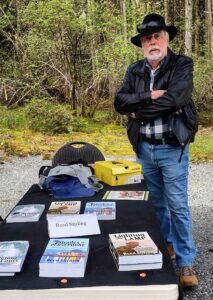
Day seven: a body is found in canal waters at the stern of the boat. On the final morning a second body is discovered.

Who among the cyclists and crew is hateful and motivated enough to kill? Twice. How are the two murders related? Why two coins for the ferryman? Is the phoenix jug, both admired and derided, merely symbolic? How does the death mask of Agamemnon lead to resolution?

Determining truth entails travelling from Amsterdam to Bruges to Paris to the ancient site of Mycenae in Greece where what’s past is shown to be prologue.

About the AuthorReed Stirling lives in Cowichan Bay, BC, and writes when not painting landscapes, travelling, or taking coffee at The Drumroaster, a local café where physics and metaphysics clash daily. Before retiring and taking up writing novels, he taught English Literature. Several talented students of his have gone on to become successful award-winning writers.

He and his wife built a log home in the hills of southern Vancouver Island, and survived totally off the grid for twenty-five years during which time the rooms in that house filled up with books, thousands of student essays were graded, and innumerable cords of firewood were split.

Literary output:
Shades Of Persephone, published in 2019, is a literary mystery set in Greece.
Lighting The Lamp, a fictional memoir, was published in March 2020.
Set in Montreal, Séjour Saint-Louis (2021), dramatizes family conflicts.
The Palimpsest Murders, a European travel mystery, is forthcoming.
Shorter work has appeared over the years in a variety of publications including Dis(s)ent, Danforth Review, Fickle Muses, Fieldstone Review, and Humanist Perspectives.

Intrigue is of primary interest, with romantic entanglement an integral part of the action. Greek mythology plays a significant role in underpinning plots. Allusions to art, literature, philosophy, and religion serve a similar function. Reed sits down to write every day and tries to leave the desk having achieved at least a workable page. Frequently what comes of his effort amounts to no more than a serviceable paragraph, a single sentence, or a metaphor that might work in a context yet to be imagined.

Website | Books We Love Publishing | Kindle Unlimited.

a Rafflecopter giveaway

Interview: Yvonne Rediger

Long and Short Reviews welcomes Yvonne Rediger who was one of last year’s Book of the Month winners here at LASR. She was born in Saskatchewan, lived and worked in northern Manitoba, Alberta, New Brunswick, and Vancouver Island, British Columbia. After a lengthy career in information technology she currently writes from her home in rural Saskatchewan. She’s been writing seriously since 2015. As of this year, she has eleven books published and is working on the next Musgrave Landing Mystery.

She’s lived all over Canada. The prairies, mountains, the far north, east coast and west coast.

“I began moving young, with my parents. I don’t actually have a hometown location; however, I do have a home province, Saskatchewan,” she explained. “This is where my football team is. I bleed green for the Riders. We moved back here a few times. Four years ago was the last time, after we retired. We live in a mid-sized small town, we know our neighbours, everyone is friendly. There is lots of community spirit and a variety of activities. We are close enough to larger centres to take advantage of them, but far enough away to enjoy a quieter lifestyle.”

Yvonne has always loved mysteries and kept getting ideas and writing them down.

“After a point, it became clear to me I was incorporating a mystery of some type in each manuscript,” she explained. “Romance, urban fantasy, it didn’t matter so I took the next step and began writing mysteries and incorporating the other elements into the mysteries. I have way more fun creating these novels.”

Her latest book, The Right Road is the second book in her Adam Norcross mysteries series with Beth Leith and Adam Norcross. As well as a mystery to solve, there is a slow burn romance between her lead characters.

“In the first book we find out about Adam Norcross’ family and where he comes from. In this new book, we discover Beth’s family and that her experience is completely different from Adam’s,” she told me. “This is merely one of their stumbling blocks, but Adam is not easily deterred. The two are growing closer, and in the next instalment, I will take the relationship a bit further.”

“What, in your opinion, are the most important elements of good writing?” I asked.

“You can’t get quality without practice, so write whenever you can. It will not be great to begin with, but over time you will improve. Also, read every day and read above yourself occasionally. What I mean is, expand your horizons once in a while to stretch yourself. Of course, read in your genre and for fun too. This is to become familiar with good characterization. Characters with stories we can understand are the basis of good writing in my mind. There must be at least on character in the story you care about and want to know what happens to them. Otherwise, what is the point?”

Yvonne told me she would describe her writing space as “cluttered organization.” She used to be an information technology solution architect and consulted for various customers.

“Paramount for an SA is a good-sized whiteboard to draw up technical sketches and suss out solutions for program integration or data flow. I now use it as my ‘Murder Board’. I have a second one with my schedule and To Do list,” she said. “I have photos on the walls, bookshelves and bookends my husband has made for me. These are for my novels and also for my collection of various authors’ books I will never part with. It’s cozy; one window over looks our giant elms and a flowerbed in the front yard. A second window is high up and allows in natural light. I am in the midst of reorganizing the space to make it more possible to add an armchair for putting my feet up while I brainstorm.”

Even though she already has some ideas for Adam Norcross Mystery book 3, it’s been put on hold until she finishes the fourth book of her Musgrave Landing mystery series, Storm Stayed.

“I have my cast of characters working at Highmere House catering to bunch of writers and their agent/publisher,” she shared. “A nasty winter gale rolls in forcing them all to stay on the island. No one can get out, not even the murderer.”

She told me that the hardest part about writing is getting the time alone to write.

“Both my husband and I are retired. He can sit still for approximately 20 minutes,” she explained. “There is little in our house, yard, or garden that needs renovation. So, we bought a track of land outside of town and he goes to build things, cut hiking trails, and hunt. I started a YouTube channel to record his adventures for our kids and grandchildren. He is truly amazing and can turn his hand to pretty much anything. Blacksmithing, carpentry, solar technology, gardening, you name it. So, on occasion I join him, but mostly I use his time away to write.”

It’s hard for Yvonne to have a set schedule to write, but she likes to concentrate on writing her first drafts between September and November. During those three months she likes to get the framework completed and tick off all the boxes in her outline.

“After that, I fill in the colour and descriptions, flesh-out the story,” she tole me. “I like to get roughly a thousand words a day down, that’s my goal. It isn’t always possible, but sometimes I can get more done too.”

When she’s not writing, she and her husband hike and visit family. She loves to bake. They also love farm markets and garage sales. They also travel somewhere every year, at least once, to some place new.

Finally, I asked, “What advice would you give a new writer just starting out?”

“Look for a writing group to join. Go through your local library, they may be able to help. You are looking for a group of people who have a range of experience. It is valuable to learn from others and make connections with new writers. Where I currently live, there is no such group close to hand, so, I’ve arranged to begin a group at my library. I’ll lead the meetings to begin with and offer short workshops so I may share what I’ve learned from others.”

Digging up the past can be murder.

Adam Norcross is interrupted by his boss for a new task. Find RCMP Sergeant Bethany Leith. Adam also wants to know how her career has gone so wrong she is suspended.

When Norcross tracks Beth to her parent’s farm in Saskatchewan they are drawn into a suspicious death investigation on her family’s land. Norcross knows it’s murder. The victim is someone Nick Leith, Beth’s father, has a troubled history with. What about the archaeologist team digging on the same property, are they involved?

Norcross will use every tool at his disposal to solve the murder and help Bethany Leith. Including navigating his way through the political intrigue surrounding the case against her.

Website | Facebook | Twitter | Instagram | YouTubeChannel

Buy the book at Amazon.

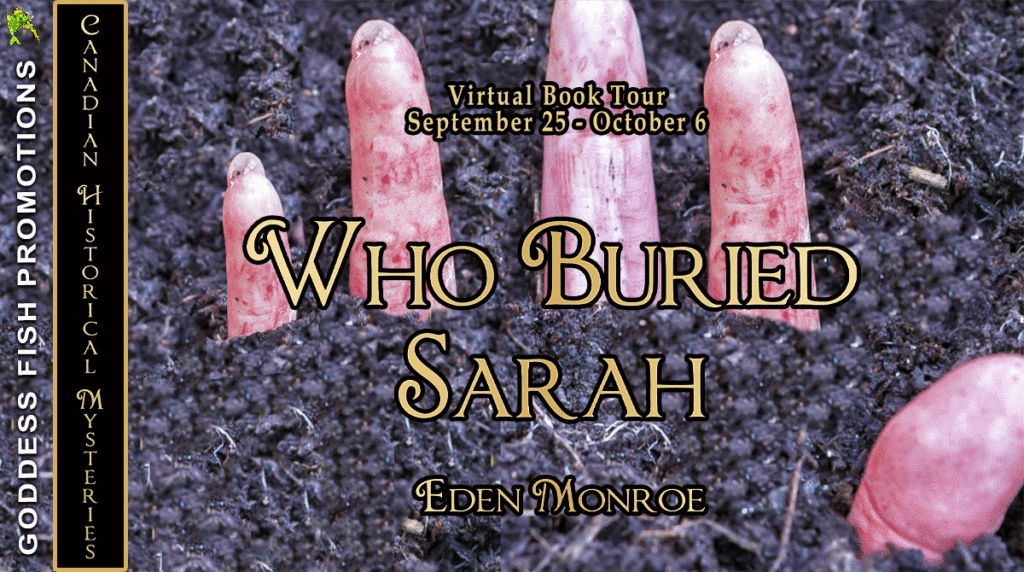
Pondering the Muse by Eden Monroe – Guest Blog and Giveaway

This post is part of a virtual book tour organized by Goddess Fish Promotions. The author will award a $20 Amazon/BN GC to a randomly drawn winner. Click on the tour banner to see the other stops on the tour.

Pondering the Muse

When I thought about writing Who Buried Sarah, my first step was to decide on a provocative title and then write the story to fit that title. Next I briefly considered time periods in which to set this story, and quickly settled on the 1920’s, my source of inspiration very quickly coming into focus. First of all 1926 when the story begins as well as 1927 as it continues are important family milestones for me, as are the settings of Gondola Point and the neighbouring village of Rothesay. Both are very dear to me because my mother spent her formative years in that area, a poor girl and youngest child of a widowed mother who worked as a live-in maid. That meant Mum had to go to school with the sons and daughters of the Rothesay elite. Given my mother’s obvious economic and social limitations she naturally felt ostracized, and her natural inclination toward melancholy, which I inherited, did not make for an easy time.

Sarah and Fanny in Who Buried Sarah shared similar life circumstances, although I choose to help them rise above it. They would not suffer as my mother once did.

My father also briefly lived in Gondola Point, a small farming community on the Kennebecasis River, and met my mother selling strawberries door to door. So how could I have anything but a romantic heart?

My inspiration for Sarah’s fiancé, Connor McLagen, the son of wealthy businessman Pritchard Mclagen and his wife Agnes, is again a throwback to old-money Rothesay and the privilege of affluence. At one time Rothesay was a summer haven for the well-to-do of nearby Saint John, but following the great fire in June of 1877 that destroyed a major portion of that city, many who had summer homes in Rothesay chose to relocate there on a permanent basis – social standing intact.

Of course placing McLagen & Son Ltd. on the Saint John waterfront during Prohibition was a natural fit. I simply could not resist the easy pickings offered by this venerable old city, incorporated in 1784: the salty tang of ocean breezes, the bustling harbor and stately stone buildings – architectural triumphs – that rose in defiance from the ashes of the great fire. A story set in Saint John is certainly worth telling.

To help breathe life into my characters I cast their roles from the ranks of TV and cinema to star in Who Buried Sarah. Going about it that way, as I always do, helps dialogue flow more easily while I get to know everyone better. When the characters are fleshed out so to speak and I hit the groove, it makes for a much more relaxed experience. I become the spectator, or however they wish to put me to good use to get their story told. But even those stars who’ve been cast must continue to inspire me, or I will find someone else to play the part. It has certainly happened before.

I’m also heavily influenced by music – inspired by a song I hear on the radio or wherever. If I am greatly moved by a song, if it touches that spot deep within me, a book idea is immediately born. I don’t even have to write it down. I will never forget the emotion it evoked in me. Emotions are one of my best inspirations, as are passions. For example, my passion for roses became Sarah’s passion for roses in Who Buried Sarah, her independent spirit my own battle cry.

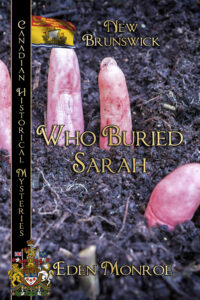
Sarah, the only child of Rev. and Mrs. Cranston Estey, was betrothed to Connor McLagen of the affluent McLagen family. The McLagens were socially revered, although there were rumours of nefarious underpinnings to their substantial wealth, and the God-fearing Esteys were not in favour of the marriage.
Three days before the June 1927 wedding, Sarah disappeared. Her note said she’d changed her mind and decided to leave town.

A week later she was found, buried in a rose garden, the gruesome and sensational discovery knocking New Brunswick prohibition wars out of the headlines.

There were many with secrets to keep…

Enjoy an Excerpt

“Then stop playing with fire. Look, I like it that you want to … go further … but not now, darling. We have to wait for the right time and I promise to live up to your expectations. There will be nothing holding us back then, but I promise I will be gentle.”

Shifting away from him slightly, she gazed out across the river. “I understand that. I’m not exactly inexperienced about such things, Connor.”

Had she really just said that aloud? She was aghast that the secret she knew she had to share with him at some point had spontaneously bubbled to the surface. This was probably the worst time for such a revelation, but there was no turning back now.
There was silence as she waited for the fallout from the bomb she’d just dropped, not daring to look at him.

“Excuse me?” he asked after a moment, his voice gone hard. “What did you mean by that, Sarah?”

Apparently this had unexpectedly become the time for truth telling. She was as surprised as he was it was happening, but she loved him too much not to be completely honest. She’d just thought it would somehow be easier to do. “What I mean is … I’ve … ahhh … been with a man before.”

He was deadly calm. “In what way?”

About the Author: Eden Monroe writes about real life, real issues and struggles, and triumphing against all odds. A proud east coast Canadian, she enjoys a variety of outdoor activities, and a good book.

Website | Facebook

Buy the book at Amazon.

a Rafflecopter giveaway

Nancy M. Bell – Interview and Giveaway

Long and Short Reviews welcomes Nancy M Bell who is celebrating the recent release of Discarded. Leave a comment or ask the author a question for a chance to win a digital copy of the book.

Nancy as been writing since she was in grade school and told me that she still has some of the stories.

“They are embarrassingly terrible. But words have always come to me and demanded to be put down on paper. It must be some past life geasa or something,” she said with a laugh. “I started a number of novels over the years but life always got in the way, although I did amass a great deal of poetry and magazine articles. Then in 2005 I had a life changing accident and went from 200 miles per hour to 0 in about 2 seconds. While it ended my career, it did give me time to read and research things I had put on the top shelf for too long. I think the Universe said ‘Hey, lady. Quit ignoring me and write the stories we keep gifting you with.’Apparently, it was time I listened to my muse’s voice.”

Nancy’s earliest memory is of reading Black Beauty by Anna Sewell. It captivated her and instilled in her a deep and abiding respect for horses and all beasts of burden. She was lucky enough from a young age to be mentored by Gilean Douglas, a British Columbia journalist, poet, nonfiction writer and ex-reporter.

She explained, “She helped shape my view of writing and the world. She once told me something that has struck me as very true: ‘You don’t meet an author in her living room, you meet the author in her work, through her words’.”

Her favorite author, however, is Charles de Lint, a Canadian author who writes urban fantasy well steeped in Irish and Celtic mythology and magic. The kind of things you see out of the corner of your eye on a bright summer day or in the dim orange-gold light of an autumn dusk. Those things that disappear when you look at them directly. she credits him for the knack of weaving myth and legend into contemporary worlds.

For Nancy, the most important elements of good writing include a clear and well-developed author voice, because it’s the basis for everything else, the foundation the work will either stand or founder on.

“The technical part of the writing must be clear and concise showing a good command of the language and use of said language, she said. “While grammar is important, it shouldn’t be strictly imposed on your characters if they are somewhat considered to be ‘beyond the pale’, i.e. if your character is a bit, shall we say, rough around the edges or speaking in an odd dialect then grammar can be set aside in those cases. The plot must be well thought out and move at a good pace without sidetracking the reader with unneeded information or back story.”

When she’s developing her plot and characters, usually it starts off with the germ of an idea. While she generally has an overall idea of what the story will entail and know where it is headed, often her characters take control of the tale and it goes in an entirely different direction than what she first envisioned.

“I know some authors who base their characters on favourite actors or personages. I can’t do that for some reason,” she told me. “My characters are a force in their own right and I must say a force to be reckoned with at times. They’ll wake me up in the middle of the night and insist I get up RIGHT NOW and write down what’s happening. If I ignore them, they go off and sulk and I spend some time rowing aimlessly in the doldrums. I am definitely a ‘pantser’ as opposed to a ‘plotter’. Interestingly for Discarded, a historical mystery releasing in September 2023, I did have to do some plotting, but damned if the characters still decided to take off on their own. Although they did agree to stay within the bounds of my rough outline.”

I asked her to describe her writing space.

“My office (big word for a little space) has a large window facing south. It is crammed with two large antique bookcases which in their turn are crammed with books. Binders full of courses I have taken, research books, bits and bobs I have collected in my journeys: rocks, stones, feathers, bits of bark, oriental incense burners, horse statues, a magpie’s skull I found in my garden, hawk feathers the local hawks have gifted me with and Lord knows what else. My writing desk is an old antique secretary, the shelves of it are full of the same kind of things listed above plus a shelf of antique books. The prize is one call Her Benny by S.K. Hocking which my grandfather used to read. The walls are covered with pictures, some indigenous moose tufting pieces, a piece of birch bark biting and a brass rubbing I did at Glastonbury Abbey. A large dream catcher, a tapestry of Bruges, Belgium, a watercolour of Nanjizal in Cornwall and watched over by a little purple wizard.”

When she’s not writing, she spends a lot of time with her horse, a 17 hand high bay Thoroughbred named Shady. She’s considered a “throw away horse” who came off the race track and was sold as a barrel horse which didn’t work out, then she went through an auction again and was bought as a combined training horse. However, she was injured in the pasture with a deep puncture wound in the armpit. It healed after a long and expensive course of treatment, but the scar would tear when she worked, so fortunately for her, the girl who owned her cared enough to find a soft place for her to land. And so she is now with Nancy.

“She’s now very sweet because she knows she’s safe and nothing bad if going to happen to her,” Nancy explained. “I also love to garden and have a number of gardens along with potted vegetables. And, no surprise, I love to read. I spend a fair bit of time, especially in the winter, doing counted cross stitch. I have many, many finished projects. I have what I refer to as my ‘Covid Winter Collection” because there was literally nothing to do during that time but stay home and keep yourself busy.”

When she was young, she wanted to be a nurse. But then, although she’s always been drawn to healing, she fell in love with horses (blame Black Beauty) and wanted to open a farm for unwanted horses. Reality and the lack of money put paid to that idea, but she did make a living with horses for many years, both as an instructor and as the proprietor of a small boarding stable.

“Writing has always been a part of my life, but I honestly never thought of being an author as a career or a ‘job’, it was just an integral part of who I am,” she said.

Finally, I asked, “What is the hardest part of writing for you?”

“Without at doubt the marketing. I suck at it. Marketing is labour intensive and takes time away from what my heart wants to do which is write. I am toying with the idea of starting a podcast or something of the sort where I would read some of my work and then post it online. The problem is I have no idea how to do that so I must delve into the intricacies of bring that to fruition. Wish me luck! I do blog on the 18th of each month at the BWL Publishing Blog. Drop by if you have the chance, you never know what I’ll be talking about. After marketing, I’d have to say the editing is next. By the time something is ready for publication it’s been read a number of times and I’m so sick of it that I can’t imagine why anyone would be interested in reading my words. Thankfully for me, people do want to read them.”

When the British arrived in Winnipeg in the 1800s it was convenient for the men to take Metis wives. They were called a la vacon du pays – according to the custom of the country. These women bore the brunt of ensuring survival in the harsh environment. Without them the British army and fur traders would not have survived the brutal winters. However, as society evolved it became accepted that wives must be white, schooled in British ways, fashionable in the European sense and married by the Anglican church. The Metis wives and their ‘country born’ offspring were thrown out and forced to fend for themselves. The unrepentant husbands continued to live comfortably with their ‘new’ wives. It was inevitable that some discarded wives did not accept their fate quietly and hard feelings on both sides were unavoidable. When the bodies of two discarded Metis wives, Marguerite and Marie-Anne, are found floating in the Red River, Guilliame Mousseau, sets out to get to the bottom of his sisters’ murder.
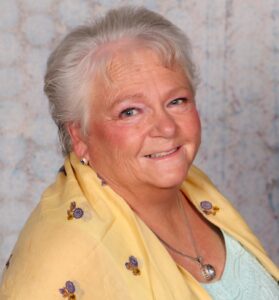
About the Author Nancy lives near Balzac, Alberta. She is a member of the Writers Guild of Alberta, The League of Canadian Poets, and the Canadian Authors Association. She has publishing credits in poetry, fiction, and non-fiction with over 20 published novels. Her work has been included in Tamaracks Canadian Poetry for the 21st Century and Vistas of the West Anthology of Poetry. Her poetry is also being included by the University of Holguin Cuba in their Canada Cuba Literary Alliance (CCLA) program.

Books We Love Author Page | Facebook | Website

Buy the book at Amazon.

Down the Rabbit Hole by Nancy M. Bell – Guest Blog

Long and Short Reviews welcomes Nancy M. Bell, who is celebrating today’s release of Discarded.

Down the Rabbit Hole

Research. I’m working on research for my latest book. There, doesn’t that make me sound academic? Learnèd? Important? The very thought makes me laugh. Research is time consuming, annoying at the best of times, but oh so necessary.

Actually, I kind of love research. One thought, one link, takes me to another and another until I’m hard pressed to remember what it was I was looking for in the first place. And that, is the fascination and the annoyance in a nutshell.

I recently sent off the final manuscript, ready for publication of a historical mystery set in Winnipeg Manitoba in the year 1869. This was during the time of the Riel Rebellion, or the Red River Resistance, as it is sometimes called. You would think there should be whole reams of documents chock full of information. I suppose there are, but the more I delved into things the more confused things became. For instance, I needed to know what newspapers were in existence during that time. The Nor’Wester, The Pioneer if I recall correctly. But then, who were the owners or editors? I came up with a number of different names, Charles Schultz is mentioned, but so is Andrew Bannatyne, Charles Mairs and a few others who had interests in the papers. Who to use? Who was actually in charge during the timeframe I needed? Sometimes you have to make a good guess based on the historical information you have and take a leap of faith.

My next issue was what did I call the head of the Hudson’s Bay Company who was in charge of keeping the peace in Rupert’s Land? You’d think that somewhere there would be hierarchy listed, but no. I found references to Chief Factor of the Hudson Bay Company, so I went with that. The number of clergy in the area was also a bit confusing, Saint Boniface Roman Catholic Cathedral, Kildonan Presbyterian Church and St. John’s Anglican Cathedral. Then to sort through the names of the priest and other clergy and decide who, if any, should have an impact on the plot. Since Riel himself was Catholic and had studied in Montreal to be a priest at one point, it made sense to include the Catholic clergy in the story. But which ones? Back to the research rabbit hole- George-Antoine Belcourt was a good friend of Riel as was Father Richott.

But the waters muddy when my main character isn’t Louis Riel, but a fictional Metis man who is looking to solve the murder of his sisters. More research, how much interaction should my Guillaume have with Riel? He couldn’t be front and centre in the provisional government proposed by Riel as there was no historical evidence to place him there. So okay, he needed to be involved in the events that went down during late November and early December of 1869 but not at Riel’s right hand. A tricky slope to slide down when inserting a fictional character into actual events and interaction with historical figures.

Then there’s the question of dress. How did the Metis and Indigenous peoples dress and how did the British and Scottish immigrants dress. What was the relationship between the two factions like, how much resentment was there and who should I lay the blame on for the purpose of my plot? More rabbit holes to fall down.

On the plus side, I now appreciate and understand the history of Manitoba now and the significance of the Hudson Bay Company’s sale of Rupert’s Land to Canada under John A. Macdonald. How that transaction served to open the western prairies to the influx of immigrants who came soon after. Sadly, that transaction also adversely affected the population already living and thriving on those lands. I have attempted to keep a neutral voice in my story without taking either side, but laying enough information in the narrative for the reader to draw their own conclusions.

Research is a blessing and a curse and can actually be fun. When I wrote No Absolution (an unconventional Jack the Ripper story) I managed to purchase an ordinance survey map of London’s East End circa 1888/89, complete with a list of who lived where and what their occup0ation was. A treasure trove of information. I plotted the murders associated with Jack and planned his escape routes. What fun. Research, love it, hate it. But to be accurate in your story you have to do your research.

When the British arrived in Winnipeg in the 1800s it was convenient for the men to take Metis wives. They were called a la vacon du pays – according to the custom of the country. These women bore the brunt of ensuring survival in the harsh environment. Without them the British army and fur traders would not have survived the brutal winters. However, as society evolved it became accepted that wives must be white, schooled in British ways, fashionable in the European sense and married by the Anglican church. The Metis wives and their ‘country born’ offspring were thrown out and forced to fend for themselves. The unrepentant husbands continued to live comfortably with their ‘new’ wives. It was inevitable that some discarded wives did not accept their fate quietly and hard feelings on both sides were unavoidable. When the bodies of two discarded Metis wives, Marguerite and Marie-Anne, are found floating in the Red River, Guilliame Mousseau, sets out to get to the bottom of his sisters’ murder.

About the Author:Nancy lives near Balzac, Alberta. She is a member of the Writers Guild of Alberta, The League of Canadian Poets, and the Canadian Authors Association. She has publishing credits in poetry, fiction, and non-fiction with over 20 published novels. Her work has been included in Tamaracks Canadian Poetry for the 21st Century and Vistas of the West Anthology of Poetry. Her poetry is also being included by the University of Holguin Cuba in their Canada Cuba Literary Alliance (CCLA) program.

Website | Publisher

Buy the book at Amazon.

Moccasin Trace by Hawk MacKinney – Spotlight and Giveaway

This post is part of a virtual book tour organized by Goddess Fish Promotions. Hawk MacKinney will be awarding a $20 Amazon or B/N GC to a randomly drawn winner via rafflecopter during the tour. Click on he tour banner to see the other stops on the tour.

It is July of 1859, a month of sweltering dog days and feverish emotional bombast. Life is good for widower Rundell Ingram and his hazel-eyed, roan-haired son, Hamilton. Between the two of them, they take care of Moccasin Hollow, their rustic dogtrot ancestral home, a sprawling non-slave plantation in the rolling farming country outside Queensborough Towne in east Georgia. Adjoining Ingram lands is Wisteria Bend, the vast slave-holding plantation of Andrew and Corinthia Greer, their daughter Sarah and son Benjamin.

Both families share generations of long-accepted traditions, and childhood playmates are no longer children. Against this rustic idyll of hard work and gracious living comes inflexible discord and divided loyalties that mutilate ties of blood and bond, tearing at their lives as smoke and battle no longer so faraway crashes and maims ever closer. Ahead of the on-coming ranks of Blue, foragers and bumlers burn, loot, scavenge and kill. Hamilton faces agonizing sacrifices with dreadful consequences. With little else than his wits, he tries anything to protect Sarah, their unborn child, his sickly father, and Sarah’s family.

Enjoy an Excerpt

Rundell liked munching raw potatoes. He favored the smaller fresh-dug ones he called new potatoes. He’d use the bent kitchen knife that’d lost its handle on the withered moldy ones that hadn’t been taken. Sometimes he didn’t peel them, just rubbed off the dirt and gnawed away.

The Hollows had been spared, but damn little else had. Growing up a gangly towhead on the sprawling acres of Moccasin Hollows, Hamilton never gave much notice to outside goings-on. On his seventeenth birthday near four years ago, he got his first notion of the world beyond.

Rundell usually kept his feelings close to home, seldom using strong language, but that day his disgusted papa’d remarked, “Damn few prudent heads among the lot of them,” as he flung down the Augusta newspaper. “Constitutionalist editors and those pigheaded politicians. They couldn’t get off a water moccasin if it was chewin’ on their big toe. Fools got no idea what they’re stirrin’. Most likely don’t care neither.”

“What happened?” Hamilton had never seen a turmoil fret his papa so.

“I suppose it’s gettin’ to me more’n I thought. Benson Crouder stopped by, that’s what. All gussied up in his top hat and new attire like some up-town Beau Brummell, that fancy rig of his hitched with his matched bays, their mane and tails all curried. Cain’t figure some folks. Let them get money in their pockets, they act like their sweat don’t stink. All fired up, heading into Queensborough for the big meet, asked if I was going. I told him I didn’t see no point to another meetin’. Far as I could tell too many done decided they were finished with talk.”

Not many days went by before Rundell swallowed his distaste for politics and got knee-deep in the middle of the commotion at the capital in Milledgeville. Hamilton harnessed and hitched the buggy for him.

Reins in hands, Rundell looked at his son. “Don’t figure my bein’ there’ll make much difference. Suppose it cain’t do no harm neither.”

“I’ll handle things. Things’ll be fine here however long you need to be gone.”

Hamilton would remember that day, watching Papa drive off, and how at the time the day hadn’t seemed different. When he thought back, he could think of no one thing which seemed to’ve change, except he recalled the yellowish-orange morning light seemed sharper with a change to the air.

For way too many folks stench and fear rode the breezes, carrying the smell of char and ashes. Each day had become a hunt for food and shelter. Tending the meager gardens at the Hollows barely managed enough food, but it was food. The lawless churning mayhem, moving far and near, sometimes too close to the Hollows for Hamilton’s liking–his wife and son, their unborn, Papa, Mother Greer and Sarah’s brother, Benjamin. Gaunt chimneys haunted the ashes of Wisteria Bends, Hamilton’s second home, the grand plantation manor where Sarah and Ben had grown up. Without money there was no point going into town. Except for land speculators, gold jingling in their pockets, there wadn’t that much food to be had in Queensborough nohow.

A blizzard of thunder and hell-hot hate had smashed most homes in the countryside around Queensborough Towne. With Sherman and his army gone, worse than carpetbaggers and a lot more dangerous were the lawless bands of white trash infesting the countryside. No questions asked, easier to kill anyone that happened in their way, and get on with the stealin’. Human locust pillaging what they could get their hands on, torching homes, farms, what was left of the Queensborough courthouse. With parish land records in ashes a fair number of low-lifes claimed land which was never theirs.

About the Author:

In addition to professional articles and texts on chordate neuroembryology, Hawk MacKinney has authored several works of fiction—historical love stories, science fiction and mystery-thrillers. Moccasin Trace, a historical novel nominated for the prestigious Michael Shaara Award for Excellence in Civil War Fiction and the Writers Notes Book Award, details the family bloodlines of his protagonist in the Moccasin Hollow Mystery Series: Hidden Chamber of Death, Westobou Gold, Dead Gold, Curse of the Ancients, and Blood of the Dragonfly.

Hawk’s science fiction novels include The Bleikovat Event, Vol I in The Cairns of Sainctuarie Science Fiction Series, followed by Vol II, The Missing Planets, and Vol III, Inanna Phantom.

Hawk MacKinney served in the US Navy for over 20 years. While serving as a Navy Commander, he also had a career as a full-time faculty member at several major state medical facilities. He earned two postgraduate degrees with studies in languages and history. He has taught postgraduate courses in both the United States and Jerusalem, Israel. He now makes his home in Augusta, Georgia, where he writes full-time.

Goodreads | Website

Buy the book at Amazon or Barnes and Noble.

a Rafflecopter giveaway