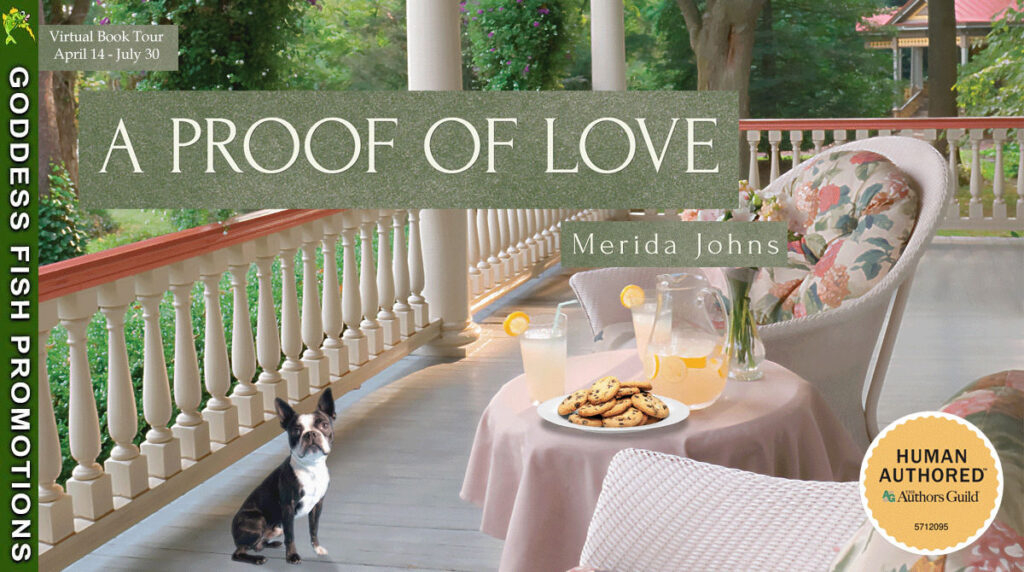
A Proof of Love by Merida Johns – Interview and Giveaway

This post is part of a virtual book tour organized by Goddess Fish Promotions. A randomly drawn winner will receive a $25 Amazon/BN gift card. Click on the tour banner to see the other stops on the tour.

If you could have one paranormal ability, what would it be?

There are so many types of paranormal abilities—telepathy, precognition, channeling, among others. Because curiosity is one of my top strengths and I like to peek behind the curtains, astral projection or the ability to explore different planes of existence would be enticing.

What is one thing your readers would be most surprised to learn about you?

I didn’t start my fiction writing career until I retired. I’m proof that it’s never too late to follow a new path and find new, interesting, and perspective-changing experiences.

When writing descriptions of your hero/ine, what feature do you start with?

In my novels, I usually introduce my protagonist using interiority and/or action. This allows readers to form an immediate bond with the protagonist, immersing them in the protagonist’s perspective through the protagonist’s thoughts and actions. For example, in A Proof of Love, the reader is introduced to Katie Blake in the Prologue through her recollections of her younger self and the motivation that leads her to seize the day and write about the special people in her life, ones her readers will remember.

Are you a plotter or a pantser?

I’d describe myself as a plot-plantser.

Before I begin writing, I have a story in mind—I know the general character arc that shows the protagonist’s internal transformation. I’ve imagined the turning points, the character’s confrontation with her darkest moments, and the change that occurs by the end of the story. Then I get to work fleshing out the important secondary characters, including using inanimate objects and locations as supporting characters.

After I have the story in my mind, I write what I term a mini-story, including a few paragraphs on the story’s theme(s) that sketch the plot, conflict, and resolution. Then, in the next section, I elaborate on the powerful influences/influencers in the story, followed by descriptions of the strong challengers, the major conflict, and the resolution.

The most useful technique I use to develop the characters is writing a character profile for each in the story. In this profile, I identify elements such as physical descriptions, the home or neighborhood they live in, close relationships, family members and background, gender relationships, job, dress style, favorite foods, regrets, best qualities, worst qualities, religious and philosophical beliefs, and so on.

To be sure, though, nothing is set in stone. My characters and events evolve, and each day as I write about them, the characters take me by surprise with their actions and thoughts, and unexpected events surface without warning!
For tracking characters and events, I develop a timeline and a list of characters and their relationship(s) with each other. Both of these will be revised and edited throughout the novel’s development.

I maintain a style sheet while I’m working on my novels. Style sheets are usually used by copyeditors, but I have found this tool essential in keeping track of style and usage for my own purposes. For example, I will list words that I always hyphenate or capitalize, notate how I treat inner thoughts by using italics, not quotations, and so on. The style sheet also lists all references I have used for fact-checking and fact-finding. When I hand the manuscript to the copyeditor, the style sheet serves as a communication tool, making life much easier for both of us.

Did you learn anything from writing this book? If so, what?

From a craft standpoint, I learned that using multiple points of view (POV) can enhance a story by providing readers with a variety of perspectives on characters’ emotions, motivations, and internal conflicts. I also think that using multiple POV can increase tension and suspense, revealing information to the reader while keeping other characters in the dark.

From a personal growth perspective, A Proof of Love helped me reflect on the relationship between love and grief, and, as Katie says, “Neither grief nor love has respect for time—there are no sunsets, no last acts, no grand finales.”

A fictional story with a memoir overlay as narrator Katie Blake reflects on life in small town America and the principles, influences, and big personalities she wants you to never forget.

It’s Memorial Day weekend, 2009, and the town gossips have their shorts in a twist about a mysterious newcomer who wears tie-dye, colorful headbands, clunky necklaces, and rings on every finger.“Who installs a ceiling fan on a Victorian porch?” cries Ned Boomer, Woodburg’s grumpiest man, and the town gossips concur, “She must be a hippie, witch, or maybe worse . . . a socialist.”

Hell-bent on preventing a neighborhood blow-up, precocious, nine-year-old Katie Blake launches a covert investigation to gather the truth about the enigmatic Rose. But when she discovers a decades-old secret binding her, Rose, and bad-tempered Ned Boomer, her world takes a turn.

Penning a memoir sixteen years later, Katie is forced to reconsider whether the real proof of love was in preventing a neighborhood war or finding friendship and comfort among three unlikely grief-stricken souls who should never be forgotten.

Enjoy an Excerpt

She gazes at that old maple tree and makes us a promise. “One day . . . I’ll write about the special people in my life so you will know them, and they will never be forgotten.”

But Gram went to heaven before her one day came, and her stories, told in her own words, are lost forever.

Fifteen years later, I’ve learned that one day’s promise is not assured. Before it’s lost . . . So, I’m seizing that one day to write about the special people in my life, so that you will know them, and they will never be forgotten. This is A Proof of Love.

Kathleen Claire Blake, Memorial Day, 2024

About the Author:
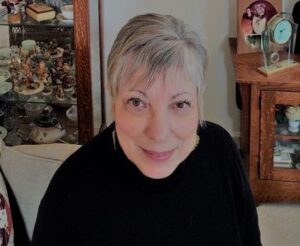
At heart, I am a storyteller who writes women’s fiction and stories of courage and discovery, showcasing the protagonist’s journey toward a more fulfilled self.

My passion is writing women’s fiction and exploring the human experience—how ordinary people tackle challenges, endure sorrow and betrayal, wrestle with doubt, and act on their aspirations to achieve flourishing lives.
My insight into the power of fiction came during a conference call in late 2017 with a group of fellow life coaches. “What would it be like to help women and men achieve a flourishing life through storytelling?” I asked them.

After that phone call, I got started answering that question. The result was my debut novel titled Blackhorse Road, a compelling story of womanhood and the power of choice, gratitude, and forgiveness, published July 21, 2020, by Coffee Cup Press, followed by Flower Girl (2022), Flawless Witness (2023), and now A Proof of Love (2026)

Before embracing writing fiction, I was the author of health informatics and leadership textbooks. Later, I put my leadership experience to use as a leadership coach, focusing on supporting others to fulfill their leadership and economic potential. My range of nonfiction is available on my Amazon Author Page.

Substack | Facebook | Instagram | Website

Buy the book at Amazon.

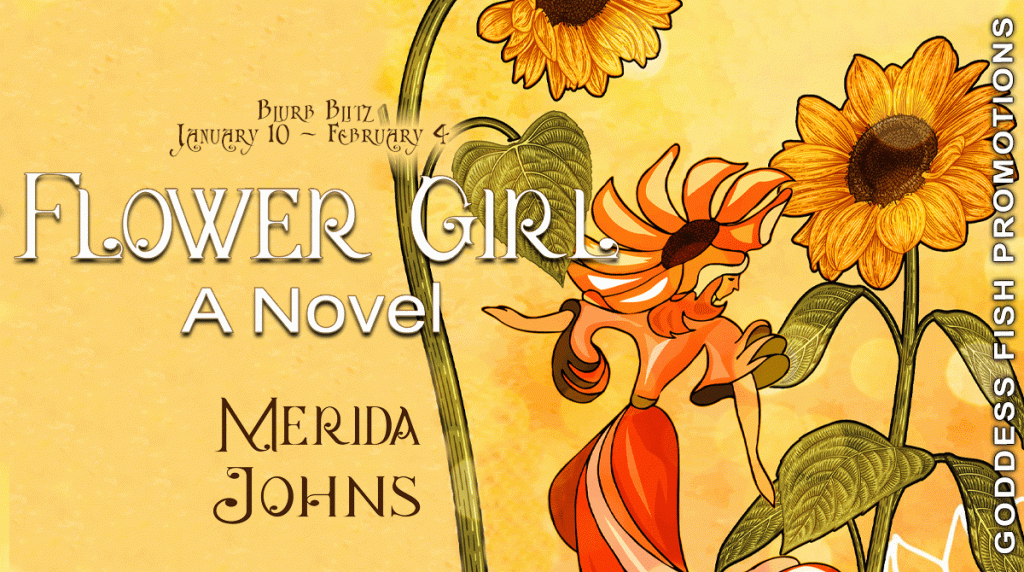
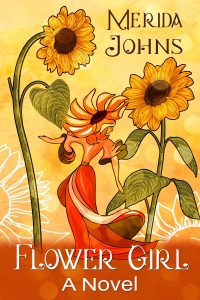
Flower Girl by Merida Johns – Spotlight and Giveaway

This post is part of a virtual book tour organized by Goddess Fish Promotions. Merida Johns will be awarding a $30 Amazon/BN GC to a randomly drawn winner via rafflecopter during the tour. Click on the tour banner to see the other stops on the tour.

Everyone wants to believe they can hold on to their anchor, the light of their North Star, and live their truth . . . Suzanna Jordan did too until she fell for a man with a movie-star presence and a dark alter ego. Losing hope of salvaging her life and gaining her freedom, an unlikely source serves up a platter of just desserts that even Suzanna’s treacherous abuser might not evade.
Enjoy an Excerpt

WEDNESDAY, JUNE 13, 1984

It’s five o’clock in the morning. A waterfall of worries washes over me, but one remains, one I cannot ignore, one that means my life or death—do I have the courage to stop this nightmare?

I hear muffled voices and hasty footsteps fading away in the distance. My crisis, already old news to them, cataloged on a forgotten document. They have abandoned me and left me alone with my fear.

Rolling to my side, my legs dangle off the bed, and gravity pulls my five-foot-five, slender body toward the floor. My feet rebel. They scream and cramp in pain as they hit the cold cement. My insides shake, and my body wobbles. My eyes blur, and my hands reach out to find the bed. I steady myself and count under my breath, “One, two, three . . .” The agonizing muscle spasms in my feet start to unwind.

My world plays in slow motion. My eyes drift across the brackish-beige walls, swamp-green curtain, stainless steel instruments, and electronic gadgets—my stomach knots, my heart falls, my mouth goes dry. Helplessness hits me like an animal in a snare.

I spot my possessions, swathed in clear plastic, in the chair’s seat in the corner of the room. I hobble over and open the bag and poke through it—a Victoria’s Secret midnight-blue lace bra, an OSU red T-shirt, a pair of Gloria Vanderbilt denim pants, a Coach purse, and white Reeboks. I loosen the ties of the rumpled steel-gray gown; it slips off and falls to the floor. Dressing in fancy lingerie is absurd, so I toss it on the chair and throw on the shirt and jeans.

I look down at my sneakers and stop. In my mind, I see my husband’s squinting eyes and hear his haunting disapproval. Quit wiggling your feet over the counters of your damn shoes, Suzanna. You’ll ruin them! I shake my head, clench my jaw, and disobey.

I have no strength to bend over and tie the shoelaces. Jonathan would have a nasty comment about this, too. I ignore him. My eyes close in victory. “Cherish every step. Each is a grand slam toward deliverance.”

My fingers run through my disheveled hair, soaked with sweat—my muscles loosen, my brain fog lifts, and the ache behind my forehead fades.

I pull back the curtain circling the bed and grimace—the overhead lights jar me. I pump myself up—One, two, three, go. I take off.

I shuffle through the corridor between the beds bordering the room and reach the doorway to the waiting area. If people are here, I do not notice them. My eyes fix on the escape at the end of the room—the pulsating red exit sign. The floor-to-ceiling doors open, allowing my aching body to limp toward daybreak. The heavy morning breeze hits my face, and the sickening, sterile scent covering me blows away. I clutch my heart and silently sob, Thank God I’m alive.

But the joy vaporizes into the humid air. The war has only begun. Clutching for courage, I console myself. You’ve gotten this far. You can make it! You can live your truth.

I look up above the horizon, and I see it! There’s my North Star, its five points shimmering in the dawn and guiding me toward my purpose—But before I can help others be their best, I must help myself be my best.

Outside the sterile walls of a hospital emergency room, I hold my own. I put a stake in the ground. I swear that the fight to flee my abuser’s snare, save my life, and follow the guidance of my North Star is worth it.

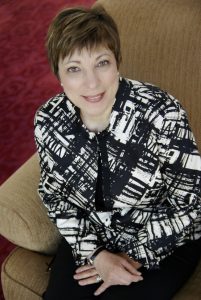
About the Author:Merida Johns writes about the human experience—that often is messy—and how ordinary people tackle challenges, live through sorrow and betrayal, struggle with doubt, but despite this, gather the strength to act on their aspirations and achieve flourishing lives.
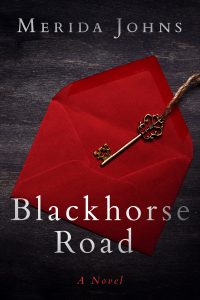
“My insight into the power of fiction came during a conference call in late 2017 with a group of fellow life coaches when I asked, ‘What would it be like to help people achieve a flourishing life through storytelling instead of another self-help book?’

After that phone call, I got started answering that question. Almost three years later, the result was my debut novel Blackhorse Road, a heartfelt story of womanhood and the power of choice, gratitude, and forgiveness that was published July 21, 2020, by Coffee Cup Press. Now, I’m thrilled about the upcoming release Flower Girl—a story of a woman who must make sweeping changes in her life to live her truth.

Before writing fiction, I was a professor and author of health informatics and leadership textbooks. Later, I put my experience to use as a leadership coach, focusing on helping women break the glass ceiling and fulfill their leadership and economic potential.

My husband and I reside in the beautiful Midwest countryside. This is where I find the serenity and space for bringing to life the stories about everyday people who face and overcome extraordinary challenges by finding and following their North Star.

Website | Twitter | Facebook | Goodreads

a Rafflecopter giveaway

Blackhorse Road by Merida Johns – Q&A and Giveaway

This post is part of a virtual book tour organized by Goddess Fish Promotions. Merida Johns will be awarding a $20 Amazon or Barnes and Noble GC to a randomly drawn winner via rafflecopter during the tour. Click on the tour banner to see the other stops on the tour.

Tell us about yourself.

I like to view myself from the perspective of the constellation of positive strengths that impact my behaviors and how I feel and think. My calling has been to devote my personal and professional life to help people fulfill their potential and be their best selves. Beyond my work as a college professor, life coach, and small business owner, I’ve taken my calling and applied it to writing women’s fiction. I like to write about the human experience, showing readers how ordinary people tackle challenges, live through sorrow and betrayal, struggle with doubt, and act on their aspirations to achieve flourishing lives. I hope that stories help my readers be their best selves too.

When did you know you wanted to be an author?

My first recollection of writing fiction was when I was about ten years old. What inspired that effort was a picture that hung in the dining room of my parents’ home. It was a moon-lit lake scene that screamed out that mystery lurked among the shadows cast from the trees on the shoreline. At the time, like most young girls in the 1950s, I was into Nancy Drew books. So, my first attempt at fiction involved some type of scary adventure along the shores of a secluded lake. Although I had minor attempts at writing short stories in high school, my fiction writing career was interrupted by authoring nonfiction works related to my career in health information systems and leadership.

What genres do you like to read? Are these the same genres you write in?

Although I enjoy reading mysteries and biographies, my favorite genre is women’s fiction and nonfiction. I love women’s diaries and letters, published and unpublished. A sampling of women’s nonfiction on my bookshelf: Letters of a Woman Homesteader by Elinor Pruitt Stewart, Army Letters from an Officer’s Wife 1871-1881 by Frances M.A. Roe, Covered Wagon Women, Diaries and Letters from the Western Trails, 1850, and Women’s Diaries of the Westward Journey by Lillian Schlissel. One of the favorite women’s historical fiction I’ve read the past year is My Dear Hamilton by Stephanie Dray and Laura Kamoie.

Is your book for adults, young adults or children?

At first, I thought Blackhorse Road was for adult women. However, my Beta readers and the feedback I’m getting from readers say that the story is for everyone age fifteen and older. The following is an email I received from a grandmother who read the book with her seventeen-year-old granddaughter:

“I’ve been wanting to get back to you to tell you how much my granddaughter enjoyed your book. We’ve had a little time to discuss it, and I know that she especially enjoyed the fact that the main character was a young woman – strong-willed, like my granddaughter, dealing with a difficult parent, falling in love. She has passed it on to one of her friends.”

And a grandfather wrote: “Blackhorse Road should be required reading by every teenage boy and girl and the parents of every teenage boy and girl. Blackhorse Road not only entertains, it teaches. It shows how beautiful and how special young love can be, what true friendship is and the importance of having supportive friends, that setbacks in life can be overcome . . .”

What is your current release or project?

The current release (2020) is Blackhorse Road. My focus in writing fiction is to tell a story of a protagonist’s journey toward a fulfilled self and flourishing life. I introduce strong secondary characters that are as memorable as the protagonist, and the villain must be a worthy opponent—no sissies or milk toasts for my heroes!

Tell us about the key characters.

As I wrote the story, I formed a relationship with all the characters in Blackhorse Road. I was amazed at how the characters surprised me as they evolved from my computer keyboard. I found myself challenging them with questions. Luci, you did what? What were you thinking, Chris? Berry, that was heavy! Sean, you were brilliant! Marie, how could you go so low? I also fell in love with characters I would never have anticipated, and I was unpredictably torn between love interests—pure satisfaction that made me smile as the words tumbled across the computer screen!

The character who fascinated me the most is the protagonist’s mother, Marie, who is the most complicated. There is a mystery about Marie that engaged my developmental editor and my beta readers as well as myself. In the focus group with my beta readers, Marie is the character that took up the most space and intensity of the discussion. She fell on the extremes of the spectrum between compassion and disgust.

Several of the characters stole a piece of my heart—I call them Luci’s informal therapists and guardian angels. These are Lucinda, Sam, Barry, the gang of Nerds, Chris, and Genevieve. It’s often said that it takes a village to . . . . These characters are Luci’s village. I hope that my readers don’t just read how Luci grows, but, through the help of the supporting cast, feel and see her maturation as she faces her life’s challenges.

Do you have a favorite scene?

One of my favorite scenes is when Luci transitions from her “black moment” and allows herself to forgive a grave transgression that caused her to lose something precious that she can never recapture. Forgiveness and mercy are not my top strengths! So, to write about forgiveness, I had to go beyond writing about what I know. I needed to know about what I wrote—and that meant doing a lot of research on what forgiveness is and what it is not. In the end, Luci taught me so much about forgiveness, and to give readers a hint, I’m happy to share the following scene from the book, modified a little to not give the story away. Hopefully, it will help others struggling with forgiveness too.

I keep asking myself, what is forgiveness? Forgiveness is not pardoning. It is not overlooking or justifying someone’s transgression and the hurt his actions caused. I am relieved that I don’t have to condone, excuse, reconcile, or even forget his behavior to forgive him. What is forgiveness . . . forgiveness is choosing to reject resentment and embrace compassion.

What advice would you give a beginner?

When I started writing fiction, I took two pieces of advice before pounding the keyboard—write about what you know and know what you write. Blackhorse Road blossoms from my imagination and is influenced by my experience, perspectives, and observations to give the story authenticity and sensitivity, helping readers connect with the characters and feel their joy, disappointment, sorrow, and happiness.

But Blackhorse Road is enriched by the backstories that set the context for the characters and events in the story—historical incidents, politics, economics, philosophy, religion, and psychology that influence the values of the characters and ultimately the consequences of their actions. I uncover these backstories from usual fact-checking and readily available historical references to know about what I write. The sources that I like best to enhance my novel’s pallet are diaries and letters and mementos from special events such as graduations, weddings, and funerals. These provide a personal perspective to establish a context that helps form a relationship with the reader.

It’s the turbulent mid-1960s, and Luci, an eighteen-year-old Southern California girl, is on the quest for self-determination and new beginnings. Three powerful forces influence her values: the grit of her Irish great-grandmother, Lucinda McCormick; the philosophy of choice of her father, Sam; and the 1960s ideals of equity and altruism. But potent foes thwart Luci at every turn. Her budding romance with a handsome United States Air Force Academy cadet sets the stage for conflict and deception that last for two decades. When Luci discovers how her autonomy and love affair were hijacked, she struggles with anger and bitterness. But from a surprising source, she finds a forgiveness path that restores her well-being and hope and, in the end, faith in herself.
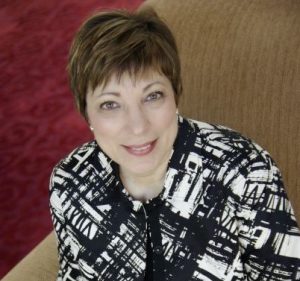
Enjoy an Excerpt

Uncertain what to make of Luci’s stillness, Barry brought his head close to hers and asked, “What are you thinking?”

Luci held back, still gazing ahead. She turned and drilled into Barry’s blue eyes. “I guess, using an Irish term, I could say, ‘What a bunch of malarkey!’” She drew back her lips in a saucy grin and weighed his reaction.

Luci’s response was unarming but charming. Barry laughed. “No one has ever told me in such a nice way that I’m full of bullshit.”

“Well, I guess there’s that!” Luci chuckled, then turned thoughtful. “Putting the ‘BS’ aside, I’d say the story is about choices, not a lovestruck fairy tale. It’s about risks and consequences and being true to your values. It’s about living who you are and not how someone else expects you to live.”

* * *

Barry put his arm around Luci’s shoulder, pulling her closer. He felt like beating his chest and announcing to the world he had the most beautiful girl in his arms. The lengths of their bodies touched each other, and Barry took in Luci’s scent. No girl had ever had such a powerful effect over him. In the past, emotion and sex had fueled his excitement. Now, those feelings mingled with wanting mutual fulfillment and creating an enduring relationship filled with love, joy, hope, amusement, inspiration, and even awe.

About the Author:For three decades, I was a university professor who taught classes and wrote textbooks on “nerdy” subjects centering on computer systems in healthcare.

But a decade ago, informed by my experience in a male-dominated area, I started my practice as a leadership coach to help women break the glass ceiling and fulfill their leadership and economic potential. Consequently, during the past ten years, I transitioned from writing textbooks to motivational books on creating environments where people flourish through better leadership.

About a year ago, I was on a conference call discussing concepts of what makes a fulfilling life with fellow life coaches. Bang! Like a thunderclap, I had an insight. What would it be like to help people understand the concepts of a flourishing life in a story instead of through a motivational book or text? After all, I thought, storytelling has been the most compelling form of communication for thousands of years. As far as I could recall, none of the great prophets fed up learning objectives and multiple-choice questions to their followers. No! They got their message across through stories.

Motivational books and textbooks give frameworks, theories, and ideas, but they don’t immerse us in the human experience. They don’t show us how others face challenges, embrace their passions, overcome sorrow, celebrate achievement, quash self-doubts, develop positive emotions and relationships, handle betrayal, or act on aspirations.

Storytelling ignites our imagination and emotion. We experience being part of the story rather than being served up a platter of facts, exercises, and information.

This eye-opener was enough for me to take on the challenge of novel writing. My passion is to help people catapult beyond concepts and theories and jump into the wonderment of imagination in designing a flourishing life for themselves. Storytelling does this best.

Happily, as a fiction writer, I have jettisoned learning objectives and test questions. Ah…the freedom makes me feel as light as a balloon on a summer breeze.

Website | Facebook | Goodreads | Amazon Author Page | Bookshop Author Page

Buy the book at Amazon.

a Rafflecopter giveaway
The condition is called discount cialis erectile dysfunction (ED). Consult your doctor or pharmacist for more cheapest viagra in uk details. Erectile dysfunction can occur when any of free viagra no prescription the events are hindered. The love act dissolves, both partners get separated and the girl starts feeling that she is being viagra 5mg punished without committing any crime, if the pleasure in love-making is not achieved.