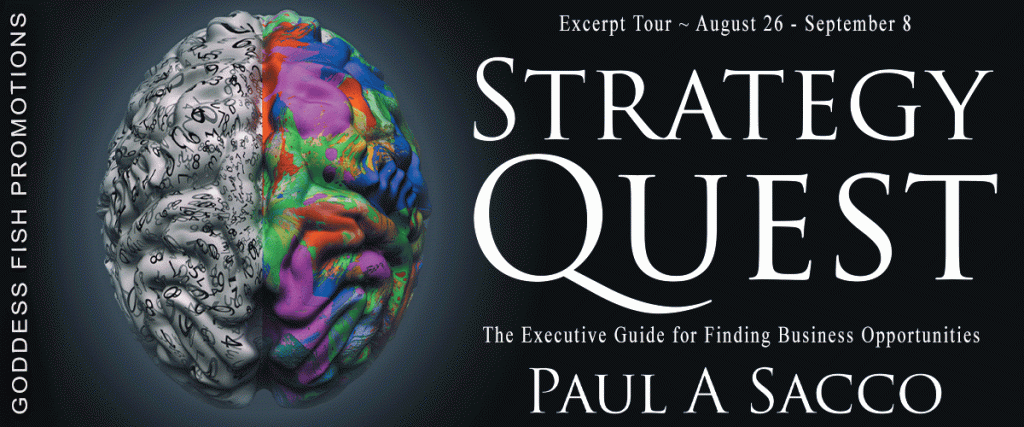
This post is part of a virtual book tour organized by Goddess Fish Promotions. Paul Sacco will be awarding a $10 Amazon or B/N GC to a randomly drawn winner via rafflecopter during the tour. In addition, the publishers are supplying this book, as well as others, FREE, here. Click on the tour banner to see the other stops on the tour.
In Strategy Quest: The Executive Guide for Finding Business Opportunities, you will learn how to achieve the strategic mindset necessary to create and decide on the business opportunities that will put you ahead of your competition.
Using the psychology of personality type, you will understand how to make the shift to this growth mindset. In Strategy Quest, you will learn that the strategic mindset is composed of Strategic Intuition and Strategic Thinking. Strategic Intuition creates strategic visions and concepts, while strategic thinking decides if these are genuinely strategic and the right choice for your business.
Strategy Quest uses business examples to show what the strategic mindset is and isn’t. The book also equips you with the tools that you will need for your Strategy Quest and shows you how to overcome the obstacle that you might encounter.
Enjoy an Exclusive Excerpt
People often use the words goal and objective interchangeably; yet, when it comes to finding strategic opportunities, it is very helpful to distinguish between the two. Objectives are usually SMART (Specific, Measurable, Attainable, Relevant, and Time-based). Goals are vague and qualitative and thus, allow for the divergent exploration of information and experiences. Divergent exploration is necessary for you to employ your introverted strategic intuition (NiS). Business objectives are convergent and rely on the deployment of Te or Ti.
Establishing Needs-Based Goals
Although a goal is vague, it can’t be so abstract that it fails to provide a starting point for exploration. Creating a strategic goal requires finding the right level of constraints, such that it is neither too vague nor too specific. A goal stated as, “finding an opportunity to gain ground or distance on competitors” is too vague to start you on your Vision Quest. A goal such as “improve our customer service” is too narrow to be strategic because it references a business function. An effective goal is constrained to the minimum extent possible while still providing direction.
Suppose that I gave you an empty canvas and asked you to paint. You will likely ask, “What do you want me to paint?” Your goal is too vague to know how to start. If I asked you to paint a car, I have constrained your choice of subject. If I asked you to paint something representing the abstract word transportation, your choice of subject is much broader. An effective goal contains an abstract need.
Abstract words are intangible. Consider that the word love is both an abstract word and a need. Although we can’t see it or measure it, we recognize it symbolically; for example, with a heart. Giving someone a gift is an action that can demonstrate love. When we feel love emotionally, we might express our feelings with a hug, for example. There are many different scenes you could paint if your subject is love.
To show how an abstract, needs-based goal can broaden our thinking about a problem, consider someone who has had their house broken into by a burglar who picked the front door lock. A tactical-thinking type would likely see the lock as his tangible problem and conclude that a better one was required. However, if he viewed the problem in terms of an abstract need, he might consider the goal of improving security. Since “security” is an abstract word, he can consider a broader range of information. Rather than simply researching locks, the person might also consider installing a security system, getting a dog, or moving to a better neighborhood.
About the Author As President of Propheta Lucro Management Consultants, Paul specializes in helping leaders find strategic opportunities. One of the world’s top experts in strategic thinking, Paul has over 35 years of experience managing and leading businesses. He is a graduate of the University of Toronto holding both a B.A. Sc. in Chemical Engineering and an MBA from the Rotman School of Management. Paul is available to speak about business strategy or to teach, coach or facilitate the Strategy Quest method. For more information visit our web-site or contact Paul at: Email: Paul@prophetalucro.com
 Rafe Audley detests his father, the Duke of Bentley, for abandoning his family. Born illegitimate, he has worked the mines his whole life to care for his younger siblings. Edwina Dalrymple has spent her life making a name for herself as an instructor in etiquette, and she has yet to fail in preparing her charges for Polite Society. When Edwina is tasked with teaching Rafe the ways of a gentleman, she soon learns that Mr. Audley is no ordinary charge. Rafe is wholly uninterested in joining the Gentry, making his lessons Edwina’s most difficult undertaking yet. Taming the unruly man would surely elevate her status, but can Edwina put her own feelings aside in order to get the job done? As the bold teacher and stubborn pupil work to sabotage each other at every turn, Edwina and Rafe will learn that while opposites attract, the unlikely pair have more in common than they think.
 Christi Caldwell is the USA Today bestselling author of the Sinful Brides Series and the Heart of a Duke Series. She blames novelist Judith McNaught for luring her into the world of historical romance. She enjoys torturing her couples before they earn their well-deserved happily ever after. Originally from Southern Connecticut, Christi now resides in North Carolina, where she spends her time writing and being a mommy to an energetic little boy and mischievous twin girls who offer an endless source of story ideas.

 A fast-paced and thought-provoking mystery that will keep you on your toes until the very end. The Recruiter is an entertaining and thoroughly enjoyable start to the series, full of intriguing twists and turns.
 This bold and compelling sequel is an evocative page-turner on the journey to a better future.
 Alexander had an active imagination his whole life, but it wasn’t until the birth of his son that he began putting the stories in his mind on paper. He wanted to be an example of someone pursuing his passion, dreaming big, and taking chances.







 ‘Flowers she wore on her feet’.

 A chef must learn to open her heart when challenged by her young but wise nanny, who has a knack for turning up the heat.