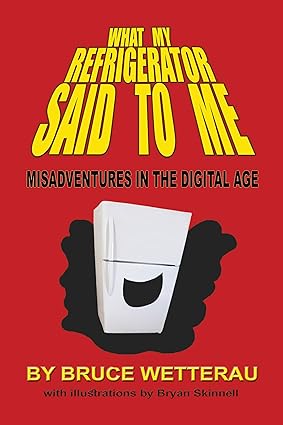
What My Refrigerator Said to Me by Bruce Wetterau


What My Refrigerator Said to Me by Bruce Wetterau
Publisher: Self-published
Genre: Fiction, Humor, Contemporary
Rating: 4 stars
Reviewed by Lavender

To Coldly Go Where No Refrigerator Has Gone Before…

What can a talking refrigerator possibly have to say? Well, if you listen to all the AI hype, you’ll believe computers will be doing all the talking and thinking for us.

What My Refrigerator Said to Me’s twenty-one tales take you on a journey into the comic possibilities of life in the digital age, now and in the years to come. After all, why should the likes of Bill, Jeff, and Elon have all the fun imagining this futuristic stuff!

You’re sure to be amused by this book’s absurdly funny answers to such burning questions as: If computers can think, will they choose a life of crime? If your pet can talk, what will it tell you? Can science turn your brain into a desktop computer? Will there still be fortune cookies in 2052?

As is so often true of comedy, along with the laughs you’ll also find thoughtful insights into the people and devices populating our futuristic, digital world.

You get the idea. These richly imaginative tales will have you boldly going where no one has gone before–again and again! This collection of witty, laughable tales makes for a great read or great gift.

This book presents twenty-one humorous short stories that delve into the comical and occasionally bizarre aspects of our technology-saturated lives. Rather than focusing on dystopian fears, the author uses playful imagination to highlight quirky or disquieting possibilities that come from the technological progress. Readers will sometimes laugh at the absurdities of this digital age.

The premise prepares us for the lighthearted and speculative tone. The author tackles questions of the digital age with comedy. Though humor is central, the stories offer moments of thoughtful insight into humans. Scenes are outlandish but relatable.

Sometimes the tongue-in-cheek humor explores potentially sensitive topics concerning race and gender that may not resonate with all readers. There are cliches. Overall, the book is humorous and creative.

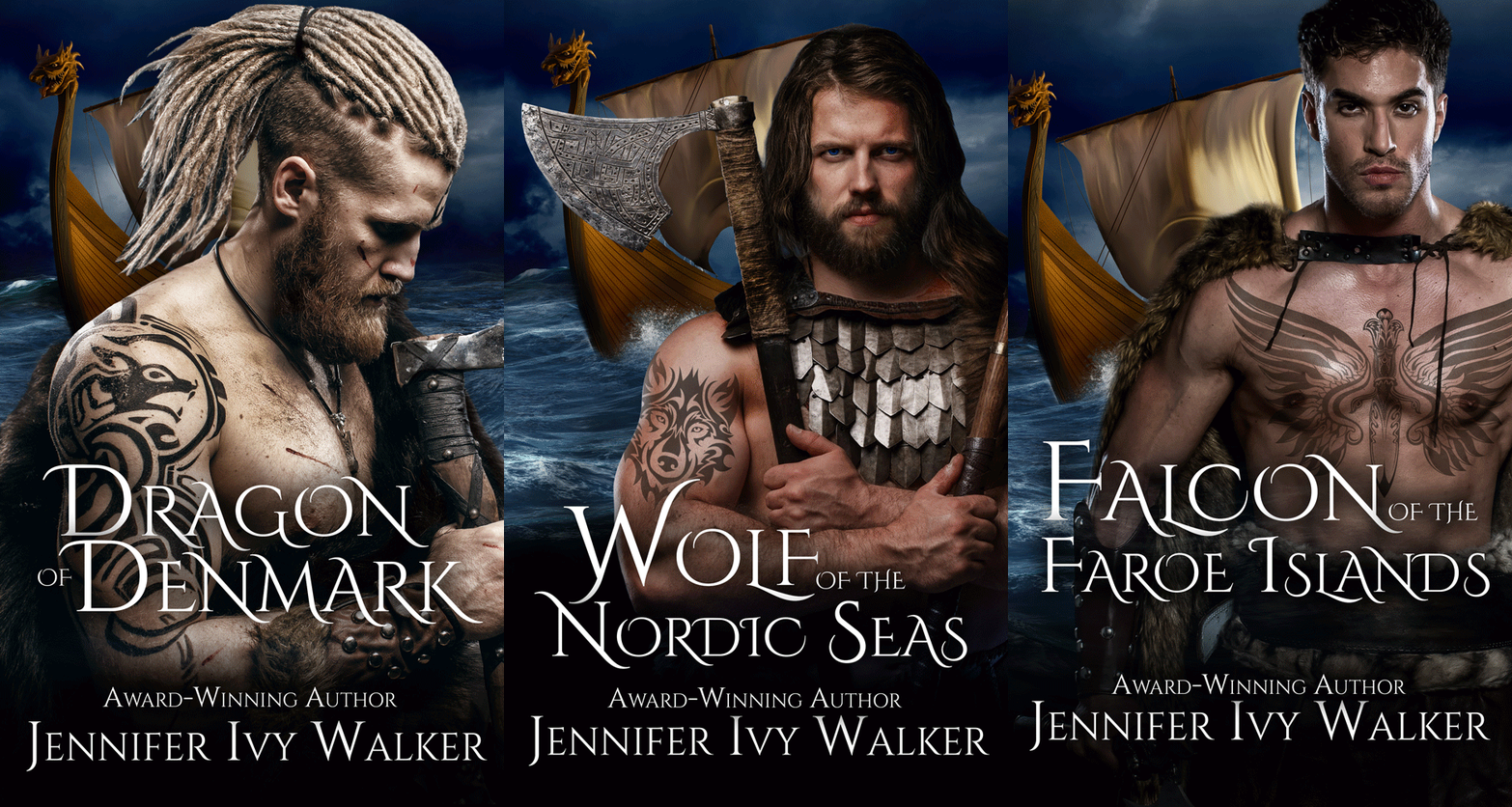
Wolf of the Nordic Sea by Jennifer Ivy Walker


Wolf of the Nordic Sea by Jennifer Ivy Walker
Genre: Historical Fiction, Paranormal Romance
Rated: 4 stars
Review by Rose

Named after the Norse God of the Sea, Njörd grew up sailing, swimming, and fishing the fjords of Norway. Endowed with extraordinary senses, speed, and strength, he became known as Wolf of the Nordic Seas, leading lucrative Viking raids from the Baltic shores to the Black and Caspian Seas. When a Viking völva foretells his future through a seidr vision, Njörd learns that his fate and his mate—the siren with the sea goddess eyes—lie on the alabaster coast of Normandy in the distant Land of the White Chalk Cliffs.

Elfi Thorfinnsdóttir is a skilled shieldmaiden who seeks vengeance against the ruthless Frankish count who killed her brother and abducted her father in an attempt to seize her clifftop castle. But rather that submit to the count’s relentless demand for her hand in marriage, Elfi allies with Richard the Fearless—the Viking Duke of Normandy— and the Danish Jarl of Ribe known as the Wolf of the Nordic Seas.

As Elfi and Njörd discover startling secrets about their respective pasts, they find that the three Norns have entwined the threads of their fates not just as political allies, but as mates destined to fulfill a divine prophecy.

Wolf of the Nordic Seas— book 2 of the Valiant Vikings series set in tenth century Normandy— is a sizzling, scintillating blend of historical fiction, Norse mythology, paranormal fantasy, and steamy Viking romance!

This is the second book of Jennifer Ivy Walker’s Valiant Vikings series but can completely stand on its own. The characters in the first book make an appearance but this is very much Njörd and Elfi’s story.

I really enjoyed the first book (you can see that review here,) but I think I enjoy this one even more! I especially loved the addition of sjóvættir and Úlfhéðnar, akin to the mermaids and werewolves. The similarities and the differences were quite enjoyable.

This book, however, does leave us with a bit of a cliffhanger as Elvi and Njörd’s story does not come to a complete resolution, but don’t let that put you off. The third book of the series should be out soon… and I can’t wait, because it features one of my favorite couples from book one. I’m so excited!!

a Rafflecopter giveaway

Groomed by Jody Paschal


Groomed by Jody Paschal
Publisher: Self-Published
Genre: Contemporary, Historical
Rating: 4 Stars
Reviewed by Astilbe

Groomed is a dark comedy coming-of-age story about Myles “Mylo” Gunn, a middle-aged man turning 50 during the 2020 global pandemic and #MeToo Movement. With nothing but downtime with his thoughts, Mylo reflects on what’s next in this new chapter of his life. Little does he know that watching a news exposé about an older politician grooming a teenager to be her husband is going to give him an unexpected reality check. The exposé sounds awfully similar to how his first marriage went, and Mylo realizes that he was groomed, too. Completely shocked by this new revelation, Mylo takes a deep dive into his past. But his trip down memory lane takes an unexpected detour. Groomed is a humorous, intriguing look at how misperception and manipulation can influence growing into ourselves.

It’s never too late to begin the healing process.

Mylo’s character development was strong and nuanced. One of the things I found most intriguing about him was how his abusive relationship stunted his social and emotional development and how he tried to heal from that terrible experience. He was a fifty-year-old man who still sometimes acted like the seventeen year old he’d been when the grooming began. It is not easy to write a character who has this many layers to his personality, especially since the author allowed so many of those layers to be revealed subtly through the way the protagonist reacted to small irritations in life or reminders of his past. The care and concern that was taken with making sure every aspect of Mylo’s life was represented and that his pain never overshadowed his honest and hardworking personality is something this reader noticed and appreciated quickly. Bravo for making this look so effortless and trusting one’s audience to notice these brief but important moments!

I did find myself wishing that the secondary characters had been given more time to be developed, especially when it came to April. Her reason for targeting Mylo made sense, but I would have loved to see it explored in greater depth. For example, knowing what sort of logic she used to justify the manipulative and cruel way she treated him and other people in her life would have been helpful whether it might have been due to how her personality formed, any past trauma she may have experienced, or something else entirely.

One of the biggest questions I had when I began reading this book involved what the responses of the people closest to Mylo were going to be when they learned he was dating a twenty-five year old woman while he was still in high school. Shouldn’t they have all been alarmed and disgusted? The answers to this question kept me reading as his friends and family members each came to their own conclusions about what was going on and how they should best respond to it. No, I can’t spoil anything by going into detail there, but I thought these passages were equally well written and an intelligent snapshot of what different parts of society thought of such things in the 1980s when society was generally less aware of or sensitive to the ways in which young men can be abused by the women in their lives.

Groomed was a thoughtful take on an important topic.

DEATH: Friend or Enemy?: Views from the Other Side by Ann Merivale


DEATH: Friend or Enemy?: Views from the Other Side by Ann Merivale
Publisher: 6th Books
Genre: Fiction, Paranormal, Contemporary, Historical
Rating: 4 stars
Reviewed by Lavender

Death, as the saying goes, is the great leveler, and though many fear it, while others view it as a blessed release, its inescapability affects us all in some way. The author of this unusual book makes use both of her spiritual reading and of the knowledge she gained from 20-plus years’ experience of taking her Deep Memory Process clients back to deaths in their previous lives, thus giving a broad spectrum of possible post-death scenarios. These she illustrates with a combination of famous and fictional characters, drawn both from accounts that came from the ‘other side’ through her figurative pen and from factual research. Part of the book’s aim is to dispel all fears of death itself and to demonstrate that the notion of eternal damnation is mistaken. At the same time, it shows the reader that whether a lifetime lasts 10 years (as did Annie Darwin’s) or 97 (like Bertrand Russell’s), it has a clear purpose and value. The stories’ precise truth is, however, immaterial, as you will find them enjoyable, educational, and reassuring.

Ann Merivale’s DEATH: Friend or Enemy?: Views from the Other Side offers a fascinating and ultimately comforting exploration of death and the afterlife, viewed through a unique lens. This book offers a captivating blend of anecdotal evidence, historical context, and spiritual insight, all aimed at demystifying our ultimate fate.

Merivale’s 20+ years of experience with Deep Memory Process, guiding clients through purported past life regressions, provides a compelling foundation for the narratives within. The author cleverly weaves together accounts purportedly channeled from the “other side” through her “figurative pen” with factual research and historical figures like Annie Darwin and Bertrand Russell. This combination lends a sense of groundedness to the more ethereal aspects of the book, making it accessible to a wider audience.

The book’s strength lies in its storytelling. The promise of personal and up-close narratives from individuals who have passed is inherently intriguing. While the review acknowledges the “precise truth” of these stories may be immaterial, the reviewer emphasizes their enjoyable, educational, and reassuring nature. This suggests that Merivale has crafted compelling narratives that resonate on an emotional and intellectual level, offering a fresh perspective on the often-feared subject of death.

The inclusion of historical context adds another layer of intrigue, suggesting a blend of personal narratives and broader philosophical exploration.

Overall, DEATH: Friend or Enemy? is a unique read. It caters to those interested in exploring the mysteries of the afterlife, past life regression, and spiritual perspectives on death. While the book’s reliance on channeled accounts might not appeal to everyone, the combination of historical figures, personal stories, and the author’s extensive experience in Deep Memory Process makes it a compelling and potentially comforting exploration of life’s ultimate question. The promise of entertainment, education, and reassurance makes this book one to pick up this year.

Sticks in a Bundle: The Early Years by Pat Spencer


Sticks in a Bundle: The Early Years by Pat Spencer
Publisher: Seaside Writer Imprint
Genre: Historical, Fiction
Rating: 3 Stars
Reviewed by Astilbe

As the middle daughter in a family of Xhosa, Zulu, and Dutch descent, Eshile Mthembu’s life celebrates the strength and resilience of the human spirit. She lives in a Soweto shanty under South Africa’s apartheid rule, a policy designed to squash her dreams and control every aspect of her life. Her story reveals a history of racial injustice many know little about, as experienced by a young woman trying to understand it herself.

Despite cultural, religious, and linguistic differences, Eshile’s family bases their love and strength on the African proverb: Sticks in a bundle are unbreakable. But when a stranger from afar offers an unexpected opportunity, Eshile must decide whether to secure her family bonds or embrace the promise of a better life.

Love is stronger than hate.

One of the tropes I enjoy reading about the most involves exploring the differences between how children and adults understand the same thing. What seems clearcut and sensible to a grownup might be utterly confusing to a kid, and vice versa. Eshile and her sisters had all sorts of questions about adult matters, from why they weren’t supposed to walk in certain neighborhoods to what happened to their Dutch birth father. Their answers to these questions made me smile and made me want to keep reading.

The large cast of characters made it difficult for me to get to know the majority of them well even though this was nearly 300 pages long. There simply wasn’t enough time to dive deeply into most of their personalities, especially given how young Eshile was when most of these events took place. She wasn’t yet old enough to think critically about most of the adults around her, much less wonder why they made more complex decisions in life. As much as I liked the protagonist herself, this made it difficult for me to bond with her large extended family or many neighbors and friends who popped into their lives every so often.

Some of the most memorable scenes for me were the ones that explored how Eshile’s family passed down some Xhosa and Zulu traditions while modernizing or skipping other ones as the 1960s went on. There was so much emotion involved in some of them, and even the easier decisions were still make with caution and care. This evolution is something people from every culture tend to need to do from time to time, and I nodded along as I took note of the similar reactions to change between these characters and members of my own family who have felt all sorts of emotional reactions to how our traditions have remained constant, changed, or simply been modified from one generation to the next.

I struggled with the slow pacing. Even though I appreciated the detailed descriptions of Eshile’s cultural and ethnic backgrounds, pausing so often to explain what certain words meant or why characters expected specific behaviors from each other meant that the plot couldn’t move very quickly in most places. Sometimes this read more like a sketch of a large, complex family than a story that could be divided into a beginning, middle, and end in even the loosest interpretations of how novels are generally paced.

There are all sorts of interesting cultural and social reactions to families whose members come in a range of colors and ethnic identities. While my extended family has never faced the threat of legal trouble or jail time for being multiracial like these characters did, I did relate to how they navigated a world that may be kind to us one day and angry at our very existence the next. Representation matters not only for people who belong to the group being explored but also to readers who have never had to think about such things and may learn something new about what their neighbors, acquaintances, coworkers, and the strangers they pass by on the street quietly deal with. The more empathy we develop for each other, the better.

Sticks in a Bundle: The Early Years was thought provoking.

You Will Be Peter by Jerry Lathan with Steven Manchester


You Will Be Peter by Jerry Lathan with Steven Manchester
Publisher: Forefront Books
Genre: Historical, Inspirational, Fiction
Rating: 5 stars
Reviewed by Lavender

He’s one of the most well-known figures in cultures around the world, etched into stained glass, painted in frescoes, even caricatured as standing at the gates of heaven with a long white beard and keys in hand. But long before he was portrayed as a venerated and untouchable figure, Peter was simply known as Simon, a twenty-something fisherman in a far-flung Jewish province controlled by the Roman Empire.

Loyal and faithful, impetuous and passionate, Simon’s quiet life is upended by the arrival of a man called Jesus of Nazareth, rumored to be the long-awaited Messiah who would rescue the Jewish people from oppression. When Simon meets Jesus, the mysterious man tells him, “You will be Peter,” a prophetic statement that would slowly transform Simon’s life. Eager to be free of the Romans, Simon joins Jesus in hopes that he can guard this leader who will, undoubtedly, build an army to challenge Rome. But as Simon waits for the army to form, he watches Jesus show a compassion for others Simon has never seen before. The miracles Jesus performs—healing the sick, feeding crowds of thousands—show not a display of military might, but of service and love.

Real, relatable and impeccably researched, You Will Be Peter draws on the four Gospel accounts to weave Simon Peter’s story into one seamless tapestry. Readers get a front-row seat to Simon’s three-year walk with Jesus, as Simon watches the Son of Man feed the hungry, raise the dead, upend the status quo and challenge the elite during one of world history’s most pivotal seasons.

In perhaps one of the greatest miracles, we can see ourselves in Simon, this ordinary man Jesus chose to accompany Him. Simon wasn’t well-educated, but he was faithful and headstrong. Though he could rush to judgment and use a foul word from time to time, he was the kind of friend who loved fiercely and was doggedly loyal—until he wasn’t. Although he failed, Simon wasn’t cast away from Jesus’ mission. In fact, his failures and subsequent redemption made him a more empathetic and capable rock upon whom the Church was built.

With storytelling artistry that transports readers to the first-century world, with the sights, sounds, and smells of that time, You Will Be Peter shares an age-old story told from a new set of eyes: it’s possible for one ordinary person, however unlikely, to change the world forever.

In You Will Be Peter, authors Jerry Lathan and Steven Manchester craft a remarkable narrative that revisits the life of one of history’s most iconic figures, Simon Peter. Often depicted in religious art as the esteemed apostle with keys in hand, Peter’s origins as an ordinary fisherman are seldom explored in depth.

This story delves into the transformative journey of Simon Peter as he encounters Jesus of Nazareth, illustrating how an uneducated man’s faith and loyalty can lead to a monumental impact on the world. At the story’s outset, we meet Simon, a young fisherman living under the overbearing rule of the Roman Empire. His life is one of simplicity and routine, until the arrival of Jesus, a man whose reputation as the Messiah incites hope among the Jewish people. The moment Simon meets Jesus, his life is irrevocably altered when he hears the words, “You will be Peter.” In this prophetic declaration lies the promise of transformation—not only of his name but also of his identity and purpose. Here, Lathan and Manchester effectively set the stage for a profound exploration of faith, loyalty, and the potential for change in every individual.

As Simon embarks on his journey with Jesus, he initially envisions a rebellion against their Roman oppressors. The expectation of military might is soon overshadowed by the reality of Jesus’ teachings and actions, which emphasize compassion, service, and love over violence and dominance. Through miraculous acts, such as healing the sick and feeding the hungry, Jesus reveals a different kind of strength—one rooted in humility and selflessness. This evolution of Simon’s understanding is pivotal; it illustrates how personal growth often occurs through witnessing the exemplary qualities of others. The authors adeptly capture Simon’s internal conflict as he grapples with his hopes for a warrior Messiah and the reality of Jesus’ mission. One of the most compelling aspects of You Will Be Peter is its portrayal of Simon as a flawed yet relatable character. He is not depicted as a paragon of virtue but rather as a passionate individual who occasionally falters. His impetuous nature leads him to make hasty judgments, and he experiences moments of failure—most notably when he denies knowing Jesus during the latter’s trial. These human shortcomings resonate with readers, reminding us that imperfection is part of the human experience. However, what truly sets Simon apart is his capacity for redemption.

The story reveals that failure does not equate to disqualification from purpose; rather, it can become a catalyst for growth and deeper empathy. This theme of redemption is integral to the narrative and underscores the belief that everyone, regardless of their past, can contribute meaningfully to the greater good. The authors also excel in their vivid storytelling, transporting readers to the first-century world filled with sensory details—the sights, sounds, and smells of the time. This immersive approach allows readers to experience the historical context that shaped Simon Peter’s journey. It emphasizes the urgency and significance of Jesus’ mission during a pivotal moment in history. By placing Simon at the forefront of this narrative, Lathan and Manchester invite readers to see themselves in this ordinary man—their struggles, their hopes, and their potential for change.

Ultimately, You Will Be Peter serves as a powerful reminder that even the most unlikely individuals can alter the course of history. Simon Peter’s transformation from a humble fisherman to the foundational rock of the Church illustrates that greatness is often born out of everyday experiences, faith, and the willingness to embrace one’s calling, even amidst uncertainty. This narrative not only reexamines the life of a biblical figure but also challenges readers to reflect on their journeys, encouraging them to embrace their imperfections and recognize the potential for greatness within themselves. Through Simon’s story, we learn that the path to making a difference in the world begins with a single step of faith.

Anastasia’s Midnight Song by M. Laszlo


Anastasia’s Midnight Song by M. Laszlo
Publisher: Alkira Publishing
Genre: Fantasy, Historical Fiction
Rated: 4 stars
Review by Rose

St Petersburg, 1917

French Huguenot Anastasia believes working in one of Sinai’s mirror factories will allow her to trap the imaginary Arctic Fox which lives in her womb.

Meanwhile, Jack escapes from London and travels to Sinai to avoid being conscripted to fight in the trenches. His strange imaginings do little to alleviate his feelings of cowardice.

When they meet, Jack is seized with a fierce desire to possess her, and nothing can diminish his obsessive urge to be noticed by her, despite her obvious disgust of his crude advances.

Their journeys twist together like a fugue, filled with fantastical delays, as they both fail to accomplish what they set out to do. On a quest for moral truths and unable to escape the consequences of their false beliefs, they relentlessly approach the acute phase of their schizophrenia.

Anastasia’s Midnight Song is a revelatory, hallucinatory account of the growing insanity of two young people who happen to be in the same place at the same time.

M. Laszlo has penned an epic journey into madness doubled, and the intersection of Anastasia and Jack and their issues leads the reader to join their travel. The book is beautifully written and immerses the reader into a surreal and nearly magical world.

The world created for this book goes beyond the physical setting of early 20th century St. Petersburg and introduces the reader into a world that is dreamlike… into the worlds that Jack and Anastasia reside in as their mental problems grow more pronounced. At times, for the reader, it’s not clear what is reality and what is inside their minds. I feel this is the writer’s intent…to draw us into their own thoughts and feelings. To let us feel and see, just for a short time, what it’s like.

This is a book that, while it was sometimes hard to follow it has also proven to be hard to forget. I am looking forward to rereading it, because I think there are even more depths to discover. Thank you, Mr. Laszlo, for providing a deeply satisfying and, at the same time, a deeply unsettling book.

a Rafflecopter giveaway

The Mortal and Immortal Life of the Girl from Milan by Domenico Starnone


The Mortal and Immortal Life of the Girl from Milan by Domenico Starnone
Publisher: Europa Editions
Genre: Mainstream Fiction
Rating: 4 stars
Reviewed by Lavender

Children can be cruel, and children can love as passionately and obsessively as adults. These two observations combine, igniting the imagination of Italy’s greatest contemporary novelist and producing a seemingly candid novel that belies remarkable psychological depths and infinite degrees of enchantment.

Imagine a child, a daydreamer, one of those boys who is always gazing out windows. His adoring grandmother, busy in the kitchen, keeps an eye on him. The child stares at the building opposite, watching a black-haired girl as she dances recklessly on her balcony. He is in love. And a love like this can push a child to extremes. He can become an explorer or a cabin boy, a cowboy or castaway; he can fight duels to the death, or even master unfamiliar languages. His grandmother has told him about the entrance to the underworld, and he knows the story of Orpheus’s failed rescue mission. He could do better, he thinks; he wouldn’t fail to bring that dark-haired up from the underground if she were dead, and it only he had the chance.

In this short, memorable tale, Domenico Starnone brings readers into the mind of a young boy and his dreams. This child is passionate and creative and is inspired by a girl he sees dancing across the way. He cannot stop thinking about her, and this triggers wild imaginings on his part. Readers see deeply into his psychology, how he is pushed to dream great things.

Themes of friendship and love are intertwined with ponderings of death while the protagonist remembers and analyzes his past and considers his future. His grandparents’ influence contributes greatly to his thinking.

There are surprises along the way. For example, is the “Girl from Milan” who the protagonist thinks she is? Does the girl’s fate truly match what the boy thinks happened to her?

This novel expounds upon themes, sometimes in detail. It is a creative way to express the ideas that are sure to keep readers thinking about them for a long time.

Crossing Day by William A. Glass


Crossing Day by William A. Glass
Publisher: Self Published
Genre: Young Adult, Alternate History, Suspense
Rated: 3 stars
Review by Ginger

It’s been one hundred and sixty years since the Confederacy won its independence at the Battle of Altamaha Crossing. Slaves of African descent still perform most of the work in the South. This seems normal to Ryan Walters and his friends who attend high school in Huntsville, Alabama. Like teens everywhere, they enjoy sharing videos, playing sports, and hanging out with friends. Jaybird’s drive-in is their favorite gathering place. There, they befriend Mish, a slave girl who works as a car hop. When the drive-in’s owner sells Mish to a dirty old man, Ryan and his friends awaken to the injustice around them. Despite the danger, they decide to help Mish escape. Will they succeed?

I was drawn to Crossing Day for its unique perspective on American history. Set in a world where the Confederacy won the Battle of Altamaha Crossing, part of the American Civil War, the novel explores the lasting consequences of slavery and the continued oppression of marginalized groups.

The author skillfully weaves a complex narrative that parallels the horrors of the Nazi regime, highlighting the enduring themes of prejudice, injustice, and the power of human resilience. While the book’s heavy subject matter may not appeal to all readers, it offers a thought-provoking exploration of history and its impact on society. I could not help but make the connection between Isabel Wilkerson’s book titled Caste: The Origins of Our Discontents, and how both books link the system of slavery in America with the Nazis’ use of racist theories to label groups of people as inferior.

Crossing Day is an enjoyable read that I would recommend to teenagers and young adults, and if they like soccer they will probably enjoy the context of the book even more. One of the novel’s strengths is that the author’s vivid imagination creates an engaging plot for younger readers through relatable characters. Though the theme can be seen as heavy and sensitive it resonates deeply and prompts moments of reflection on personal values and had me looking to see what bias I may have. The author offers a reminder of history, its impact on society and various cultures, and the importance of standing against cruel and oppressive laws and actions.

Melanie Montgomery, the mayor’s daughter, never gave much thought about having slaves and how wrong it was. Her friends, who only thought of their time in high school, soccer games, and hanging out at Jaybird’s now have a newfound sense of justice as they embark on their mission to help Mish flee her fate. The teenagers’ journey of selflessness, courage, and activism are inspiring and thought-provoking. However, the frequent shifts in perspective and the overwhelming number of characters can be disorienting at times. Some of the character’s stories end abruptly and feel a little disjointed. This did not give me much time to develop a connection with the characters, nonetheless, I felt empathy for them because of their circumstances.

Since the book is titled after the Battle of Altamaha Crossing, I would have appreciated a more in-depth exploration of its significance. There are a few paragraphs where Bryson Walters explains to his son Ryan why they commemorate Crossing Day, however, I was confused why Bryson would celebrate Crossing Day when he is part of The Resistance group that is against General Van Dorn.

Through the journey of standing up against injustice, some gained insight, adapted, and joined the fight. However, those who choose to control with power and prejudice will see that there is redemption in a just world. Ryan and his friends demonstrate resilience and offer inspiration and examples of selflessness where the world needs it. In summary, Crossing Day is a compelling and thought-provoking novel offering a unique perspective on American history. Its exploration of themes such as prejudice, injustice, and the power of human resilience makes it a valuable book for readers of all ages.

a Rafflecopter giveaway

The Household by Stacey Halls


The Household by Stacey Halls
Publisher: Manilla Press
Genre: Historical
Rating: 3 stars
Reviewed by Fern

In a quiet house in the countryside outside London, the finishing touches are being made to welcome a group of young women. The house and its location are top secret, its residents unknown to one another, but the girls have one thing in they are fallen. Offering refuge for prostitutes, petty thieves and the destitute, Urania Cottage is a second chance at life – but how badly do they want it?

Meanwhile, a few miles away in a Piccadilly mansion, millionairess Angela Burdett-Coutts, one of the benefactors of Urania Cottage, makes a discovery that leaves her her stalker of 10 years has been released from prison . . .

As the women’s worlds collide in ways they could never have expected, they will discover that freedom always comes at a price . . .

In a large house in a small town the young ladies who enter and leave it’s walls are all kept practically secret. Offering a refuge to a select few they are allowed to forget their pasts – as prostitutes or petty thieves or merely destitute. They can learn regular household skills with a strict schedule and a plethora of nice clothing and warm food. Then when they are trained, they can begin a new life in the colonies – should that be their wish. The women’s worlds collide in ways neither them, nor their benefactors could ever have guessed.

I was quite curious about this blurb and this new-to-me author. What I found within was a very unusual but highly enjoyable story. Set solidly in the past, the best way to describe the genre of this book would be straight historical. It’s definitely not a romance or mystery, and really at the heart its historical setting is used to highlight the small group of main characters and the entirety of the plot revolves around these people. I loved finding out how they came to be where they were, how they all came together and how the course of their lives brought them together and drifted them all along their own paths. I found this highly engrossing and particularly during the last quarter or so struggled to put it down.

I particularly liked that most of the main characters were women, but also women of different ages – ranging from I suspect late teens to maybe their forties or fifties – and from all walks of life, poor, rich and working class. I thought the author handled these differences very well, and equally I was impressed how the workings of the plot and set up meant this variety of people all needed to work and interact together and find a way to proceed forward. It was interesting, and I was pleasantly surprised.

While there are a smaller number of men, I found these characters were also well varied and while there’s certainly no explicit romance in this story – and certainly there’s no romanticizing the historical time setting – I do like that there were both good and bad characters and a balance between everything. I feel readers who like historical novels, or readers who enjoy character driven plots and storylines should definitely find this to be a well written book with a different and very fresh type of story. While somewhat gritty – as real life was back in those days – I didn’t feel the author went overboard to turn off the reader with many of the realities back then. Also, none of the darker aspects of those times were used in a titillating manner or in a distasteful way. I really thought the author had done a good amount of research and I believe care has been taken to make the historical context realistic, but not unduly dark.

A well written character driven novel, I found this to be a good historical book with a very different and fresh outlook. I enjoyed it and would be happy to read more by this author.