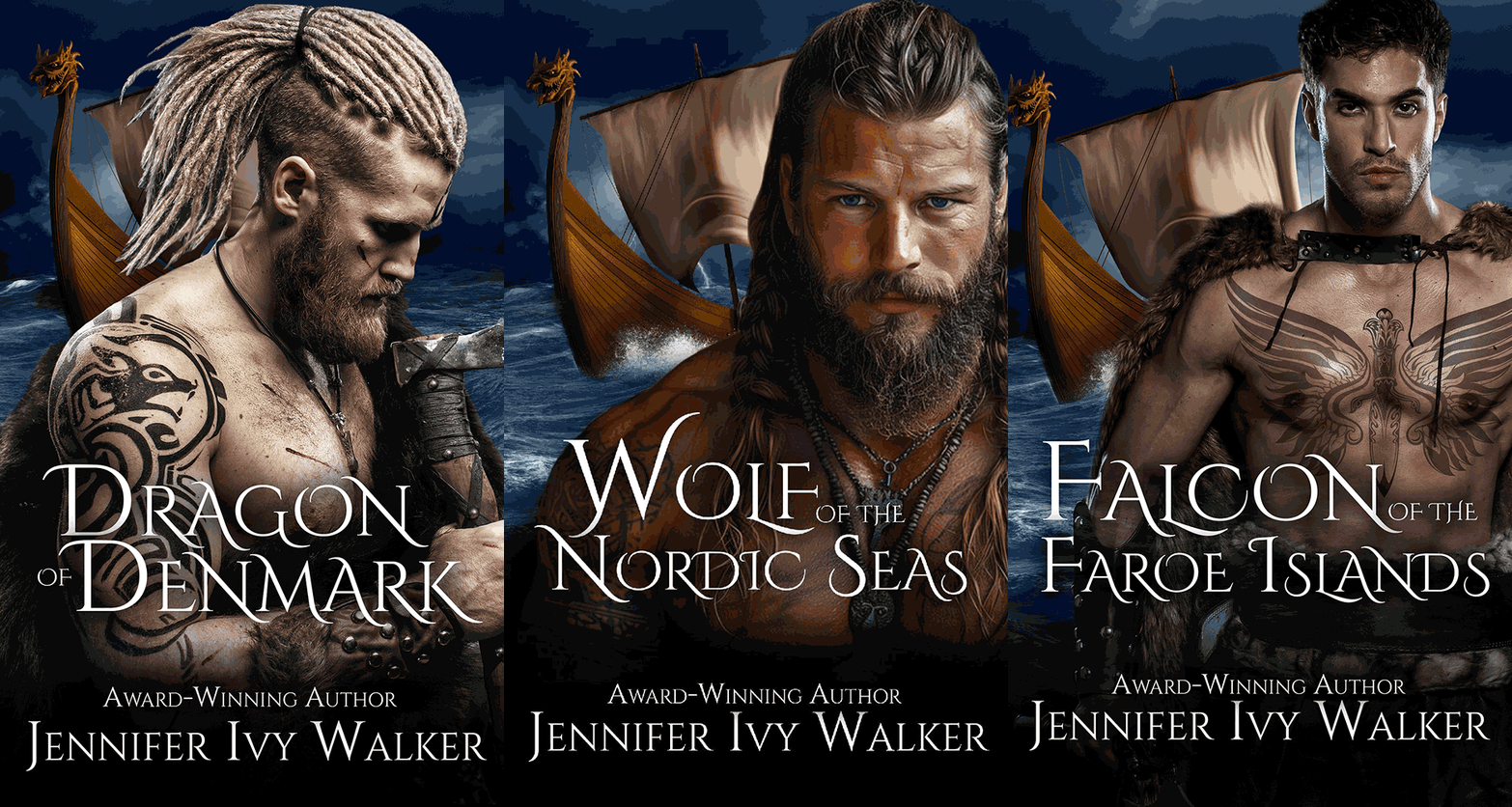
The Fox Creek Plantation Trilogy by M. E. Torrey


The Fox Creek Plantation Trilogy by M. E. Torrey
Fox Creek: Book 1
Publisher: Sly Fox Publishing, LLC
Genre: Historical
Rating: 3 Stars
Reviewed by Ginger

The year is 1843 when six-year-old Monette, the pampered and beloved daughter of a French Creole sugar planter, is taken to New Orleans and sold into slavery. Sold along with her is Cyrus, a boy big for his age, torn from his mother without a chance to say goodbye.

Together they go to Fox Creek Plantation in “English” Louisiana, home to the Jensey family. While Cyrus is sent to the fields, Monette becomes the childhood playmate of Kate, the planter’s daughter, and catches the eye of Breck, the planter’s son. It’s easier and safer for Monette to pretend life is normal. That she belongs. To forget her past, even to forget Cyrus, whom she’d loved. But as the years pass, it becomes clear that children of color do not belong in the world of the white elite—at least, not as equals. The brutality and powerlessness of slavery begin to take their toll upon Monette.

Who is she now? Who will protect her? And who is that big boy from the fields who keeps pestering her?

Fox Creek is a powerful novel set in 1843 Louisiana, during one of the most turbulent times in American history. The story follows six-year-old Monette, a French Creole sugar planter’s daughter, and Cyrus, who is a little older, after they are sold into slavery and sent to Fox Creek Plantation. While Cyrus is sent to the fields, Monette becomes a playmate for the planter’s seven-year-old daughter, Kate, and forms a bond with the planter’s son, Breck.

While the novel’s subject matter is compelling, I found its narrative flow to be challenging at times. The story jumps between multiple perspectives and over several years, making it difficult to identify the central plot and a clear main character. For a book of its length, I felt the plot lacked focus, and I was often left waiting for a significant event to occur. This untraditional narrative style made it hard to connect with the characters on a deeper level, as many were introduced and then given little attention. For example, Cyrus, a significant character at the beginning, is barely mentioned again.

I understand that plantation life wasn’t always exciting, but for the sake of fiction, I was hoping for more. The book was unnecessarily long, with a lot of slow-paced and less interesting details—such as the in-home schooling from Mr. Gilbert, singing and dance lessons, social gatherings that introduced additional characters, and every detail of Sarah’s pregnancies was very slow-paced and not that interesting. What I assumed would be the heart of the story—the bond between Monette and Cyrus—never developed. Instead, the focus shifted to Monette and Breck, and my excitement for a climactic taboo romance was short-lived.

Despite these issues, the book’s greatest strength lies in its ability to show the complexities of life on a plantation from various perspectives. The author provides a glimpse into the bonds between Kate and Monette and the relationship between Breck and Monette. The character of William Jensey, the father, is particularly complex. He is shown to be a “kind master,” yet his actions reveal a more ruthless, less compassionate side. I wanted Monette to have a happy ending, but the author’s uncomfortable portrayal of reality ultimately felt more true to the time period.

Overall, M. E. Torrey’s writing captures the pain and complexity of the era, providing insight into the characters and events. Although the narrative structure could be improved, the book succeeds in exploring the painful legacy of slavery and the difficult truths of that time.

Blood Slaves by Markus Redmond


Blood Slaves by Markus Redmond
Publisher: Dafina
Genre: Historical, Mystery/Suspense/Thriller, Paranormal
Rating: 5 stars
Reviewed by Ginger

What if nobody ever freed the slaves…because they freed themselves – 150 years before the Civil War?

In the Province of Carolina, 1710, freedom seems unattainable for Willie, for his beloved Gertie, and for their unborn child. They live, suffer, and toil under their brutal master, James “Big Jim” Barrow, whose grand plantation was built by the blood, sweat, and tears of the enslaved. To flee this hell on earth is be hunted and killed. Until one strange night Willie is offered a dark hope by Rafazi, an enigmatic slave with an irresistible and blood-chilling path to liberation.

Hailing from the Kingdom of Ghana, Rafazi is the lone survivor of the Ramanga, an African vampire tribe rendered nearly extinct by plague. Rafazi has roamed the world for centuries with an undying desire to replenish the power that once defined his heritage. In Willie, Rafazi has found his first biddable subject to be turned and to help in a hungry revolt. And Willie desires nothing more than to free his people from malicious bondage. Whatever it takes.

One by one, as an army of blood slaves thirsting for revenge is gathered, the headstrong Gertie fears that no good can come from the vampiric legacy that courses through Rafazi’s veins. Willie knows that only evil can fight evil. And when the woman he loves stands between the reemergence of the Ramanga and the justified slaughter of the oppressors, Willie must make an irreversible decision. Only one thing is certain: on the Barrow plantation, and beyond, blood will spill.

Part historical drama, part supernatural horror, and part alternate history, Blood Slaves is an ingenuous and defiant new creation myth of the vampire, one rooted in both justice and the sometimes-violent means necessary to achieve it.

If given the chance to fight for freedom from slavery, what would you be willing to sacrifice to achieve it?

Markus Redmond’s exceptional storytelling seamlessly blends American history with supernatural horror in a deeply satisfying fight for freedom. I kept telling everyone they had to get a copy of this book the moment it released. I am convinced this would be incredible as either a movie or a TV series. It has everything: love, betrayal, plenty of action, and a classic good-versus-evil theme.

Blood Slaves is a tough read at times, but a necessary one. It’s much more than just a book about vampires and slaves; it’s thought-provoking and opens up vital discussions. I appreciated the way Redmond explores the differing opinions among slave owners and the complex arguments among the enslaved. Even though Robert Callowhill, James Barrow’s (Big Jim) house guest, owned slaves, he didn’t share Big Jim’s particularly vicious justifications for slavery. The novel delves into the difficult question of violence versus non-violence, and the multifaceted nature of freedom and its cost. Gertie’s verbal stance, weighing enslavement by white men against enslavement to blood, and questioning if being undead equates to true freedom, is particularly compelling. If you had the opportunity to fight for freedom from slavery, would you do so, and to what extent?

I also appreciated Redmond’s portrayal of Rafazi, who admitted his fear and acknowledged that, while not a natural leader himself, he recognizes and respects Willie/Kwadzo’s leadership. I like Redmond’s inclusion of how the enslaved people honored and shared the land with the Indigenous people. I felt that the violence and revenge in this story were not portrayed as the actions of heartless killers, but of a need to survive and change the narrative of the mistreatment of humans for the color of their skin.

Redmond also raises important points about the significance of identity and heritage, and how profoundly the loss of one’s birth name, as experienced by Willie and the other enslaved, can impact a person.

Redmond successfully built the Barrow Plantation, vividly depicting the plantation, the lives of the slaves, and the characters. I found it interesting how little Big Jim valued his chief overseer, Monroe Washington, almost less than his slaves, and how that dynamic fueled Monroe’s hatred for Willie. Redmond also provides a rich history of the Ramanga Tribe, and through Rafazi, we learn about the nature of their blood and how humans respond to it.

From every angle, the story maintains a compelling and intriguing pace, building towards the action and rebellion. Readers seeking a traditional vampire story may not find this book to their taste. But those who enjoy historical fiction with an alternative blend of supernatural horror will find Blood Slaves full of depth, entertainment, and characters that readers will both love and hate.

This novel receives my highest recommendation for readers willing to engage with challenging themes presented without sugar-coating. Potential readers should be aware that the story is set in 1710 in the province of Carolina. It contains triggers and content warnings, including violence, blood/gore, murder, abuse, sexual abuse, child abuse, racism, hate speech, racial slurs, and systemic racism.

Orion’s Masquerade by M.E. Rose


Orion’s Masquerade by M.E. Rose
Publisher: Self-Published
Genre: Contemporary, Sci-Fi/Fantasy, Romance
Rating: 3 stars
Reviewed by Ginger

Years ago, Chancellor Talia Steele’s husband vanished on an exploratory mission, leaving her to lead their aging generation ship alone. Now, with New Horizon’s life support failing, Talia must attend Orion’s Masquerade—a rare gathering where leaders from across the galaxy forge alliances through marriage. This is her last hope to secure a future for her people and her unborn daughter, who lies in stasis, awaiting a chance at life.

But Ryker Steele survived. He crash-landed on an uncharted planet—one that could be the perfect new home for New Horizon’s colony. After years of survival and rebuilding his ship from scrap, he’s finally on his way back to Talia . . . only to find that she’s left.

With time running out, Ryker must race to reunite with Talia and save their family and people from being scattered across the galaxy. Will love be enough to bring them back together, or will he lose her to Orion’s Masquerade?

M.E. Rose’s Orion’s Masquerade offers a compelling blend of contemporary issues, science fiction elements, and a touch of romance. The story centers around Talia, appointed Chancellor of New Horizon, a strong and committed woman striving for the survival of her people while dealing with heartbreak. Rose creates an intriguing political landscape where people depend heavily on Talia, adding a layer of complexity to her character and motivations. The plot is concise and engaging, quickly capturing my interest in the characters and their world. While I occasionally struggled to discern which character was speaking, the overall narrative flow kept me invested.

Rose clearly possesses a talent for writing science fiction, crafting a world that, despite my limited experience in the genre, was easy to follow and enjoy. The dynamic between Ryker Steele and his wife, Talia was particularly admirable, highlighting the power of love amidst conflict. I enjoyed the clashes between Talia and Vice Chancellor, Jules Strickland, over what was best for New Horizon. I found Jules’s personal biases about why Talia should marry Chancellor Abernath added an interesting dimension to the story. I am curious about the characters’ lives beyond the masquerade and would eagerly read a sequel to see their stories further developed. Despite the minor confusion with dialogue, I would read more from this author.

At the Island’s Edge by C. I. Jerez


At the Island’s Edge by C. I. Jerez
Publisher: Lake Union Publishing
Genre: Contemporary, Fiction
Rating: 4 stars
Reviewed by Ginger

An Iraq War veteran returns to Puerto Rico to reconnect with―and confront―the past in a heart-wrenching novel about duty, motherhood, and the healing power of home.

As a combat medic, Lina LaSalle went to Iraq to save the lives of fellow soldiers. But when her convoy is attacked, she must set aside her identity as a healer and take a life herself.

Although she is honored as a hero when she returns to the US, Lina cannot find her footing. She is stricken with PTSD and unsure of how to support her young son, Teó, a little boy with Tourette’s. As her attempts to self-medicate become harder to hide, Lina realizes she must do the toughest thing yet: ask for help.

She retreats to her parents’ house in Puerto Rico, where Teó thrives under her family’s care. Lina finds kinship, too―with a cousin whose dreams were also shattered by the war and with a handsome and caring veteran who sought refuge on the island and runs a neighborhood bar.

But amid the magic of the island are secrets and years of misunderstandings that could erode the very stability she’s fighting for. Hope lies on the horizon, but can she keep her gaze steady?

Combat medic Sergeant Catalina (Lina) LaSalle-Rivera returns from Iraq a hero but struggles with the moral implications of having taken a life during an attack. Lina moves back to Puerto Rico with her son, Matteo (Teó), who has Tourette’s syndrome, to be with her family. However, hidden family secrets and past misunderstandings threaten to further drive her into a downward spiral, leaving her to question whether she can truly find healing and hope.

The early parts of the novel are engaging and emotional, particularly as Lina navigates the growing tension between her personal turmoil and her family. Lina’s journey is compelling and heart-wrenching, but it seems her life has always been overshadowed by sadness. She has faced pressure from her family, feeling inadequate as a female. She later grappled with feelings of disappointment after becoming pregnant and joining the Army. The family dynamic, which aimed to ensure that Lina had a better life, is understandable; however, after her return, it seems the pressure then turned to her being a good parent. Lina holds in a lot of her emotions, yet her family remains unaware of her struggles. Though I empathize with Lina, I believe she needed counseling long before the incident in Iraq.

**Warning**: For readers struggling with depression or low self-esteem, Lina’s story may be triggering.

I enjoyed the author’s story; the pacing was consistent, and there were a few twists that I did not see coming. I appreciated the cultural history and visual details of Puerto Rico, and I especially liked the inclusion of Spanish phrases throughout the book. Since I can read Spanish better than I can speak it, this was a real treat.

Lina’s story is one that many military and medical professionals can relate to. They take an oath to heal and treat those in medical need, but it can be traumatic for them if they are involved in causing someone to lose their life. Processing that experience can be heavy and difficult.

Lina was very shut off from others, trapped in her own thoughts, which were overwhelming her. Her despair led her to seek escape in alcohol. I was glad to see her courage to recognize that her drinking was problematic and to accept therapy—not only for her own well-being but also for Teo’s sake.

Although I was captivated by the story, it felt like some phrases were repeated several times throughout the book. The supporting characters, especially Tia Lisandra and Papi, often seemed one-dimensional. Tia Lisandra was very vocal and took charge of the family, but I did not fully understand her motivations. I was hoping for more details and closure between Lina and her Tia, as well as between Tia Lisandra and her daughter Dolores. It appeared that Tia Lisandra was alone and bitter, driven by pride rather than love and compassion. Papi had chauvinistic opinions, but there were conversations with Lina that revealed a loving and softer side to him. I was grateful that Lina found support from her niece Dolores and a fellow veteran, Elijah Montgomery, who helped Lina through her healing process.

The shocking revelation regarding the misunderstanding with Leonardo, Teo’s dad, seemed to indicate that the author did not want to portray Leonardo as a villain, but rather this created a family secret. Nevertheless, I was pleased that things were resolved in the end. The resolution and Lina’s redemption brought her back to feeling like a healer, enabling her to serve her country again.

The author wrote from a sensitive perspective, and I appreciated that. At the Island’s Edge is a touching exploration of trauma, healing, and the enduring power of family. Jerez crafts a compelling narrative that resonates with raw emotion, inviting readers to connect with Lina’s struggles and celebrate her resilience. This is a story that will stay with you long after you turn the final page.

The Business Trip by Jessie Garcia


The Business Trip by Jessie Garcia
Publisher: St. Martin’s Publishing Group
Genre: Contemporary, Mystery/Suspense/Thriller
Rating: 5 stars
Reviewed by Ginger

THE BUSINESS TRIP is the gripping, page-turning debut from author Jessie Garcia.

Stephanie and Jasmine have nothing and everything in common. The two women don’t know each other but are on the same plane. Stephanie is on a business trip and Jasmine is fleeing an abusive relationship. After a few days, they text their friends the same exact messages about the same man—the messages becoming stranger and more erratic.

And then the two women vanish. The texts go silent, the red flags go up, and the panic sets in. When Stephanie and Jasmine are each declared missing and in danger, it begs the questions: Who is Trent McCarthy? What did he do to these women— or what did they do to him?

Twist upon twist, layer upon layer, where nothing is as it seems, The Business Trip takes you on a descent into the depths of a mastermind manipulator. But who is playing who?

This is an entertaining read. The narrative unfolds through the perspectives of various characters, instead of one or two main characters, and it adds an intriguing layer of mystery and tension in the whereabouts of Jasmine and Stephanie. I was so drawn into the narrative that I did not concern myself with whether the methods used were believable; the author made them sound plausible, so I just went with the flow without questioning anything. My focus was solely on what was happening in the story.

Jasmine has deep issues, which I found sad, and I felt compassion for her. She had a difficult upbringing and tried to attend beauty school to improve her life. Her abusive relationship with Glenn was leading her nowhere, and I admire her for taking charge and leaving him. I wanted her to have something good in her life; however, as we learn from Jasmine, envy can be deadly. Jasmine’s troubled past and her desperation to have more and better evoke a side of her that can be very costly.

There are themes of jealousy, identity theft, and suspense, along with a host of memorable characters who are genuinely concerned for Jasmine and Stephanie’s well-being. Several times, I found myself frustrated with Stephanie’s assistant news director, Bruce, because he was so naïve, while I cheered for Lucy, who was perceptive enough to realize something was wrong. I enjoyed the relationship between Stephanie and her neighbor, Robert; it felt genuine and had a best-friend vibe. I cannot forget to mention Trent J. McCarthy. His character is so true to life, even if he was a nuisance to be around.

I appreciated how the different points of view came together to maintain suspense, and the second half of the book revealed what had happened. I did not expect the surprising ending which, while a bit far-fetched, was a creative addition from the author that I appreciated.

The novel’s suspenseful pacing and unexpected twists make it a thrilling read. I highly recommend to readers that enjoy suspense, and an intriguing puzzle where the characters lay down their own piece and then later all the pieces start to connect.

And Then You Were Gone by Ivy Logan


And Then You Were Gone by Ivy Logan
Publisher: Notion Press; 1st edition
Genre: Contemporary, Mystery/Suspense/Thriller, Young Adult (14-18)
Rating: 4 stars
Reviewed by Ginger

Nina, a popular fantasy author, maintains a reclusive existence. Aside from Nina’s work, her primary focus is her daughter, Sophie.

Incessant bullying at school and a public, mortifying falling out with another girl sparks a downward spiral in Sophie’s emotional state.

Nina watches helplessly as her daughter appears to be unable to move past this unfortunate event. Nina grows so consumed with Sophie’s suffering that she loses her desire to write. How does one help a teenage daughter in torment?

But then Nina has an idea—an unorthodox method to help her daughter. She is going to write a story—bringing in a special character into Sophie’s life. As the author, Nina can control the outcome of the story. Or can she?

As fiction and reality blur, Nina realizes that things have gotten out of hand. Is her story the blessing she hoped for or a curse she never expected?

“My beautiful girl, now gone – what if it’s forever?”

A unique and creative plot blurs the lines between fiction and reality. The narrative explores themes of bullying, family, and the power of storytelling. The book is primarily told through Sophie’s diary entries, spanning from ages 7 to 16, with her mother Nina providing responses.

Nina is a successful author of the Deadly Lives series. One diary entry that stands out to me is at the age of 10, Sophie asked her mother what would happen if Nina went to live in one of her books and why her mother needed to escape into a different world. As Sophie grows, her diary entries give us insight into her life, which is filled with both joy and the challenges of adolescence. She makes new friends, some of whom are not very nice. Sophie experiences bullying at school, but thankfully, she can express her feelings in her diary. Meanwhile, her mother worries and wants to help her.

The book clearly illustrates that Sophia has always had the love and support of her mother. Nina’s ex-husband, Sophie’s father, was an abusive figure who abandoned them before Sophie was born. As a result, Nina has become a fiercely protective mother, determined to shield Sophie from the bullying she experienced in high school. As a writer, Nina found solace in her words during her struggles with her ex-husband—could writing also help her daughter?

This story is thought-provoking and resonates strongly in today’s world. It beautifully depicts the powerful and emotional bond between mother and daughter, and the impact that adultescent bullying can have on an individual and family. Although this is a short read, it is artfully crafted. The desire to escape reality is something most of us readers think about. It’s pretty much why we read and/or write: to create a temporary world/moment of escape or entertainment from our current reality. For some, the mind is a powerful place; the stories we immerse ourselves in can both harm and protect us. While the book’s ending may leave some readers feeling unsettled, it conveys a hopeful message about the power of imagination and presents an optimistic conclusion that challenges society’s conventional views.

Not What She Seems by Yasmin Angoe


Not What She Seems by Yasmin Angoe
Publisher: Thomas & Mercer
Genre: Contemporary, Mystery/Suspense/Thriller
Rating: 3 Stars
Reviewed by Ginger

After years of self-exile, Jacinda “Jac” Brodie is back in Brook Haven, South Carolina. But the small cliffside town no longer feels like home. Jac hasn’t been there since the beloved chief of police fell to his death—and all the whispers said she was to blame.

That chief was Jac’s father.

Racked with guilt, Jac left town with no plans to return. But when her granddad lands in the hospital, she rushes back to her family, bracing herself to confront the past.

Brook Haven feels different now. Wealthy newcomer Faye Arden has transformed the notorious Moor Manor into a quaint country inn. Jac’s convinced something sinister lurks beneath Faye’s perfect exterior, yet the whole town fawns over their charismatic new benefactor. And when Jac discovers one of her granddad’s prized possessions in Faye’s office, she knows she has to be right.

But as Jac continues to dig, she stumbles upon dangerous truths that hit too close to home. With not only her life but also her family’s safety on the line, Jac discovers that maybe some secrets are better left buried.

Not What She Seems by Yasmin Angoe is a compelling mystery set in a small Southern town. The story follows Jacinda Brodie as she returns home after six years, haunted by a tragic incident involving her father, the police chief. Will the town have a change of heart or will Jac’s return open old wounds?

Told entirely from Jac’s perspective, the novel offers a limited viewpoint that can be both intriguing and frustrating. While the single narrator provides a deep dive into Jac’s thoughts and feelings, it can also limit the reader’s understanding of the broader community and the events surrounding her grandfather’s death.

The story begins with a strong premise, however, the introduction of multiple subplots was distracting, taking away from an already full storyline. Some of these subplots, such as the mysterious two cases her grandfather was working on solving, specifically what happened to the Colleton Girls, feel disconnected and raise more questions than they answer. When the truth came out about what happened to Jac’s dad I was confused she was there, how did she not know what happened? Was there an investigation into what happened to her father?

Jac’s grandfather’s killer is suspected early on, but the suspense of why they were the killer, along with the resolution to the other mysteries, kept me reading. While I appreciated the author’s writing style and her ability to create memorable characters, the storyline was lacking for me. It was long-winded and Jac was not a character that I admired. She seemed immature to be taking on murder cases, accusing people with little to no evidence, and then having a tantrum when the police did not take her seriously.

Despite its shortcomings, the author’s writing style is engaging enough to warrant exploring her future works. While the conclusion may not be entirely satisfying, the novel does provide closure. The book’s title and cover are fitting and effectively capture the theme of the book.

Ultimately, Not What She Seems is a mixed bag. While the central mystery is intriguing, the execution could have been fine-tuned.

Readers who enjoy character-driven mysteries may find this book worth exploring, but those seeking a fast-paced plot may be disappointed.

Crossing Day by William A. Glass


Crossing Day by William A. Glass
Publisher: Self Published
Genre: Young Adult, Alternate History, Suspense
Rated: 3 stars
Review by Ginger

It’s been one hundred and sixty years since the Confederacy won its independence at the Battle of Altamaha Crossing. Slaves of African descent still perform most of the work in the South. This seems normal to Ryan Walters and his friends who attend high school in Huntsville, Alabama. Like teens everywhere, they enjoy sharing videos, playing sports, and hanging out with friends. Jaybird’s drive-in is their favorite gathering place. There, they befriend Mish, a slave girl who works as a car hop. When the drive-in’s owner sells Mish to a dirty old man, Ryan and his friends awaken to the injustice around them. Despite the danger, they decide to help Mish escape. Will they succeed?

I was drawn to Crossing Day for its unique perspective on American history. Set in a world where the Confederacy won the Battle of Altamaha Crossing, part of the American Civil War, the novel explores the lasting consequences of slavery and the continued oppression of marginalized groups.

The author skillfully weaves a complex narrative that parallels the horrors of the Nazi regime, highlighting the enduring themes of prejudice, injustice, and the power of human resilience. While the book’s heavy subject matter may not appeal to all readers, it offers a thought-provoking exploration of history and its impact on society. I could not help but make the connection between Isabel Wilkerson’s book titled Caste: The Origins of Our Discontents, and how both books link the system of slavery in America with the Nazis’ use of racist theories to label groups of people as inferior.

Crossing Day is an enjoyable read that I would recommend to teenagers and young adults, and if they like soccer they will probably enjoy the context of the book even more. One of the novel’s strengths is that the author’s vivid imagination creates an engaging plot for younger readers through relatable characters. Though the theme can be seen as heavy and sensitive it resonates deeply and prompts moments of reflection on personal values and had me looking to see what bias I may have. The author offers a reminder of history, its impact on society and various cultures, and the importance of standing against cruel and oppressive laws and actions.

Melanie Montgomery, the mayor’s daughter, never gave much thought about having slaves and how wrong it was. Her friends, who only thought of their time in high school, soccer games, and hanging out at Jaybird’s now have a newfound sense of justice as they embark on their mission to help Mish flee her fate. The teenagers’ journey of selflessness, courage, and activism are inspiring and thought-provoking. However, the frequent shifts in perspective and the overwhelming number of characters can be disorienting at times. Some of the character’s stories end abruptly and feel a little disjointed. This did not give me much time to develop a connection with the characters, nonetheless, I felt empathy for them because of their circumstances.

Since the book is titled after the Battle of Altamaha Crossing, I would have appreciated a more in-depth exploration of its significance. There are a few paragraphs where Bryson Walters explains to his son Ryan why they commemorate Crossing Day, however, I was confused why Bryson would celebrate Crossing Day when he is part of The Resistance group that is against General Van Dorn.

Through the journey of standing up against injustice, some gained insight, adapted, and joined the fight. However, those who choose to control with power and prejudice will see that there is redemption in a just world. Ryan and his friends demonstrate resilience and offer inspiration and examples of selflessness where the world needs it. In summary, Crossing Day is a compelling and thought-provoking novel offering a unique perspective on American history. Its exploration of themes such as prejudice, injustice, and the power of human resilience makes it a valuable book for readers of all ages.

a Rafflecopter giveaway

American Daughters by Piper Huguley


American Daughters by Piper Huguley
Publisher: William Morrow
Genre: Historical, Fiction
Rating: 3 stars
Reviewed by Ginger

In the vein of America’s First Daughter, Piper Huguley’s historical novel delves into the remarkable friendship of Portia Washington and Alice Roosevelt, the daughters of educator Booker T. Washington and President Teddy Roosevelt.

At the turn of the twentieth century, in a time of great change, two women—separated by societal status and culture but bound by their expected roles as the daughters of famed statesmen—forged a lifelong friendship.

Portia Washington’s father Booker T. Washington was formerly enslaved and spent his life championing the empowerment of Black Americans through his school, known popularly as Tuskegee Institute, as well as his political connections. Dedicated to her father’s values, Portia contributed by teaching and performing spirituals and classical music. But a marriage to a controlling and jealous husband made fulfilling her dreams much more difficult.

When Theodore Roosevelt assumed the presidency, his eldest daughter Alice Roosevelt joined him in the White House. To try to win her father’s approval, she eagerly jumped in to help him succeed, but Alice’s political savvy and nonconformist behavior alienated as well as intrigued his opponents and allies. When she married a congressman, she carved out her own agendas and continued espousing women’s rights and progressive causes.

Brought together in the wake of their fathers’ friendship, these bright and fascinating women helped each other struggle through marriages, pregnancies, and political upheaval, supporting each other throughout their lives.

A provocative historical novel and revealing portrait, Piper Huguley’s American Daughters vividly brings to life two passionate and vital women who nurtured a friendship that transcended politics and race over a century ago.

This is an inspiring story about two women who form an unexpected friendship that transcends their different social statuses, politics, and race. It showcases historical figures that we are familiar with, such as Portia Washington the daughter of the famous educator, Booker T. Washington, and Alice Roosevelt, the President of the United States at the time, Teddy Roosevelt. The journey of these two women is a testament to their resilience and the power of friendship.

I enjoyed reading and learning about the strengths and resilience of the two fascinating women in the book. The author did a fantastic job of crafting a tale that navigated the life and friendship of Portia and Alice. It was interesting to see how their bond exceeded wealth, privilege, race, and cultural background – from their start as “Good Daughters” to their eventual “Liberation” as individuals. As I read, I saw that they were both women of intelligence, determination, and hope. Their differences were obvious but the similarities to me are what drew them together, and the bond formed from there is what forged their relationship that lasted over a century.

The book alternates between the voices of Portia and Alice. I could not help but be drawn to their strong but lady-like characteristics. Their historical significance is one to notice as it shows their influential relevance as they navigated their famous title of American daughters during their roles as wives, mothers, and women facing various relevant life issues that many of which still apply today.

Portia’s husband, Sid Pittman, was a source of trouble that I knew Portia should have avoided. Although I could sympathize with his internal struggle as his father-in-law, Mr. Washington, mentioned to his daughter, Portia about the challenges that men of color in an industry where “Negro men have never gotten to do before.” I am sure that with Booker T. Washington as his father-in-law, Sid was held to a high standard and expectations were set higher than he could achieve. However, it was difficult to understand why he channeled his anger towards damaging the spirit and minds of those who loved him. As for Alice, she is supporting her husband, Nick, during his political career as he is up to become the next Speaker of the House, and a surprise adds more excitement to her unconventional marriage of convenience.

I was glad to read American Daughters, but it did not captivate me as much as I expected. I found some slow spells of dialogue that made the story longer than necessary. Additionally, I did not think ahead of how the book would end, and I felt that all I read about was what the two ladies going through. I wanted more details of the ending that matched the energy of the earlier parts of the book. The book ended leaving me with only the assumption of how their lives would unfold after the last big reveal.

Portia and Alice were remarkable women who encountered many challenges throughout their lives. They always had each other to rely on, which was inspiring to read about. My takeaway from the book is that their beginning not only benefited them and that “motherless children must stick together” but it also changed the narrative for their daughters and their bond is a testament that will live on. This was an interesting story.

Double Lives by Mary Monroe


Double Lives by Mary Monroe
Publisher: Dafina
Genre: Historical, Mystery/Suspense/Thriller
Rating: 5 stars
Reviewed by Ginger

Since childhood, identical twins Leona and Fiona Dunbar have been getting in—and out—of trouble by pretending to be each other. Yet underneath, they couldn’t be more different. Outspoken Leona lives to break rules, have a good time, and scandalize their respectable hometown of Lexington. Fiona is a seemingly-demure churchgoing girl who is the apple of her domineering, widowed mother Mavis’s eye.

But together, the twins have fooled teachers, boyfriends, bosses, racist police—and most importantly, strait-laced Mavis. Even when Leona does jail time for Fiona, their unbreakable bond keeps them fiercely loyal. . . . So when Fiona feels stifled in her passionless marriage, and Leona is heartbroken over losing her one true love, it’s perfect timing to change places once again . . .

Leona is shocked to discover she enjoys the security of being a wife and homebody. And the unexpected spark between her and Fiona’s husband is giving her all kinds of deliciously sexy ideas. Meanwhile, Fiona enjoys being free, single, and reveling in the independence she’s never had. And the more she indulges her secret, long-repressed wild child, the more Leona’s ex-lover becomes one temptation she’s having trouble resisting . . .

As the sisters’ masquerade ignites desires and appetites they never expected, it also puts their most damning secrets on the line. Once the fallout rocks their small town, can Fiona and Leona’s deep sisterhood shield them from total disaster and help them reconcile their mistakes? Or will the trust between them become a weapon that shatters their lives for good?

Identical twins Fiona and Leona find it amusing and convenient to switch identities as it suits them, but could their harmless switching lead to serious trouble?

This 320-page historical fiction is a great example of why Mary Monroe is one of my favorite authors. Her unique writing style and engaging plots are always a guarantee that I will be drawn in for a thrilling read. The author masterfully developed Fiona and Leona’s story throughout, and lastly climaxed in a plot twist that I did not see coming.

Double Lives is a work of historical fiction that spans from 1901 to 1938 in a small, segregated country town in Alabama. Readers are introduced to identical twins Fiona and Leona Dunbar who find it amusing in ‘fooling folks’ by switching their identities. The narrative alternates between Fiona and Leona’s perspectives. The author’s signature style of creating characters that are intriguing and memorable resulting in this entertaining, and original plot. I found myself unable to put the book down, eager to see how the story would unfold.

The bond between the sisters is like no other. I found it disturbing the sacrifices Leona made for Fiona. It was even more unsettling that Fiona allowed her sister to take on a negative image while benefiting from their switching. In my opinion, Fiona was selfish, while Leona was naive and always ended up being the protector or scapegoat. This unfair dynamic between the sisters made me angry. Leona was also naive when it came to her friendship with Bonnie Sue. Bonnie Sue got on my nerves and was very much obsessed with Leona, but Leona could not see it.

Who wouldn’t want to trade places to get out of trouble or to get out of their current circumstances? Mary Monroe has written another captivating five-star book that tells the story of the Dunbar sisters’ masquerade, which ignites into something they may not be able to switch back from. I highly recommend it.