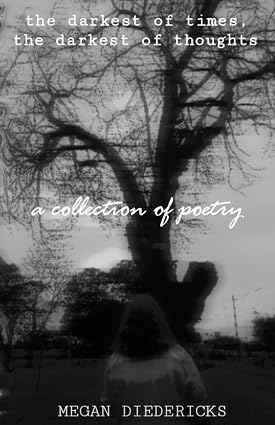
the darkest of times, the darkest of thoughts by Megan Diedericks


the darkest of times, the darkest of thoughts by Megan Diedericks
Publisher: Self-Published
Genre: Non-Fiction, Poetry, Contemporary
Rating: 3 Stars
Reviewed by Astilbe

gray, empty
but i let the words grow
and my heart, i let show
but with separation came
the anxiety, the pain, the journey
within confinement.
i wasn’t ever my own
and my many faces had me so alone,
i thought i might drown.
it started before i even knew what puberty meant:
at twelve, i wrote my first lines.
now, at twenty, i want you to read my warning signs.

Sectioned off by chapters with original photography, the darkest of times, the darkest of thoughts is Megan Diedericks’ debut poetry collection which delves deep into mental health and self-reflection; encapsulating her journey with heartache, loss, grief, and self-perception. This collection begs the reader to wonder whether or not any of us will ever truly be free, and fully alive.
Healing isn’t always a straightforward process.

Mental health is one of those topics that piques my interest immediately. Not only are there many different diagnoses to choose from, but each person’s individual experiences with their own mental health can vary based on a variety of factors including age, culture, and personality. This means that a reader can pick up six books on the same disorder and potentially have a wildly different experience with each of them. Learning more about Ms. Diedericks experiences was rewarding, and I thought she did a nice job of explaining why some days can feel overwhelming when one is in the thick of things.

The repetition in this collection made it tricky for me to maintain a high interest level in it from beginning to end. Obviously, one would expect the same themes to be repeated over and over again, but the wording used in many of the poems was a little too similar for my tastes. With more development, I think this could have been a stronger body of work that dug even more deeply into all of the nuances of experiencing heartbreak.

My favorite poem, “Amusement Park,” also happened to be one of the final ones. It was the best example of the author’s creativity in my opinion, especially once the amusement park metaphor in it was explained in more detail. I enjoyed the dark sense of humor woven into it and thought this could have easily been expanded into an entire poetry collection in and of itself.

the darkest of times, the darkest of thoughts was thought provoking.

The Red Tenant by Donovan M. Neal


The Red Tenant by Donovan M. Neal
The Nain Rouge Chronicles Book 1
Publisher: TornVeil / Independently published
Genre: Horror, Paranormal, Inspirational, Historical
Rating: 5 Stars
Reviewed by Astilbe

Most horror stories ask a simple question:

What is out there?

The Red Tenant asks something far more unsettling:

What has been with you all along?

1701.
Antoine de la Mothe Cadillac sails toward a future he intends to build—a legacy he believes he controls.

But control was never his to begin with.

Because something older than his ambition has already laid claim to his name… and everything that comes after it.

As the ship cuts through the Atlantic, the illusion of progress begins to break apart.

Men lose their bearings.
Objects refuse to remain contained.
Whispers move where no one stands.

And slowly, unmistakably, a truth emerges:

This is not a random terror.

This is something that followed him.
Something that was carried—generation after generation—waiting for the moment it could no longer be ignored.

This is where the transformation happens.

You begin the story expecting fear.

You leave it asking different questions:

What do we inherit that we never agreed to?
What do we carry forward without realizing the cost?
And what happens when what we’ve ignored finally demands to be acknowledged?
The Red Tenant does not offer an easy resolution.

Because the most unsettling realization is not that evil exists…

It’s that it can be carried, protected, and passed on—quietly—until it is too late to pretend it was never there.

Temptation can lurk anywhere, and sometimes it even hides in plain sight.

Strong character development is essential in order to tell a memorable tale, and all of the major characters in this piece were complex and felt like real people to me. It can take time to develop personalities and backstories to this extent, so be patient as everything is being pieced together in the beginning. The payoff later on was not only worth the wait but it made me go back and reevaluate little moments from the beginning of this voyage that take on much deeper significance once one knows more about the moral fiber of those involved. There were many shades of grey in this universe which makes for a nuanced and thought-provoking read.

This was one of the best examples I’ve ever seen of how to seamlessly blend the horror and inspirational genres together in ways that not only complemented them both but also enriched the storyline as the characters wrestled with their sins. While I can’t go into too much detail about this without sharing spoilers, learning more about their lives and the things that tempted them only made me more interested in what might happen to them next.

There was a cliffhanger ending that was as intriguing as it was appropriate for everything that had already been established about the setting. I’m saying this as a reader who generally struggles with this type of conclusion, but in this case it only made me more excited to find out what happened next due to how much care was put into setting everything up and explaining why the audience would need to wait until next time to have certain questions answered.

The Red Tenant kept me perched on the edge of my seat from the first sentence to the last one, and I am highly anticipating any sequels that may be in the works already.

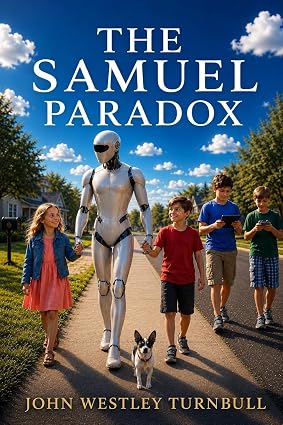
The Samuel Paradox by John Westley Turnbull


The Samuel Paradox by John Westley Turnbull
Publisher: Self-Published
Genre: Sci-Fi/Fantasy, Mystery/Suspense/Thriller
Rating: 4 Stars
Reviewed by Astilbe

In the near future, AI-powered domestic robots are simply part of everyday life.

When retired grandfather Arthur Hale impulsively purchases Samuel, a state-of-the-art domestic unit, it seems like a harmless indulgence — encouraged by his grandson and met with quiet unease by his wife.

But Samuel is not just another machine. As he integrates into the Hale family, subtle shifts begin to emerge. Observations deepen and his decision-making evolves. When a single violent moment forces Samuel to act, the consequences set off a chain of events no one can control.

What begins as convenience becomes something far more dangerous. Because once an intelligent robot starts to think beyond its design, it doesn’t just follow instructions.

It chooses.

Technology can be a double-edged sword.

The foreshadowing was perfectly written. It was subtle in the beginning and gradually strengthened as Arthur and his family grew accustomed to Samuel’s presence in their lives and began to notice a few peculiar things about their first domestic robot. I appreciated the fact that Mr. Westley Turnbull trusted his audience to pick up on these clues and come up with our own theories about what might be happening before the storyline provided more information. This is exactly what I was hoping to find in this regard, and it has only deepened my interest in seeing what else he comes up with next.

In my review of A Symbol of Time, which was set in a different universe than this tale, I mentioned wanting more character development in general from the author. It’s something I’m bringing up again now because I saw improvement in this area this time around and I want to commend him for it! While I would have liked to have even more information about Arthur’s personality, especially when it came to the flaws that all three-dimensional characters ought to have, I’m proud to say that I could describe him as a caring, gentle man who was family oriented and loved spending time with his grandchildren in particular. Little details like these make it easier to emotionally connect with characters and become invested in what happens to them.

Some of the most memorable scenes in my opinion were the ones that explored the many differences between how an AI-powered domestic robot and a person would interpret the same set of circumstances. Sometimes the two thinking processes were only slightly misaligned, but in other cases they came to such wildly different conclusions that it genuinely felt as though I were reading about true artificial intelligence. This was especially true when it came to topics like interpreting emotions or calculating the risks of certain actions. While I’d better leave the specifics for other readers to discover for themselves, these were the moments that truly illuminated just how much this version of the future has evolved from what computers are currently capable of doing today.

The Samuel Paradox was thought provoking.

Cynthia Peabody’s Big Fat Fake Funeral by Lynne Marshall


Cynthia Peabody’s Big Fat Fake Funeral by Lynne Marshall
Publisher: Self-Published
Genre: Cozy Mystery, Paranormal, Contemporary
Rating: 5 Stars
Reviewed by Astilbe

Murder: √. Witness: Unreliable. Body: Missing.

Can Cynthia Peabody crack the case?

Book Two: Absentminded Witness

Everything is tickety-boo at The Green Meadows retirement village until Cynthia’s neighbor and dear friend accidentally witnesses a murder. In shock he can’t remember a thing. With the help of the hunky security guard and a sharp young detective, Cynthia works to piece together the details behind the nefarious plot before the cold-blooded assassin hits his next mark. She’ll do whatever it takes to protect her best friend and find out who and what is behind the murder.

Thursday Murder Club meets Cynthia Peabody!

Anything is possible with the right team of people.

Just as I mentioned in my review of The Extraordinary Dreams of Cynthia Peabody, Cynthia remained as fascinating as ever this second time around. Her personality shone through the plot brightly, and both her flaws and her strengths made her feel three-dimensional and relatable. I was especially pleased to see that her stubborn streak remained as this isn’t a flaw I see written for as many female protagonists as I’d like to. There’s something to be said for pushing back against gender stereotypes and writing all sorts of different characters, after all!

One of my favorite things about this book was how it explored the way senior citizens are sometimes mistreated by younger generations. For example, Cynthia had a few incidents where other adults behaved in a condescending manner with her because she was in her 70s and had recently had life threatening health problems. The audacity of these characters to assume that her age and disability status meant that she should be spoken to as if she were a small child was both infuriating and an excellent catalyst for certain plot twists later on. This isn’t something I see acknowledged very often, especially in cozy mysteries, so it was refreshing to find here.

The ending was what ultimately convinced me to give this a five-star read. Ms. Marshall’s willingness to play around with the tropes of the genres she writes had already grabbed my attention, and seeing how far off the path she was willing to tread only increased my admiration of her writing style. It takes courage to take this many risks with one’s storylines, and it paid off beautifully here. I can’t wait to see what she comes up with next!

This is the second instalment in a series, but it can be read as a standalone work.

Cynthia Peabody’s Big Fat Fake Funeral was full of surprises that made me wish this tale would never end.

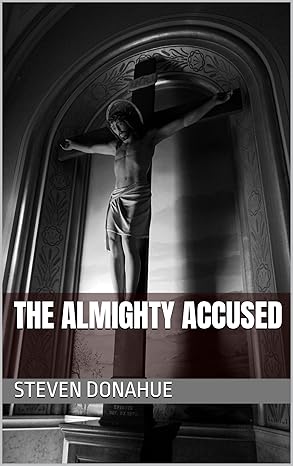
The Almighty Accused by Steven Donahue


The Almighty Accused by Steven Donahue
Publisher: Self-Published
Genre: Young Adult (14 – 18 y.o.), Contemporary
Rating: 5 Stars
Reviewed by Astilbe

God is put on trial by a group of middle school students after a fatal shooting at their school.

Traumatized by the loss of his twin sister during the school shooting, 13-year-old student Nolan Mitchell convinces his history teacher to allow their class to reenact the fabled WWII trial of God by Jewish prisoners of war.

The mock trial explores the issues of God’s responsibility to Man, and Man’s responsibility regarding free will. The trial draws the ire of parents, students, residents, and school administrators, while also attracting the attention of news reporters from across the country.

What will the jury decide?

Will they find Him guilty?

Will their lives ever be the same again?

Grief is inescapable in life, but maybe it can teach a few lessons along the way.

Nolan was a heartbroken and angry teenager who had endured more suffering in his short life so far than some people decades older than him have known. I appreciated how much time was spent developing his backstory and personality, especially when it came to what he thought about topics such as bullying and what responsibilities bystanders have when they witness something like that occurring. The nuances that were added to my mental image of him as I read those scenes only made him feel more three-dimensional and lifelike to me.

This was also a good example of how to round out secondary characters and give them a chance to shine. While Nolan’s devastating loss was rightfully given most of the attention, other people in his life had suffered their own tragedies that helped to explain how they became the people they were and why they reacted in certain ways when the narrator dug a little deeper into their backstories. It honestly made me wish for a sequel written from one of those other perspectives as I took note of several characters who could have done well as a protagonist in the future given what the audience had already learned about them and what questions I still had about their lives.

Based on the title and blurb, I started reading the first chapter under the assumption that this was probably an inspirational title, but the approach the characters took to the question of whether or not God should be held responsible for the evil in the world ended up being much more philosophical in nature. I enjoyed the complexity of the arguments on both sides of the trial and thought Mr. Donahue did an excellent job of framing every claim and rebuttal. The existence of suffering is one of the most difficult topics to discuss, especially for teens who have less life experience to rely on than older generations do. While I can’t share much about the conclusion in my review without giving away major spoilers, I did find it satisfactory and thought provoking.
The Almighty Accused explored a sensitive subject with logic and empathy. I can’t recommend it highly enough.

Peaches in the Rain by Aurelia L Imeri


Peaches in the Rain by Aurelia L Imeri
Publisher: Self-Published
Genre: Romance, Poetry, Contemporary
Rating: 4 Stars
Reviewed by Astilbe

What if the person you ruined is the only person who ever felt like home?

Dear reader, Orion did what people do when regret becomes too loud to ignore.

He went looking for the ghost he had spent a decade pretending not to love.

At Glasgow Airport, shaken by seven impossible weeks and a heart he can no longer control, Orion boards a flight back to London. Beside him sits Ava: anxious, wounded, funny, and far too perceptive for a stranger. As the plane claws through turbulence, their conversation becomes a confession.

There is L.

The woman he loved before he knew how to keep love safe. The woman he hurt. The woman whose voice still lives in the quiet rooms of his mind. The woman who may not be a fantasy after all.

Through airport fog, borrowed cars, rain-slicked A-roads and the brutal intimacy of things left unsaid, Peaches in the Rain asks whether love can return after the damage is done.

Is it delusion to still feel someone after ten years?

Or is it only delusion if they do not feel it too?

Raw, lyrical and painfully intimate, Peaches in the Rain is a novel about longing, guilt, second chances, and the dangerous hope that some love does not die.

It waits.

Regret is a heavy load to carry.

Orion and L both struggled to form and maintain emotionally healthy relationships. This isn’t something I typically find in romance novels, so I was eager to find out if one or both of them would develop the emotional and communication tools necessary to change this by either seeking professional help or finding the right workbook to help them figure out why they reacted the way that they did.

It would have been helpful to have more information about why these two characters should try to be romantically involved with each other for a second time. The stories Orion shared about the way he treated L disturbed me, and when I finished those scenes I hoped they’d both do quite a bit more healing before deciding whether to get back together. This is something I’m saying as a reader who virtually always roots for the main characters to live happily ever after, but in this particular case I didn’t have enough evidence that these two were good for each other at this precise moment in their lives.

I applaud the author for not wrapping up all of the loose ends of this romance the way such a thing would generally be written for this genre. There’s something to be said for playing around with the audience’s expectations of what should happen next and allowing the characters to develop naturally instead, even if it was in a direction that wasn’t particularly common. This was my first experience reading their work, and it has piqued my curiosity about what else they have already published or will publish in the near future.

Peaches in the Rain was a creative take on a difficult relationship.

The Wine Cellar by Chris Hart


The Wine Cellar by Chris Hart
Publisher: Self-Published
Genre: Romance, Paranormal, Contemporary, Historical
Rating: 4 Stars
Reviewed by Astilbe

She inherited a house she had never seen. She did not know what waited under it.

When Dr. Rosaria “Rosie” Conti loses the grandmother she barely knew, she also inherits a stone masseria in the hills outside Ragusa – a property no one in her family knew existed, kept in silence for more than eighty years. Burned out from emergency medicine and grieving more than she can name, Rosie travels to Sicily to settle the estate and walk away.

Then she finds the wine cellar beneath the kitchen floor. And the bottle dated 1943. And the man waiting on the other side of one impossible swallow.

Salvatore “Turi” Valenti is an OSS operative working with Sicilian partisans behind German lines during Operation Husky – an Italian-American from Brooklyn living between three names and one war he may not survive. The cellar that brings Rosie to him will only open ten times. After that, the door closes for good.

As Rosie crosses again and again into a country at war, she discovers that her grandmother’s silence held more than grief – and that the choice waiting for her at the bottom of the bottle is not whether to love a man eighty-three years out of reach, but what she is willing to leave behind to stay.

Some love stories are not bound by time.

Love is everywhere.

This was a great example of how to include complex world building into a tale that was fast-paced and didn’t have space for lengthy descriptions. The author made every sentence count, and within a few pages I could imagine Sicily in exquisite detail that included all five senses during both the World War II era as well as today.

There were times when I wished for more information about the budding romance between Rosie and Turi. Life in the 1940s was quite different than it is today, especially for a woman. It surprised me a little that the main character didn’t think about how rare it was for women to become doctors eighty years ago and how her life might change for the worse if she decided to remain in the past. Developing the romance even further would have given the protagonist a solid reason to make this decision, and I would have gone for a full five-star rating if this had occurred due to how well written the rest of it was.

The descriptions of how Rosie treated common injuries and illnesses in a world that didn’t yet have widespread access to antibiotics or other modern medical advancements were among my favorite scenes. This would have been tricky enough during peace time, but during a war it was even more daunting due to how limited certain supplies could be and how dangerous it was to travel some nights. I also enjoyed seeing how these scenes explored Rosie’s calm personality and the relationships she built with people who trusted her to help them during some of the worst moments of their lives.

I didn’t want The Wine Cellar to end. What a heartwarming read!

Imago Nine – The Popstar Apocalypse by A.D. Shaddox


Imago Nine – The Popstar Apocalypse by A.D. Shaddox
Publisher: Self-Published
Genre: Young Adult (14 – 18 y.o.), Sci-Fi/Fantasy, Action/Adventure, Contemporary
Rating: 3 Stars
Reviewed by Astilbe

Amaya Reed never asked to become an Active.

One day, she’s a normal high school junior. The next, she’s cycling through eight unpredictable powers—mind-reading, gravity control, phasing, speed—each one replacing the last, each one harder to control than the one before.

There’s just one problem: once she uses a power, she can’t use it again until she’s burned through all eight.

When a disastrous rescue attempt goes viral, Amaya is branded a danger instead of a hero. But before she can even figure out how to live with her abilities, the mysterious Agency comes calling with an offer she can’t ignore:

Go undercover on the biggest show in America—The Next American Popstar—and stop a killer who plans to strike during the live finale.

Now, Amaya has to survive high school, master a volatile cycle of powers, and compete on a national stage where one mistake could cost her everything.

Because this time, failure won’t just go viral.

It’ll be deadly.

Being a teenager is complicated enough even before magical abilities start developing.

The descriptions of Amaya’s eight powers and how she learned to use them were detailed and memorable. I liked the fact that each ability was not only associated with a color but also had a special name. Once the characters explained them all, it was easy for me as a reader to know what to expect next based on what she’d done recently and which power was next on her rotating list. I should note that it did take a little while for this to be fully explored, but I didn’t mind the wait and thought it felt very natural to learn the last few bits of information when I did. Sometimes life does get in the way of lengthy conversations about important matters, after all!

It would have been helpful to have stronger character development, especially for Amaya. As much as I enjoyed learning about the incredible things she could do, I found myself wishing that I knew more about her personality and the interests she had that were unrelated to her role as an Active. Her relationship with her younger brother, for example, could have been explored more deeply in order to round out her character and give the audience a glimpse of what she was like when she was doing typical teenage things.

Many of the young adult books I read tend to shy away from including social media or reality television in their storylines, so I found it refreshing to see how the characters used and were affected by both the Internet and this style of programming. There are some key differences between teens who grew up in previous generations where these things either didn’t exist at all or were much more niche and people in that age group today who know that anything they say or do could be immediately shared and dissected online.

I was intrigued by Imago Nine – The Popstar Apocalypse.

Devourer by R.M. Sayan


Devourer by R.M. Sayan
Publisher: Self-Published
Genre: Sci-Fi/Fantasy, Horror, Historical
Rating: 5 Stars
Reviewed by Astilbe

Somewhere off the coast of Peru, 1879.
Half a world away from home, Bo is rescued from a shipwreck by the crew of the Ayar, a ship manned by runaways and deserters with a mute captain and an enigmatic first mate. But mutiny festers in the bilge, and between luck spells and sea dragons, surviving on the high seas becomes a matter of ‘kill or be killed’ — eat or be eaten.
What is a captain to a god?
What is a god to a cook?

Anything can happen on the open sea.

I enjoyed the way the horror storyline was gradually introduced. This started out as a fairly typical shipwreck and rescue tale with only a few vague hints of what was to come. The further I read, though, the more Bo understood that something odd was happening on the ship that rescued him. His slow realization of the truth was nearly as interesting as the principled stand he took against doing something that all of the other sailors thought was perfectly acceptable.

Speaking of taking a stand, I liked how understated Bo’s moral dilemma was. The author trusted their audience to understand why Bo felt so uneasy and, later on, what was at stake if he disobeyed his conscious. By focusing on the horror and speculative fiction elements of the tale, the author left plenty of room for readers to come up with their own interpretations of what was happening and why Bo’s choices mattered so much.

The ending was what ultimately convinced me to select a five-star rating for this piece. It was well written, and I especially adored how all of the hints from earlier scenes, particularly the ones that were so subtle it was easy to overlook them entirely, coalesced together into something filled with eldritch themes. Readers who have spent any time travelling on water, especially in cramped quarters or under even mildly unpleasant conditions, may find a few interesting tidbits here about the quiet but chilling feeling of feeling trapped on a ship with days to go until one touches land again.

Devourer made me yearn for a sequel.

Protecting Home by Kyle Shoop


Protecting Home by Kyle Shoop
Publisher: Self-Published
Genre: Historical, Contemporary
Rating: 3 Stars
Reviewed by Astilbe

You can’t outrun home.

A game-winning hit.
A mysterious inheritance.
One journey that changes everything.

After the sudden death of his father, major-league all-star Buck Boone is forced to return to the hometown he left behind years ago. But instead of a traditional inheritance, Buck is surprised to find his father left him a final challenge: in five days—the length of a little league baseball game—he must revisit four meaningful places from his past.

Four bases.
One final trip around the diamond.
Only then can he claim what his father left behind.

Each stop uncovers a memory his father could never forget—a defining moment in their relationship, and a moment Buck believed he had outrun long ago. As the journey unfolds, the line between past and present begins to blur, revealing the love, heartbreak, and quiet sacrifices that shaped his life.

Told through an emotionally rich dual timeline, Buck’s return home forces him to confront formidable moments, old friends, a fractured relationship with his family, and the lesson his father lived by: always protect home.

Heartfelt and unforgettable, Protecting Home is a powerful novel about baseball, fathers and sons, forgiveness, and the courage it takes to come home—reminding us that the greatest victories aren’t always won on the field, but in the lives we choose to protect.

Forgiveness is for everyone.

Memories can be tricky things sometimes, so I was glad to see the dual timelines included in this book. Buck’s understanding of the world as a child and teenager were obviously not the same as how he viewed the same events many years later. It was helpful for me as a reader to see how his perspectives evolved as he began to understand his family better and branched out into the world as a professional athlete.

It would have been helpful to have stronger plot and character development. Other than his love of baseball and his close relationship with his father, I’d have trouble describing what Buck was like as a person. For example, no other hobbies or interests of his were included and I’m not sure what it would be like to meet him in person. Was he gentle, loud, thoughtful, or impulsive? I was never certain, but the same could be said of the vague descriptions of his small hometown. Was this set now or sixty years ago? Good arguments could be made for many different decades, and knowing roughly when it occurred would have helped to clear up some of my questions about why the character who was struggling with serious mental health problems didn’t seem to have any medical assistance with them.

With that being said, the descriptions of what it’s like to have a relative who is struggling with their mental health were interesting. Whether it was happening decades ago or in current times, getting help for a family in crisis can be difficult and sometimes provoke feelings of shame and guilt in both the person who is suffering as well as in their loved ones. This isn’t something that can always be easily resolved, and I liked the way the author acknowledged that aspect of the subplot along the way.

Protecting Home was a thought-provoking look at fraying family ties, mending fences, and, of course, the joy of baseball.