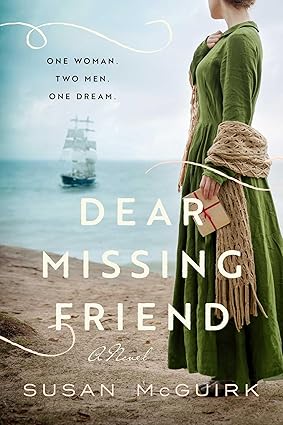
Dear Missing Friend by Susan McGuirk
Publisher: Sea Crow Press
Genre: Romance, Historical
Rating: 3 Stars
Reviewed by AstilbeThree hearts. Countless letters. One impossible choice.
Through letters exchanged across oceans and Manhattan streets, Irish immigrant Catherine McGuirk navigates love, ambition, and heartbreak. Torn between her seafaring husband, the suitor she once refused, and her own dreams, Catherine’s fate unfolds in an intimate, epistolary saga of passion, resilience, and 19th-century life.

Not all choices are equal ones.
Being an immigrant requires courage and the hope that that things will improve. Some of the most memorable passages were the ones that described the prejudice Irish people faced when they came to the United States in the 1800s as well as how Catherine and her loved ones pushed through their struggles to find housing, employment, and a sense of community in cities and towns that were anything but accepting of them. These sections were written tenderly and with so much sympathy for all of the hard times this family experienced as a result of their social class and ethnicity.
I struggled with the slow pacing of this novel, especially in the beginning as the characters were being introduced. Since not everyone’s relationship to the protagonist was explained immediately, this only made those passages trickier to get through. This is something I’m saying as a reader who enjoyed the plot in general and was hoping to choose a much higher rating for it. I simply needed things to unfold a little faster and with a bit more attention paid to how everyone knew each other.
The realistic and bittersweet ending fit the characters and the era they lived in perfectly. While this was a work of fiction, it was loosely inspired by the life of author’s great-aunt. There was a section at the end that shared some of the research Ms. McGuirk did about her family tree in the 1800s and this relative in particular. I love it when historical fiction authors use real life as inspiration for their work, and despite my struggles with the pacing I thought this was a good example of how to use a few historical records to imagine what might have happened generations ago that was never written down. Life was incredibly difficult back then for the vast majority of people, and I liked the fact that this was acknowledged as Catherine lived out her days.
Dear Missing Friend was thoughtful.