This post is part of a virtual book tour organized by Goddess Fish Promotions. A randomly drawn winner will be awarded a $25 Amazon/BN gift card. Click on the tour banner to see the other stops on the tour.
The siege of Rome in 508 BC by the Etruscan King of Clusium, Lars Porsenna, sought, according to Roman tradition, to restore the monarchy of Tarquinius Superbus, the last Roman king, whom the Romans had deposed the year before. Porsenna drew a blockade around Rome that slowly starved the city. Repeated attempts by the Romans to break the siege failed.
The Senate despaired that the city might have to be surrendered to Porsenna, handing Tarquinius back his crown and strangling the infant Roman Republic in its crib. With the city about to collapse, a young noble named Gaius Mucius came forward. He found it intolerable that Rome might lose the liberty it had just won the year before. Mucius proposed an act of assassination—that he would commit—as the only way to save the city from a return to the tyranny of kings that Rome had endured for over two centuries.
With little to lose, the desperate Romans agreed to his outlandish plan. Disguised as an Etruscan soldier, he entered the enemy’s camp with most of the army gathered before Porsenna to be paid. Mucius encountered two men sitting on a raised platform in the heart of the encampment, each wearing a purple robe, soldiers clustered around them. One was Porsenna and the other his clerk, but Mucius had no way of knowing which one was king. Unwilling to reveal himself by asking, he chose the one whom soldiers seemed to be thanking and plunged his dagger into the man’s chest.
Unfortunately for Mucius and Rome, the man he killed was not Porsenna. Guards quickly subdued Mucius and hauled him before the king. Mucius remained defiant. “I am Gaius Mucius, a Roman citizen. I came here to kill my enemy, and I am as ready to die as I was to kill.”
Porsenna threatened to burn him alive unless he disclosed the details of the Roman plot. Mucius turned to a large brazier filled with glowing coals and thrust his right hand into the flames, without flinching or making a sound. He held his hand in the fire, staring all the while at Porsenna, as though he were insensible to the pain.
He told the king that he was one of three hundred Romans who had sworn to murder him. The others would be coming forthwith. The shaken Porsenna, in awe of the courage and endurance of pain he had witnessed, ordered Mucius released. He made peace with Rome and withdrew his troops, having no desire to test his fortune another two hundred and ninety-nine times.
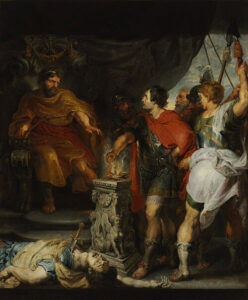 The painting from the workshop of Peter Paul Rubens, possibly finished by Anthony van Dyck, shows Mucius before Porsenna on his throne, his clenched fist in the fire. His dagger can be seen in the chest of the murdered clerk. Because his right hand was permanently damaged by the fire, he was given the nickname Scaevola—the Left-Handed. He was also given a piece of land by the Senate, known for centuries as the Mucian Meadows, a physical reminder of Roman resolve.
The legend of Gaius Mucius Scaevola is one of the most enduring foundational myths of the Roman Republic, epitomizing Roman virtus (bravery) and pietas (duty). Mucius thrust his hand into the fire not merely to show bravery, but to demonstrate how great endurance can be when it serves a just cause.
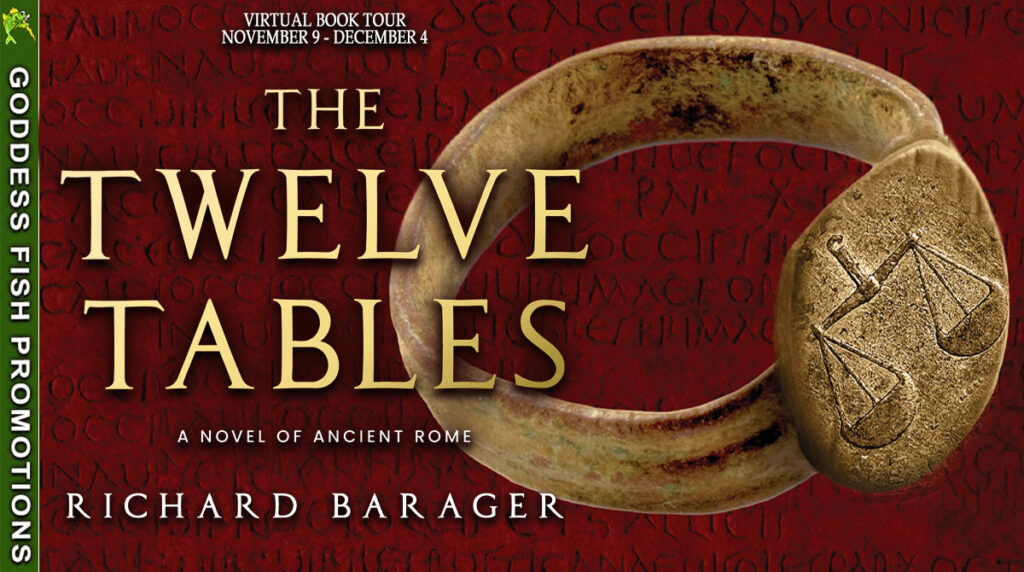
That fierce attachment to liberty forms part of the world of my historical novel The Twelve Tables, which begins in 462 BC, less than half a century after Mucius supposedly placed his hand in Porsenna’s fire. By then, Romans had created a rich collection of stories about men willing to sacrifice almost anything to preserve their Republic. Yet Rome faced another question: what did liberty mean within the Republic itself? For plebeians burdened by debt and subject to laws they could neither see nor readily know, freedom from kings did not necessarily mean freedom from arbitrary power.
The struggle to answer that question would eventually lead to Rome’s first written law code, the Twelve Tables, the cornerstone of Western legal tradition and a foundational text of Western civilization.
Modern historians believe, as did Roman historians such as Tacitus, that Porsenna may actually have captured Rome. The story of Mucius, they argue, may have developed for much the same reason as the legend of Horatius—to transform the memory of a Roman defeat into a story of Roman courage. But whatever its historical origins, over time it served to transmit Roman values and highlight the importance of liberty to the early Republic.
Prometheus gave fire to man and was punished by Zeus for generations, until Hercules freed him. Mucius gave his hand to the fire and is lauded for it still.
“The blood of the bulls on Jupiter’s hill gave them liberty—the words graven unto these Twelve Tables made them equal.”
ROME, 462 BC. To save his family’s failing farm, sixteen-year-old Marcus Atilius is sold into debt servitude by his own father. Plunged into the city’s underbelly, Marcus must endure a world of cutthroat trading stalls and gritty warehouses, all while navigating a forbidden entanglement with a woman far above his station. Survival demands sharp guile and moral compromise.
As a bitter class struggle pushes Rome toward the brink of civil war, Marcus vows to beat the elites at their own ruthless game to win his freedom and a fortune worthy of the woman he loves.
Yet his rise brings a fateful choice. A historic demand sweeps the city for the Twelve Tables—a revolutionary legal code to protect plebeians from patrician tyranny. With a corrupt aristocrat holding the tether to his trading empire, will Marcus protect his hard-won power, or risk everything for the soul of Rome?
Enjoy an Excerpt
The fire crackled. His father’s eyes roved over their faces. “He said I was too weak for bondage. That I was the reason for the debt.”
Quintus rose in protest. Fausta began to weep, and Lucia went to her, wrapping her arms around her.
“Is it so, Marcus?” Servius whispered. “Has father slowed that much?”
Marcus feigned doubt that Mettius had, but only out of respect. The weight loss, the gray in his beard—his father had aged. Strong as a bull one year, enfeebled the next.
Mettius drew a breath and went on. “He threatened to seize our land. Make vagrants of us. Beggars.”
If they lost their land, Marcus knew, they would live in crowded squalor in Rome, desperate for work. And why? Because it had always been that way. There was one set of laws for the privileged, another for everyone else.
His father stared over their heads at the wall. “I asked for another way. He wanted Quintus.” Mettius lowered his gaze. “I did not allow it. If I were to die with Quintus in bondage, the family would have no paterfamilias. The risk was too great.” His father’s voice had gone cold.
Quintus turned around. Marcus nodded to show he agreed. Better to lose their land than a son. It would be a hardship, but the family would stay together this way.
Marcus looked at his father. Their eyes met.
“I sold Marcus into mancipium with Gaius Licinius. A term of three years. He comes tomorrow to take him to Rome.”
About the Author:  Richard Barager is the author of The Atheist and the Parrotfish and Altamont Augie, the latter a winner of the Silver Medal in Foreword Reviews 2011 Book of the Year Awards (Historical Fiction); a Gold Medal in the 2011 eLit Book Awards (Literary Fiction); and a Silver Medal in the Independent Publisher 2012 Regional Book Awards. The Wall Street Journal reviewed Altamont Augie in its Five Best column: “No other novel so crystallizes the themes, flavors and attitudes of an era [the 1960s].” The Atheist and the Parrotfish was featured on Book Talk Radio, with Kory French. Richard completed undergraduate studies and medical school at the University of Minnesota and was a nephrologist in private practice for many years. Long devoted to medicine and fiction, he now writes full time (and no longer at night!). He believes fiction explores meaning in ways science cannot. Sometimes only fiction can discover truth.
Buy the book at Amazon.