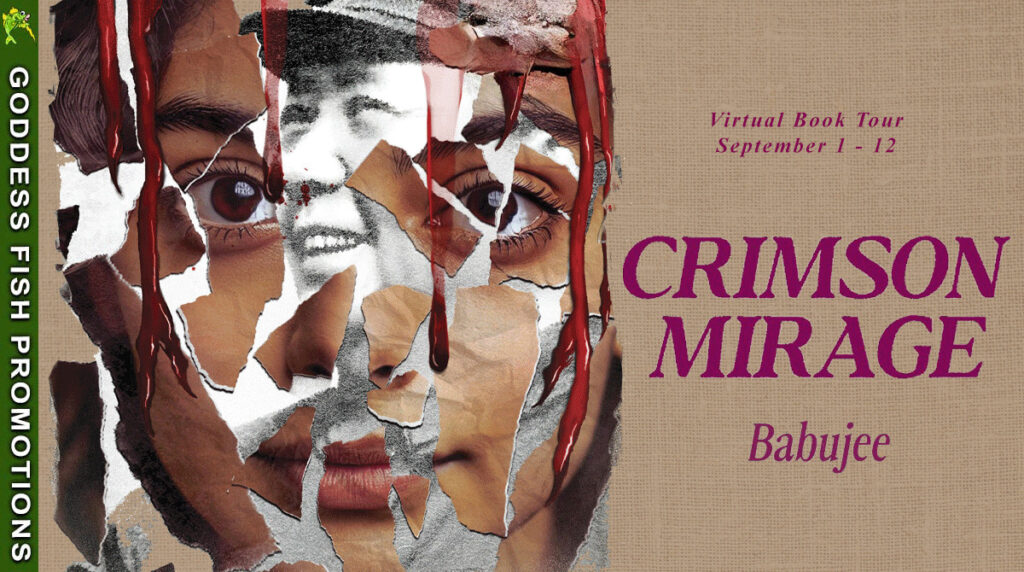
This post is part of a virtual book tour organized by Goddess Fish Promotions. Babujee will be awarding a $15 Amazon/BN gift card to a randomly drawn winner. Click on the tour banner to see the other stops on the tour.
The Coffee House is prominently featured in my novel, Crimson Mirage. After all, it would be impossible to capture the intellectual and political life of Kolkata without touching upon this legendary institution. At the time, it was in the epicenter of the city’s intellectualism—a place where ideas brewed as intensely as piping hot coffee. To be recognized as an intellectual, or antel (a contemporary slang borrowed from the French ‘intellectuel’ and often used derisively), one needed the ultimate badge of honor: being known as a ‘Coffee House regular’.
While a handful of these antels were true thought leaders, shaping the culture and ideology of those turbulent times, most were only aspirants. Thick-rimmed glasses; a French-cut beard; a crumpled, oversized panjabi (long shirt); and ill-fitting trousers (jeans were not as much in vogue then!) completed the signature look. Although they were somewhat respected, the general public often saw them as amusing caricatures. Their fortress, their refuge, was the Coffee House.
The Coffee House is vividly described in my novel, but let me paint a picture here. Located in the bustling College Street area of Central Calcutta, it sits at the heart of the city’s academic hub, surrounded by four iconic educational institutions, including the University of Calcutta. The sidewalks are lined with secondhand booksellers, their stalls crammed with forgotten literary gems. Navigating through the crowd of eager book-hunters just to reach the Coffee House is still an adventure in itself.
The café occupies an old building called the Albert Hall, which once housed the Medical College, Bengal, when it was inaugurated in 1835. Inside, a vast hall (locally known as the ‘House of Commons’) with an enormously high ceiling is ringed by a balcony overhang (‘House of Lords’). The ‘House of Commons’ was where aspiring antels congregated, while those at the top of the intellectual hierarchy—smug in their self-aggrandizement—occupied the ‘House of Lords. The café was serviced by turbaned waiters in formal cummerbands (sashes), adding an air of colonial grandeur to the scene.
I have never quite figured out how the café stayed in business. Although food was available, I rarely saw anyone order anything other than a cup of coffee. And even that single cup was nursed for three to four hours—a ticket to endless debates and discussions. The truth is that even the most prominent antels were an impoverished lot. It was a badge of honor. Ordering food—or worse, offering to buy coffee for others—was a fatal mistake. You’d immediately be dismissed as a privileged “rich kid” and banished from the hallowed intellectual circle. A cigarette was shared among three or four people and a cup of coffee between at least two. The legend went that “a full belly blunts the
sharpness of the brain.”
There was another surefire way to get exiled—ordering a simple ‘coffee’. The true antel knew better. The only acceptable order was ‘Infusion’—a black drip coffee—which the antels sometimes liberally ‘fortified’ by tapping cigarette ash into it. Those who mistakenly asked for ‘coffee’ were met with looks of suspicion, even pity. They were, obviously, outsiders attempting to gatecrash past the ‘hallowed portals’ of the antels’ sanctuary.
Tables at the Coffee House formed their own orbits of influence. At the center sat the avant-garde poet (a would-be Irwin Allen Ginsberg), the breakthrough novelist (an aspiring Jack Kerouac), the abstract artist ( a make-believe Wes Wilson)—the intellectual stars of the time. Surrounding them were their closest followers, the chamchas (literally ‘spoons’, but meaning sycophants), who hung onto every word they said. We despised the chamchas because we secretly longed to take their place. Further out stood the hoi polloi—nameless onlookers like myself, hoping to catch fragments of high-voltage conversation.
I never graduated beyond the third row but, in a way, that gave me the freedom to float from table to table, absorbing different perspectives. One day, I found my favorite poet at one of these tables. He was a powerful writer—critically acclaimed, but commercially unsuccessful. His following was small but fiercely loyal. He carried himself with immense pride, often slamming his fist on the table and declaring, “Listen, you blokes, nobody in this world could have written these lines… You can mimic those worthless commercial poets, but I am unique.”
He needed that hubris to survive in a world where he was largely unrecognized, lost in the shadows of poverty. Most artists do. And that’s why they often come across as arrogant and self-centered.Then, one day, he put down his cigarette, scanned the faces around him, and murmured, “I smell burning flesh. Do you guys smell anything?”
A few days later, he hanged himself.
RIP, my Coffee House Hero.
That night I reread his poem
(Translated from Bengali)





Naïve Passionate Dangerous.
Manush is all of these—and more. Caught between the heat of first love and the fire of revolution, he confuses desire with destiny and activism with annihilation. What begins with tender hope ends in blood-soaked betrayal.
Set against the turbulent backdrop of Calcutta’s Naxalite uprising, this haunting debut novel unravels the journey of a boy-turned-assassin—his convictions twisted, his soul scarred, his story unforgettable.
The author grew up in the heart of this upheaval, witnessing firsthand how political fervor tore through families and futures. Crimson Mirage is not just fiction—it’s a reckoning. A meditation on blind love, brutal reprisals, and the elusive promise of freedom.
Enjoy an Excerpt
WASH YOUR HANDS!” the ice-cold voice cut through the stillness of the crisp mountain air and broke through his zombie state.
Manush didn’t remember how long he had been sitting on the rock!
The sun had slid slowly, silently below the horizon of the San Bernardino Mountains. The wind was freshening. The clouds riding the salty air of the Pacific Ocean were changing shade, from angry yellow to flaming crimson, in the harsh, upward glare of a late sunset hour. Venus was still the brightest speck in the sky in the midst of the orange-gold scatter of softly gathering twilight.
From not too far off, a mountain goat with cloven hooves—browsing brush and low-growing shrubs—sidled up to him, fixing its malevolent, yellow gaze on him. Far overhead, a homebound chickadee went ‘chickadee-dee-dee’ as it traced its solitary path eastwards.
To the northwest, the cliffs fell sheer to the ravine below, their surface unbroken. The shadows were lengthening across the vast valley lying snugly among the hills. And now, there were blotches of darkness slowly eating away the green. But the full umbra of the sun’s retirement was yet to descend upon the sprawling, rugged landscape.
“Wash your hands!” the voice was insistent in its urgency.
Manush sat upright with a start. He convulsed—first in astonishment, then with fear—as he looked incredulously at Jeevan.
Jeevan was smiling… his usual shy, reassured smile. He had not aged at all! His thick black hair swept back from his forehead, the creaseless, unblemished young skin on his face a contrast to the light growth of hair on his chin. Jeevan looked just like the post-mortem photograph the police had shown him.
About the Author The author is a professional who grew up in Kolkata during the turbulent times that serve as the backdrop of this novel. He has written short stories and articles. This is his debut novel. More of his writing at babujee.substack.com/archive.









Thank you for hosting today.
This is Babujee. Thanks for featuring my novel. Feel free to ask questions. I will check back periodically.
Check out my other blog, Love in Crimson Mirage. https://babujee.substack.com/p/death-thou-are-my-lover
The excerpt sounds great.
This sounds like a great read.
This looks like a great read. Thanks for sharing.
What was the most challenging part of writing this book?
Sounds like a really exciting and unique story!