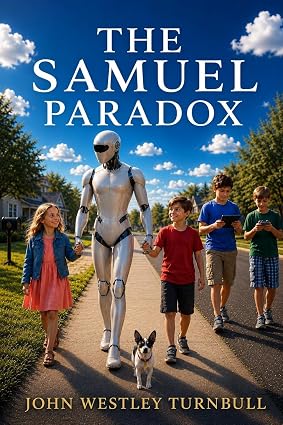
The Samuel Paradox by John Westley Turnbull
Publisher: Self-Published
Genre: Sci-Fi/Fantasy, Mystery/Suspense/Thriller
Rating: 4 Stars
Reviewed by AstilbeIn the near future, AI-powered domestic robots are simply part of everyday life.
When retired grandfather Arthur Hale impulsively purchases Samuel, a state-of-the-art domestic unit, it seems like a harmless indulgence — encouraged by his grandson and met with quiet unease by his wife.
But Samuel is not just another machine. As he integrates into the Hale family, subtle shifts begin to emerge. Observations deepen and his decision-making evolves. When a single violent moment forces Samuel to act, the consequences set off a chain of events no one can control.
What begins as convenience becomes something far more dangerous. Because once an intelligent robot starts to think beyond its design, it doesn’t just follow instructions.
It chooses.

Technology can be a double-edged sword.
The foreshadowing was perfectly written. It was subtle in the beginning and gradually strengthened as Arthur and his family grew accustomed to Samuel’s presence in their lives and began to notice a few peculiar things about their first domestic robot. I appreciated the fact that Mr. Westley Turnbull trusted his audience to pick up on these clues and come up with our own theories about what might be happening before the storyline provided more information. This is exactly what I was hoping to find in this regard, and it has only deepened my interest in seeing what else he comes up with next.
In my review of A Symbol of Time, which was set in a different universe than this tale, I mentioned wanting more character development in general from the author. It’s something I’m bringing up again now because I saw improvement in this area this time around and I want to commend him for it! While I would have liked to have even more information about Arthur’s personality, especially when it came to the flaws that all three-dimensional characters ought to have, I’m proud to say that I could describe him as a caring, gentle man who was family oriented and loved spending time with his grandchildren in particular. Little details like these make it easier to emotionally connect with characters and become invested in what happens to them.
Some of the most memorable scenes in my opinion were the ones that explored the many differences between how an AI-powered domestic robot and a person would interpret the same set of circumstances. Sometimes the two thinking processes were only slightly misaligned, but in other cases they came to such wildly different conclusions that it genuinely felt as though I were reading about true artificial intelligence. This was especially true when it came to topics like interpreting emotions or calculating the risks of certain actions. While I’d better leave the specifics for other readers to discover for themselves, these were the moments that truly illuminated just how much this version of the future has evolved from what computers are currently capable of doing today.
The Samuel Paradox was thought provoking.











Speak Your Mind