Search Results for: the perfect distance

*All Rhodes Lead Here by Mariana Zapata


*All Rhodes Lead Here by Mariana Zapata
Publisher: Avon and Harpers Voyager, Avon
Genre: Romance, Women’s Fiction
Rating: 5 stars
Reviewed by Larkspur

The people we lose take a part of us with them…but they leave a part of themselves with us too.

Aurora De La Torre, or Ora to her friends, knows moving back to Pagosa Springs, Colorado, a place that was once home and is now full of bittersweet memories of her late mother, isn’t going to be easy. Starting your whole life over probably isn’t supposed to be.

But after breaking up with her longtime, famous musician boyfriend, hiding out in a small town in the mountains might be the perfect remedy for a broken heart. And checking out her landlord who lives across the driveway just might cure it, too.

Only Tobias Rhodes didn’t rent out the apartment to her, rather it was his teenage son, Amos. Fiercely protective of his family and distrusting of strangers, gruff and grumpy Rhodes initially keeps little miss sunshine Ora at a distance. But over days and weeks, long hikes and fireside chats, Aurora breaks down his walls and soon an unbreakable friendship blossoms into a once-in-a-lifetime love.

When I first read this book in 2021 I thoroughly enjoyed it. Now that it has been rereleased, I decided to read it again and I found that I loved this story just as much the second time around. Mariana Zapata knows how to paint a picture and make the story come alive.

All Rhodes Lead Here is a slow burn, emotional story with realistic character development. The two main characters Rhodes and Aurora, are confident, successful people, but they also have insecurities in some areas of their lives.

Aurora is recovering from a breakup that left her devastated. She had no power or control in her last relationship and is now on a mission to achieve some goals she has set for herself to regain her self esteem. Aurora is slowly learning to believe in herself again, face her fears and regain her confidence that her last relationship destroyed. She has nowhere to go and nothing to show for the years she wasted on her past relationship so she decides to move to Pagosa Springs, Colorado. She meets Rhodes when she rents an apartment from him.

Rhodes is the strong silent type and he keeps his emotions hidden behind his stoic demeanor. He is perfect for Aurora because he is protective, has a big heart and he is willing to wait to give Aurora the time she needs before starting another relationship.

I enjoyed reading Rhodes and Aurora’s story, they have loads of chemistry and I loved all of their interactions. These two cautious people are perfect for each other. This beautiful story is filled with emotion and yearning and it immediately drew me in. I cared about the characters and I couldn’t stop reading until they found their happily ever after. I loved this endearing story and I think you will too.

Alex by Dianne Hartsock – Exclusive Excerpt and Giveaway

This post is part of a virtual book tour organized by Goddess Fish Promotions. The author will award a $15 Amazon/BN GC to a randomly drawn winner. Click on the tour banner to see the other stops on the tour.

Alex is twenty and confused. He always is. The world presses on him with its horrors and pain, with scintillating auras that bewilder his eyes and drive the migraines deeper. He hears the cries of the children, sees the brutal images of tortured victims. He feels out of control and his mind slips…

Severely abused as a child, he is left with horrible scars on his body and even worse scars within his mind. Even though it puts him in danger, he’s compelled to help those who call to him. He’s driven, motivated by his visions to rescue them and hopefully uncover the killer. When he can, he helps the police; yet some detectives suspect he’s involved. Often, Alex finds himself alone and afraid in a world he doesn’t always understand.

Enjoy an Exclusive Excerpt

“Hi.”

He jumped, spinning toward the voice. “Kyle.”

He had to look away. The young man’s white hair was loose, the blue tips catching the sunlight. The color was irresistible and drew Alex’s gaze back to it. As they walked, he stared at the fluttering strands in bewildered fascination.

Kyle was aware of his fixation and gave a secretive smile. “Here we are.”

They had walked some distance and Alex stopped abruptly, perplexed by the neighborhood he found himself in. They’d passed the college dorms and were on a street with rental homes for students. “What?”

“My house. Didn’t you say you’d look over my sketches?” Kyle searched his face. “Did you forget?” The gold flecks in his eyes unsettled Alex even more. He shook his head, unable to think. Kyle was all brilliant light and color, and Alex, in his exhaustion, was overcome by the visual stimuli. “I should go home,” he mumbled.

Kyle took his arm. “Come in just for a minute.”

Alex stumbled inside. A vague uneasiness fluttered in his stomach, but the thought of returning home was suddenly unbearable. He didn’t want to be alone with his fear. And though the horrible images had stopped flashing in his head, he was terrified he’d lose his mind if the images returned, and there was no one around to help him.

Kyle pushed him down on the couch and pressed a glass of wine into his hands. Distraught, Alex watched as he lit a few candles in the room, then drew a bulging portfolio from a cabinet. Alex settled back on the couch with a slight sigh of relief. Kyle hadn’t lied to him after all.

Kyle pulled a chair closer and opened the folder on his lap. He looked up. “Do you mind?”

“Not at all.” Alex leaned forward for a better look. There was definite talent in the sure strokes and firm lines Kyle used in his landscapes. Just then Alex noticed the long fingers holding the paper, and a sudden awareness of the young man flooded through him. He drew back, confused by the unexpected desire leaping to life in him; he wanted those fingers on his skin. He pulled in a desperate breath, fearing the attraction was a warning his body misinterpreted. What was going on? He wanted to run away, but Kyle glanced up, captivating him. He’d always thought Kyle’s eyes were beautiful.

“Kyle,” he began, then his voice trailed off as the silver and blue of Kyle’s aura swirled around both of them. He followed it with his eyes to where it danced across the ceiling, losing the thread of his thoughts in the dazzling imagery.

He cried out when Kyle suddenly dropped the folder and grabbed his arms. The glass fell from his numb fingers and shattered on the hardwood floor. Alex watched, stunned, unable to move, as Kyle pulled a roll of gray tape from under the couch and bound his wrists.

Kyle leaned closer. “Hush. It’ll be fun.”

About the Author Dianne grew up in one of the older homes in the middle of Los Angeles, a place of hardwood floors and secret closets and back staircases. A house where ghosts lurk in the basement and the faces in the paintings watch you walk up the front stairs. Rooms where you keep the closet doors closed tight at night. It’s where her love of the mysterious and wonderful came from. Dianne is the author of m/m romance, paranormal/suspense, fantasy adventure, the occasional thriller, and anything else that comes to mind.

She now lives in the beautiful Willamette Valley of Oregon with her incredibly patient husband, who puts up with the endless hours she spends hunched over the keyboard letting her characters play. Dianne says Oregon’s raindrops are the perfect setting in which to write. There’s something about being cooped up in the house with a fire crackling on the hearth and a cup of hot coffee in her hands, which kindles her imagination.

Currently, Dianne works as a floral designer in a locally-owned gift shop. Which is the perfect job for her. When not writing, she can express herself through the rich colors and textures of flowers and foliage.

Blog | Facebook | Facebook Author Page | Goodreads | Instagram
Buy the book at Amazon.

Buy the book at Amazon, JMS Books, Barnes and Noble, Kobo, or Smashwords.

a Rafflecopter giveaway

Fitting the Financier by Rebecca Austin – Spotlight and Giveaway


Long and Short Reviews welcomes Robecca Austin who is celebrating today’s release of Fitting the Financier, a Man of the Month novella.

If opposites attract, she’s made for me. She’s my match.
The perfect combination of sassy, sweet, and sexy. She’s also my daughter’s best friend, off limits.

I have no plans to visit the small town or partake in the festivities of mistletoes and pumpkin spice lattes this Christmas. For good reason. One look into her stormy gray eyes and I’ll want no one except her to fill the void in my life.

But when Naomi needs an investor that’s more ruthless than nice, how can I say no?

She thinks I’m helping her out of charity, but she’s wrong. I can crush bullies, and using that power is the distraction I need to break my forbidden desires for her.

The MAN OF THE MONTH CLUB is a steamy small-town collection featuring a new hottie (or two!) every month. In 2023, escape to Candy Cane Key, Florida, and celebrate ALL the holidays with your favorite group of romance authors and their delicious men. Can’t wait to see you there!

Enjoy an Excerpt

“You’re staring.” He passes me a pouch.

“Am I?” The peanuts are warm in my hand. The scent of caramelized sugar tickles my nose.

“Now you’re flushing. If I didn’t know better I’d say you’re having naughty thoughts about the side of my digits.”

I choke on a nut. My eyes water. “I think the reference is to shoe sizes.” I make a point to glance at his snickers.

“Twelves, baby.” He wiggles a brow.

This time I chomp on the nut before it goes anywhere near my throat. “I was thinking your hands belong to a mechanic not a person working in city hall.”

“Give me half a chance and I can show you what these hands are good for.”

“Travis…” I flush, not because I’m a prude, but because despite the lovely evening, Charity’s dad is at the edge of my thoughts. I blame Charity for mentioning him, for convincing him to visit Candy Cane. Most of all, I blame myself for falling for a man who didn’t know I existed beyond being his daughter’s best friend.

“Get your head out of the gutter,” Travis says with a smile that I wished set my heart on fire. “I noticed you didn’t have any Christmas decorations up yet. Any later and the entire town will write to the big man himself.” He glances around him, then whispers. “Or worse, put a complaint in with the city.”

I groan. He’s only half joking. Candy Cane had a Chrsitmas committee of four grandmothers that took their positions as seriously as the mayor. There hasn’t been a change in membership since Carter was president and unless one died, their word is law when it comes to Christmas.

“I’ve just been—”

“Hey, no need to explain.”

But I want to. Want to share my good news with someone other than Charity. “I recently received good news that will help my business.”

“That’s amazing.”

“And nerve racking but it’s an opportunity to grow.”

“You’re not trying to let me down easily, are you?” He searched my face.

I shook my head. “No.” This is my chance to have a fresh beginning all around. It is definitely time I put a stop to this madness I feel for Nathan and get a hold of my love life. I realize that I went about my dating life the wrong way. Pushing Travis away or engrossing myself in work isn’t the answer to forgetting Nathan Dawan. Dating is. Nights like tonight are. We are at the end of the path. The end of a beautiful evening. “Sorry it took so long to make tonight happen.”

He paused, taking my hand. I stared at our hands. This was nice in a gentle, reassuring sort of way. My middle didn’t flutter from the mere thought of him and his name didn’t have my pulse racing. “You’re worth the wait Naomi Waters.”

We’re caught in a loop of staring into each other’s eyes. I will myself to relax, drown in the blue sea staring back at me but all I see are Nathan’s dark intense eyes that mimic the howling winds of a category four hurricane.
Travis leans in and my stomach flutters. The feeling is so unexpected that my eyes widen instead of closing in anticipation of our first kiss and I gasp. He tosses his peanuts aside to cup my cheek. My lips part to tell him to wait…that I’m not ready, but no words escape.

Not a single one.

The distance closes between us and I slam my eyes such, too afraid he’ll see my thoughts for another man in my eyes. The first kiss I’d shamelessly envisioned having with him.

“You really shouldn’t litter,” came an icy tone.

Shit. Shit. I’m even hearing his voice. Squeezing my eyes tighter, I pucker my lips like a tenth grader and concentrate on what is about to happen.

“Naomi!” Nathan growls, the sound bouncing behind my eyelids. I try harder to block him out. He’s only in your imagination.

I count to five and wait.

About the Author: Robecca Austin is the author of happy ever after romance stories. She enjoys crafting tales of sassy heroines and alpha heroes that have a soft center.

She writes historical romance and billionaire romance stories.

You can find her outside enjoying nature and lots of sunshine when there are no bugs. When she’s not writing her next novel, she’s busy battling Cystic Fibrosis and hugging family. She lives and works in Canada.

Website | Instagram | Patreon | Goodreads | Bookbub | Amazon | Newsletter

Buy the book at Amazon

Never Plan a Billionaire’s Wedding by Julia Kent – Spotlight

Long and Short Reviews welcomes Julia Kent who is celebrating her recent release Never Plan a Billionaire’s Wedding, the first book in her Whatever It Takes, Maine series.

Rule #1: Don’t fall in love with the groom

Stalker exes. Momzillas. Drunk uncles. Hurricanes. Jealous siblings. Paparazzi.

You name it, Kari Whitevelt has seen it all.

And that’s why brides and grooms hire her.

Because she makes it all go away.

Wedding Protectors, Inc., is here to make sure that special day stays special.

Whatever it takes.

No matter what.

But when her newest client turns out to be her own long-lost high school sweetheart, rising tech star billionaire Caleb Mikelmas, suddenly Kari’s not sure whether she’s protecting the wedding couple —

Or her own heart.

Tech billionaire Caleb never thought he had a chance, much less a second chance with his first love and high school sweetheart, Kari. When a case of mistaken identity turns their reunion into one big misunderstanding, unraveling his feelings about the one who got away while supporting his brother’s nuptials means facing old demons.

And kissing Kari.

He likes kissing Kari far more than that whole demon thing.

But if kisses were enough, Kari would already be his wife.

Maybe it’s time to revisit the past and right some wrongs.

One vow at a time.

Welcome to the Whatever It Takes series:

Every bride needs something old, something new, something borrowed, something blue –

But you know what brides don’t need?

Complications.

Welcome to Wedding Protectors, Inc. Have a spritzer or a latte or some lovely Zen tea and sink into a comfortable chair in our sunlit offices as we listen to your wedding problem – and form the perfect solution to every possible contingency.

We plan for everything.

Except our own love lives.

But that’s not your problem. 😉

Enjoy an Excerpt

Carolina was introducing him to his former fiancée.

Fine. Near fiancée. It had been a promise ring, not an engagement diamond, but still.

The run he’d just finished was apparently unnecessary from a cardio standpoint, since his heart was now racing, crashing into his ribs as if it were fleeing a crime scene. Not that he was the bad guy. But still.
Kari. No way.

It was his Kari. And okay, maybe she was never formally his fiancée, but until college and distance broke them up, they always planned on it. He’d given her a promise ring in high school, so that was close enough.

When Carolina had mentioned she was meeting two wedding professionals named Katie and Carrie, he’d heard it as the more familiar spelling. She’d never spelled it out, and she hadn’t bothered to tell him Kari’s last name.

“Caleb, have you swallowed your tongue along with your manners? Shake the poor woman’s hand, for goodness sake!” Carolina crooned, giving him side-eye while managing a puzzled smile at Kari as the two stood awkwardly in front of each other, gaping.

Kari had changed in some ways, for sure, but it was her, alright. Her brown hair was a darker shade but still thick and shiny, framed in soft layers around her face, brushing the edges of straight, strong shoulders. He recognized those whiskey brown eyes, deceptively sleepy unless you knew her, knew that behind them, her brain was working constantly at warp speed.

She was taller now–or anyway, she didn’t wear four-inch heels back then–so instead of having to bend to kiss her lips, he could just dip his head.
If he wanted to kiss her.

If wanting to kiss her wasn’t the only thing he could think about.

About the Author: New York Times and USA Today bestselling author Julia Kent writes romantic comedy with an edge. Since 2013, she has sold more than 2 million books, with 4 New York Times bestsellers and more than 21 appearances on the USA Today bestseller list. Her books have been translated into French, German, and Italian, with more titles releasing in the future.

From billionaires to BBWs to new adult rock stars, Julia finds a sensual, goofy joy in every contemporary romance she writes. Unlike Shannon from Shopping for a Billionaire, she did not meet her husband after dropping her phone in a men’s room toilet (and he isn’t a billionaire she met in a romantic comedy).

She lives in New England with her husband and three children where she is the only person in the household with the gene required to change empty toilet paper rolls.

Website | Facebook | Twitter | Newsletter | Instagram | BookBub | Goodreads | Amazon Author Page

Buy the book at Amazon, Amazon UK, Amazon AU, Amazon CA, iBooks, Kobo, Barnes and Noble, or Google Play.

Six Elements Every Historical Fiction Story Should Have by Kate Bristow – Guest Blog and Giveaway

This post is part of a virtual book tour organized by Goddess Fish Promotions. Kate Bristow will be awarding a $25 Amazon/BN GC to a randomly drawn winner via rafflecopter during the tour. Click on the tour banner to see the other stops on the tour.

Six Elements Every Historical Fiction Story Should Have
I love reading historical fiction because if written well the story will not only immerse you in another time and place but also inspire you to do a little research for yourself to learn more about the events depicted. Because of ‘Wolf Hall’ by Hilary Mantel, I started exploring Tudor England and the shadowy history of Thomas Cromwell. ‘Lonesome Dove’ by Larry McMurty sent me off on a journey to the Old West. While the historical fiction author needs to focus on many of the same elements as any writer, they need to work a little harder to ensure that the reader finds the story credible.

1. Setting

As in any story, setting is critical in putting the reader into the heart of the novel from the beginning. In historical fiction, the writer must ensure that the location is described in a way that makes sense in the time period. London today looks very different from London in 1823 despite the fact that many of the buildings from two hundred years ago are still standing.

2. Characters

Often in historical fiction, the cast of characters will be based on a mix of real and fictional people. A good novelist will create living breathing creatures that dress appropriately for the time period and behave in the right way. Women for example lived under very different societal norms in years gone by. My heroine Elena was not encouraged to be educated to the same degree as her male counterparts, nor expected to want a job outside the home.

3. Dialogue

As with the descriptions of characters and their traits, dialogue needs careful research in historical fiction. Characters cannot come out with modern expressions or use language that would be considered inappropriate in that time period. Words can change their meaning over time: ‘awful’ used to mean ‘worthy of awe’ whereas today it simple means something or someone terrible. In my novel, I also had to think about Italians and the fact that they tend to be more formal when addressing elders or people they don’t know very well. At the same time, you want to make sure that the modern reader isn’t struggling to read and understand the text.

4. Plot

The plot is the sequence of events that happen in the story, each of which causes the next thing to happen. In historic fiction, the plot is sometimes drawn from an event that actually took place at some point in the past. But the fiction writer has the ability to add imagined elements to the story and to alter the timeline. My book is based on real life events but I simplified certain aspects in order to give the story a dramatic arc.

5. Conflict

A good story always contains a conflict of some description and historical fiction should be no different. But even when a novel is based on an extreme example of a conflict—in my case, World War 2—it is still critical that the main conflict is at a very personal level. My heroine Elena believes art is worth saving in a time of war: my hero Luca thinks that more energy should be spent worrying about whether there is enough food to eat.

6. World building

World building—the ability of a writer to create a credible fictional world—is of particular importance in historical fiction. The reader has to embrace the world that is being described and understand why the story needed to take place at exactly that time and place. Are the characters behaving in a believable way given the time period? How are the events taking place in the wider world affecting the people in the story? What kind of relationships and conflicts would you expect to see in this particular moment in time? Authenticity is so important. If the reader senses something out of place, they begin to subconsciously doubt the entire premise of the novel. Attention to detail is a must if the world being built by the novelist is to appear plausible to the reader.

I hope you enjoy my historical fiction novel ‘Saving Madonna’ and the glimpse it gives of the lives of ordinary Italians during the war.

Is a painting worth dying for?

Inspired by real events, an unforgettable story of love, courage and sacrifice to save a country’s heritage.

Italy 1943. As the Allies bomb Milan, Elena Marchetti reluctantly gives up her coveted job as an art curator in the city to return to her family farm near Urbino. She takes up a new role assisting Pasquale Rotondi, the Superintendent of Arts in the region, in protecting works of art from all over Italy that have been hidden in the relative safety of the countryside.

At a family celebration, Elena reunites with Luca, a close childhood friend. A shattering event instigated by the occupying Germans deepens their relationship, and they start planning a life together. When rumors surface that Italy’s art is being stolen by the German occupiers, Pasquale hatches an audacious plan to rescue the priceless paintings in his possession. Elena and Luca are forced to make an impossible decision: will they embark on a dangerous mission to save Italy’s cultural heritage?

Enjoy an Excerpt

Marco looked beyond his home to a small wood that stretched out from the rear of the property down to the narrow white road snaking through the valley toward the distant hilltop town of Peglio. His home was called Ca’Boschetto (House of the Copse) because of these trees, and Marco knew it would soon be time for his father and uncle to gather their friends and bloodhounds for the annual truffle hunt. Their small wood was known far and wide as a fruitful location for the illusive and highly sought-after fungi, and the truffle hunt was one of the highlights of the season.

Beyond the wood, a patchwork of fields that had been parched brown after the harvest in the heat of August was beginning to turn into shades of green from recent rain. Marco spotted a couple of deer making the most of the fresh grass. Something else caught his eye as it glinted in the distance. Marco lifted his hands to his brow to deflect the glare of the autumnal sun. Whatever was flashing in the sunlight was moving toward their farm. The ox-drawn carts that often made this journey on the back road couldn’t move that quickly. He squinted. Something was not right.

“Luca! Luca! I can see a car coming. Look at the road!”

His older brother turned away from the flock and walked over to where Marco was standing. Luca stared at the distant vehicle for a minute and his face darkened. “Marco, Gianni, run down to the house and tell Papà that there might be Germans coming. Move!”

About the Author: Kate Bristow was born in London. She fell in love with reading when she got her first library card at the age of four. Her first attempt at writing and publishing for a wide audience was a local newspaper typed laboriously at home on her mother’s typewriter while at primary (elementary) school in north London. It is surely a loss to cutting-edge journalism that only one issue was ever produced. Kate divides her time between her small-but-perfectly-formed modern home in Los Angeles and her five-hundred-year-old farmhouse just outside Sassocorvaro in Italy.

Website | Facebook | Instagram

Buy the book at your favorite online venue.

a Rafflecopter giveaway

An Author’s Thoughts on Writing Groups by Kelly Byrd – Guest Blog and Giveaway

This post is part of a virtual book tour organized by Goddess Fish Promotions. Kelly Byrd will be awarding a $25 Amazon or Barnes and Noble GC to a randomly drawn winner via rafflecopter during the tour. Click on the tour banner to see the other stops on the tour.

An Author’s Thoughts on Writing Groups

Writing groups can feel like drinking from a fire hydrant if you’re not careful. I did my first group in early college, and it was incredibly overwhelming. When I was just starting out and terrified of anyone seeing anything I wrote, hearing opinions about it felt like walking naked down Front Street with no bush or shrub to duck behind for cover. To be frank, putting my work out there still feels that way in some aspects, but it has gotten easier the more groups I’ve done.

Writing groups are invaluable for getting multiple opinions and insights into your work all at once. This feedback is often extremely helpful in identifying issues and common places for improvement in your story, especially if you start to notice pain points brought up by everyone in the group. If you’ve been with the same writing group for a long time, and they know your specific voice and style, a writing group can be a great place for edits at any stage. And, as all writers know, edits are honestly the most important part of the process.

In my personal experience, it’s been important to find a writing group that understands my specific genre. I workshopped my first book, City of Lights, in a general group with all kinds of voices and styles. A common note I received was, “I don’t read fantasy.” Sometimes, receiving feedback like this is helpful because you can experience how people who don’t normally interact with your genre perceive your work. This can lead to a deeper understanding of structural issues. On the other hand, everyone’s audience is different, and you don’t want to fully alter what’s great about storytelling—your perspective—to satisfy one or two people. To get the best feedback, seek out a group that is open to your specific genre of work.

Writers are (generally) introverts who spend the majority of their time in dark rooms, pouring out their insides. We are a competitive and sometimes angry bunch. It’s always important to remember that not every single opinion is the right opinion about your work. This was a lesson I had to learn over years of practice. Just because Sally Joe in the group doesn’t like your pages doesn’t mean that they’re bad. They’re just not for Sally Joe.

As I’ve progressed in my work, I now tend to lean on individuals more than I do groups. I think groups are best for new ideas and workshopping something that you’re not sure about. Groups are a great way to get fledging ideas out of the nest and give them some structure. If you’ve completed a work and are moving into hard editing, I find that working with a few trusted advisors one-on-one is often the safest bet.

But, also remember: Writing is an art form. There’s no right or wrong way to go about getting the words on the page. The most important thing is to tell a story. So, find a group. Start getting yourself in front of people. Push that baby bird out of the nest. You won’t regret it.

Book Two of the Far from Home Trilogy

Catch up with Mary Jingo as she trains with her friends in the Great Big Ocean Sky-side city of Festdelm. She may have survived the danger in Luminos, the City of Lights, but new challenges await as she, Teeny, Van Clare, Corb, Mikeala, and WindRunner continue their fight to save the Everything. When a new Shadowlander comes to LeeChee, will Mary be able to trust him—even if he is one of her closest friends?

Join Mary Jingo and her motley crew as they travel to the far ends of the world on their quest to save the Everything.

As more of LeeChee falls under Thrall, Mary must choose wisely. Whom will she trust? What bonds will endure? And… how did a Yorkshire Terrier end up as a part of this crazy experience?

The answers, dear reader, await inside as we set sail on the Great Big Ocean Sky.

Enjoy an Excerpt

WindRunner shot into the air, following the great ‘Dragon through the sky. Peregrina’s wake was strong and fast, and WindRunner put himself in the center of her air stream. Mary looked around, sensing for the other Thoughtdragons that had attacked the Garnet Revenge, but did not feel them.

It doesn’t mean they aren’t nearby, WindRunner said.

Really?

Do not become overconfident with this power, Mary Jingo. The Thoughtdragons are dangerous. Older even than my Kin. While I face the same temptation as you—I am drawn to her great power—remember that Peregrina wanted to be found. Otherwise, we would not have been able to follow her.

That couldn’t be possible, Mary puzzled to herself. She had known where Peregrina was. Mary had made this decision to follow Peregrina, hadn’t she? A stab of doubt hit Mary in the chest. Had they walked into a trap?

Peace, Warrior, WindRunner said soothingly. Peregrina wanted us to follow her. I don’t think she will harm you. I think she wishes to speak with you. Or, that is what Mikeala said to me before we left the boat.

You had a private Mindspan with Mikeala?

Yes. She told me I should take you if you wished to go.

Private Mindspans are rude when they are about someone else. The Father says so.

WindRunner laughed in her mind.

Suddenly, Peregrina stopped in midair and whipped around. WindRunner dove to keep from running straight into her serpentine length, ending their conversation. Peregrina beat her wings softly to stay stationary, and WindRunner flew around until he was face to face with the great Thoughtdragon.

Mary’s stomach sank. The last time she had been face to face in the air with someone like this, it had been the evil Mellie. She had won that battle, but only barely. She was not certain she could win a battle like that again. Peregrina was even more terrifying than Mellie. Her head was twice the size of WindRunner. The Thoughtdragon only needed to barely open her mouth to swallow them both whole.

WindRunner sent courage through their bond, but Mary felt his unease. He was being strong for her, just like she wanted to be strong for him. Peregrina spoke then to them both, her voice rich, gravelly, and musical, like a bass note dropped beneath a perfect melody.

“Well, you followed me out here, Shadowlander. What is it that you want?” She slithered her great head to the side as she said this, and Mary felt and smelled the Thoughtdragon’s untamed power. It blotted out her fear.

“I need your scales. Three of them. We need them in LeeChee. The Everything is shrinking, and I am fighting with the Resistors. We are trying to save it,” Mary said, breathing deeply. She spoke clearly and with confidence. “Please help us, great Peregrina.”

The ‘dragon shook her head and laughed.

“Save it? Save the Everything with my scales? Child, in your tiny mind, I might as well be the Everything. You cannot save the Everything with the Everything. And that world, that island, has been pitiful and beyond saving for many annuals now. Your Keeper is the size of a child. Don’t you see? It is lost. Go home to your dark, dark world and leave us in peace. Your People are causing the problem anyway.”

“My People?” Mary responded, trying to hide the hurt in her voice.

“Yes—you Shadowlanders. The Everything is created in the Shadowlands. It cycles up and up to places like LeeChee to be kept safe. Over time, it drifts back down to the Shadowlands and the cycle continues, with the ebb and flow of time. Do they not teach you anything in school down there?” Peregrina paused and turned her livid golden eyes to WindRunner.

“And you, the Lumon’s son. Bound by oath to protect a girl from the Shadowlands. Why have you done this?”

“She can save us,” WindRunner blasted back.

“Can she?” Peregrina replied with a grin on her giant mouth. “How? It is the greed of her People that has caused the blight in your lands. They don’t go outside anymore. They are trapped in their own heads, in their own tribes. They don’t listen to each other. They hardly interact with anyone who doesn’t think exactly how they do. How does one child heal rifts and tears that are hundreds of years old? This is why the Everything shrinks. Do you not know, WindRunner, son of Spearwing? Or are you all much too blind to see it?”

“Mellie is to blame for the Void. Mellie has been warping the Everything to her own purposes,” Mary said, yelling across the distance.

“Fool! Mellie was once like your precious Mikeala. As tall as a mountain and charged with keeping the Everything and the flow of the Cycles safe. She could no more turn the Everything into the Void than I can. It is against her nature. But to regain her former strength and form, she may have been tempted to help someone corrupt the Everything. The Void is powerful, even if it is unnatural. She may be helping the flow of the Void, but no, no. She did not create it.”

“Her scars,” Mary said to herself and WindRunner, thinking of the marks that marred the woman’s face. “Her scars are from the Void.”

“Yes,” Peregrina said. Her hearing must be excellent to perceive Mary over such a distance. “Yes. She has paid dearly in service to the Void.”

“You must help us,” Mary cried desperately. “Mikeala said you brought me out here to talk to me. Help me. I know you can.”

The giant Thoughtdragon swirled her body in the air in front of Mary. Small flames burst from her mouth when she laughed. Mary could feel their heat as they crackled in the air.

“Why would I help you? As I said, the greed of your people is what is causing LeeChee to die. It will grow dark and cold and fade, and me and my kind will visit it no more. And your land will suffer, Mary Jingo. As we have all suffered.”

“Please—you cannot let this happen.”

“How dare you!” Peregrina boomed. Her jaws opened wide. “How dare you accuse me of letting anything happen. It breaks my very being to know that LeeChee will fall into darkness and the Void, but I cannot intervene. Your People, you Shadowlanders, with your pride and your lack of imagination, your desperation for profit. You will kill LeeChee. I allowed you to follow me here because I wanted to see your face before I send you back to that darkened world of the Shadowlands. You don’t belong in LeeChee, Mary Jingo. You will only make things worse.”

Peregrina dove towards Mary and WindRunner, spinning her long body in the air and flapping her wings hard. WindRunner, always ready for attack, spun out of the way, as Mary gripped the handholds. She cast for Peregrina’s power, but found herself blocked from it.

WindRunner. She has shielded me. I cannot channel or control.

Sensing Mary’s fear, WindRunner burst through the air, the giant ‘dragon following swiftly behind. Peregrina was bigger, which WindRunner used to his advantage, banking and turning quickly through the air, making it hard for the Thoughtdragon to follow. Mary found herself dizzy and out of sorts, casting about for ideas. WindRunner blasted a mighty caw at the Thoughtdragon and watched as a jet of light shot from his beak and hit Peregrina squarely between the eyes. She roared angrily, then continued her wild pursuit.

About the Author:Stories have crept around the halls of Kelly Byrd’s mind since she was a little girl. Not even the combined will of her two loyal pups, her devoted husband, and all her house plants could keep her from putting this story into the world. You’ll find this happy crew in Nashville. Tennessee.

Website | Blog | Instagram

The book will be on sale for only $0.99.

Buy the book at Amazon, Barnes and Noble, or IndieBound.

a Rafflecopter giveaway

Three Ways to Handle Negative Criticism by Charlene Bell Dietz – Guest Blog and Giveaway

This post is part of a virtual book tour organized by Goddess Fish Promotions. Charlene Bell Dietz will be awarding a $25 Amazon/BN GC to a randomly drawn winner via rafflecopter during the tour. Click on the tour banner to see the other stops on the tour.

Three Ways to Handle Negative Criticism

Negative criticism hurts, yet you have to laugh. It’s built into our DNA. Don’t believe me? Scold a toddler and watch the outrage in form of pouting or temper tantrums. When we’re involved in creating something, we never want to hear it’s a failure.

Writers hold dear the stories in their heads, which they mold into words and sentences for others. If wise, we have others critique our works before we send them out into the world. We do this by asking our friends, families, or the worst critiquer of all, our mothers. More accurate critiques come from dedicated critique groups. These groups have individual experiences of being told what’s wrong with their own writing. Trust me, they can’t wait to share their newfound knowledge.

For example, one might say to you, “When you write a gerund, don’t you know you must never say ‘you’ but ‘your’ before the gerund, such as, ‘I appreciate your giving me this hacksaw.’” Your critique partners will use their hard-earned information as a point of brilliance in their offering to make your work better. However, you know this advice is incorrect, because you’re focusing on a person, Sam, instead of the hacksaw. Your protagonist has asked five other people for a hacksaw, but it’s Sam who gives her one. You’re correct in writing, “I appreciate you giving me this hacksaw.”

When a piece of your writing gets a negative critique, or a reader suggests a correction in your published book, you have many ways to respond. A defensive, “How dare they!” reaction often jumps into our head. Next, we feel compelled to defend our writing in question. Neither response yields productivity. Instead, try my three ways to handle negative feedback.

Before reacting, take a deep inhale and exhale through your mouth, completely. This resets your brain and body, releasing tension. Practice doing this discretely when others are around so you can secretly deep breathe in your critique group. If you do this three times in a row, you’ll be surprised at how much calmer you feel.

Be polite, but chose to ignore: If your critiquer is an individual or a part of a group gathered for this purpose, say, “Thank you, I’ll take your suggestions into consideration.” Then you can let the advice simmer in your mind and decide later. When you’ve cooled down, if it’s right advice for your work, accept it. My first book opened with the words, “Die, old lady, please die.” My critique group exploded. I had to, they demanded, get rid of that line. They insisted, and so I did. I shouldn’t have. Many revisions later, that detonation of a line opened my story. Trust me, even if they reread your revised version, they’ll not remember what they said or know you’ve ignored their generous wisdom.

Recognize the truth and acknowledge: My first novel went through countless revisions, after being applauded, as well as, in part, shredded by my critique group over the years. When I knew it shined and emitted perfection, I’d send it off to a writing contest. However, the results would come back with a bit of praise, and in my mind, lots of scathing remarks. I don’t remember what the judges wrote, but they’d say something like this: Your first chapter doesn’t engage. This section doesn’t move the story forward. You aren’t letting the reader know what the other characters are doing. The reader needs more descriptions. The husband of the protagonist is one-dimensional. You’re writing in the weeds, here. You need another murder closer to the beginning. You’re overwriting.

Yikes! Should I quit? Should I respond back to them and explain why I wrote what I did?

No. Never give up. Never explain or justify. They don’t want to hear it, and they don’t care. It’s their opinion. Your job is to look at your manuscript with fresh vision. What if they’re right? You don’t have to believe them, but “What if?”

I rewrote my novel, giving careful considerations to the judges’ comments. I reinserted the “Die, old lady . . .” first line my critique group found objectionable. Then, I found a publisher. This book, The Flapper, the Scientist, and the Saboteur, won first place in the New Mexico-Arizona Book Awards, and when sent to Kirkus Reviews, it earned their coveted Kirkus Review: starred review.

When given negative feedback, take a deep breath, ignore it, or accept what’s appropriate and expand your writing knowledge.

A privileged teenager from Minneapolis in 1923, scraps her college scholarship and runs away to become a flapper in dangerous, chaotic Chicago. In her search for illusive happiness, she confronts the mob and then must contrive a way to not be murdered.

Enjoy an Excerpt

Kathleen continued, “You said you wished you could go to college with me. What if we could go somewhere together, not to college, but someplace where we could dance and act and you could sing? I bet with our talents, we could turn this horrid world into something much more joyful—help make it one big party.”


“How?” Sophie’s eyes opened wide.


“We’ll go where you won’t have to teach kids piano, or act or dance, unless you want. You’ll be able to sing your heart out and, who knows, maybe even write your own songs.”


“My mother would never let me.” Sophie looked off into the near distance.

“Sophie, we’ll get to wear sparkly dresses. And wouldn’t you love to wear those modern, classy clothes? We’d bob our hair even shorter, wear lipstick, and be around people who know how to have fun and not have a care in the world.” Sophie should see the photos in Kathleen’s collection of theater magazines again. Then she’d be excited too.


“I’m sick of funerals and consoling others,” Kathleen continued.


“Look at how miserable Dolly is. Aren’t you tired of that too? We’d be around progressive people, thinking people, people who know how to make the most out of life. They’re searching for talent, Sophie. We’ll fit right in.”


“Where, Kathleen? No one much appreciates our abilities here.”


“Chicago. There are all sorts of openings for attractive young ladies with well-turned ankles and voices like canaries. That’s what theadvertisements say.”


About the Author:Charlene Bell Dietz’s award-winning mystery novels The Flapper, the Scientist, and the Saboteur combines family saga with corporate espionage, and The Flapper, the Impostor, and the Stalker propels readers back into 1923 in frenetic Chicago. The Scientist, the Psychic, and the nut gives readers a frightening Caribbean vacation. Her latest novel The Spinster, the Rebel, and the Governor is a historical biography about Lady Margaret Brent, the first American woman to be called an attorney, whose integrity and intelligence saves pre-colonial Maryland from devastation. This book won the New Mexico Press Women’s first place award and an award by the National Press Women. The Spinster, the Rebel, and the Governor will be released as a second edition by Artemesia Press in February 2024. Two of her Flapper books have won the coveted Kirkus stars, and two were named best book of 2018. Charlene, a retired educator, lives in the foothills of the mountains in central New Mexico where abundant wildlife, solitude, and natures’ beauty inspires her creativity.

Website | Facebook

Buy the book at Barnes and Noble, Amazon, or Treasure House Books.

a Rafflecopter giveaway

Curve Appeal by Lucy Felthouse – Spotlight

Long and Short Reviews welcomes Lucy Felthouse who is celebrating the recent release of Curve Appeal, a standalone contemporary reverse harem.

An exciting opportunity could solve all Brianna’s problems. But will it ultimately create more?

Brianna Denton is a primary school teacher at the end of her tether. Budget cuts, changes in legislation and a pandemic have left her feeling like walking away from the only career she’s ever wanted. The trouble is, if she did quit, what would she do next? Living in London is expensive, and keeping on top of her rent and bills while retraining would be nigh-on impossible. An offer to move in with her best friend, Joel Harris, is appreciated, but feels way too much like charity for her liking.

But then Joel throws her a curveball. On a complete whim, he’s bought a fixer-upper cottage on a remote Scottish island. He wants to transform it into an uber-luxury holiday home and rent it out. To do that, however, he needs a skilled, reliable workforce and a project manager to keep things running smoothly. A visit to the island in question provides as many questions as answers, but one thing becomes clear – Brianna is the perfect woman for the job. She’s smart, organised, works well under duress, and if she can handle a classroom full of young children, surely a bunch of skilled tradesmen won’t be a problem. Working and living in such a stunning setting is a massive plus point, too.

Brianna takes a leap of faith, leaving her home and beloved career behind to help turn Joel’s dream into a reality. It’s a steep learning curve, but Brianna is definitely up for the challenge. But when working relationships develop into something more, will it bring the entire project crashing down around her ears, or is it simply the beginning of a whole new life?

Enjoy an Excerpt

Brianna smiled as she caught sight of Joel, already waiting for her outside the pub. His job as a high-flying London City banker meant he put in some insane hours at work, but he ensured he was always available and on time for their last-Friday-of-the-month meet up at their favourite Thames-side establishment. Not only was it a lovely place, but the location was perfect for them both—it was just far away enough from Joel’s work it was unlikely he’d bump into any colleagues, and close enough to the primary school Brianna taught in that she could tie up any loose ends and scurry the short distance to meet her friend in no time at all. Today she’d had quite a few loose ends, which always seemed to be the way lately, and was a few minutes later than she’d planned, so was scurrying more quickly than usual, not wanting to keep him waiting any longer than necessary.

He hadn’t spotted her yet—he was leaning against the wall, one expensively-shod foot propped up on the bricks behind him, his head tilted up to the early spring sunshine, which even this late in the day was surprisingly strong and picked up the few lighter strands in his dark hair. He’d removed his tie—knowing him, the moment he set foot outside his office building—the end of which poked from the pocket of his black trousers, and rolled up the cuffs of his subtly-patterned shirt to expose most of his forearms. The look was casual, relaxed. Handsome.

In a parallel universe, she and Joel might be a couple, off travelling the world together, or perhaps married and getting ready to settle down and have a couple of kids. Maybe they’d have started early and had the kids already. And a dog.

In this universe, however, they were best friends—had been since their first day of senior school at the tender age of eleven. And while Brianna thought Joel handsome, it was in an impartial, stating a fact way. She wasn’t attracted to him, and it wouldn’t have made a difference if she was, because in this universe, Joel was as gay as they came—a fact she hadn’t realised she’d already known, until at eighteen he’d sat her down, his expression serious, and said he had something to tell her.

Her heart had pounded, and a sick feeling had taken over her stomach. Thoughts started racing through her head—was one of his parents ill? Was he ill? Was he moving away? Unable to cope with the internal onslaught of negativity any longer, she’d said, “For Christ’s sake, Joel, spill the beans, would you? You’re freaking me the fuck out.”

His seriousness had morphed briefly to annoyance, then resignation. He’d taken in and released a deep breath, then, “Bree, I wanted you to be the first to know… I’m gay.”

A sound somewhere between a squeak and a giggle had escaped her lips before she could stop it. She’d clapped her hand over her mouth for a second, then removed it and burst out with “Oh, you idiot!” before landing a playful slap on his arm. “Is that all? I thought you were going to say something bad. That something terrible was going on. Thank God.”

Joel had frowned. “So you… don’t mind?” He’d paused, narrowed his eyes. “You don’t seem surprised.”

She’d shaken her head. “Of course I don’t mind. Why the hell would I mind? I’m not a homophobe. If blokes float your boat, so be it. As long as you’re happy, I couldn’t give a toss. And, for the record…” it had been her turn to pause, “I think I’ve known for years.” She nodded as long-forgotten jigsaw pieces began slotting together in her head, then shrugged. “Yeah. I have. Years.”

And now, twenty years later, their friendship had endured—flourished, even. Weathered storms, and basked in sunlight—much as Joel continued to do as she grew closer. Her smile widened, and she was glad she had on flat shoes—not only did it make both her job and the short walk from the school easier, it also meant she had a good chance of creeping up on Joel, maybe scaring the shit out of him as he sunned himself. They might be approaching forty, but when they were together, they often acted as immature and idiotic as they had when they’d first met. Yes, they were getting older, but they sure as shit weren’t growing up.

Respective partners had come and gone, most of them never able to comprehend, much less tolerate, hers and Joel’s unique friendship, but as their jobs, and other friends and family kept them busy and fulfilled, singledom had never particularly concerned either of them. As far as she was concerned, at least, what would be, would be.

She enjoyed the sunshine on her skin as she closed the gap between them, then held her breath as she came within a couple of metres of Joel before flinging herself forward and grabbing onto his nearest finely-muscled arm. “Gotcha!”

He yelped, jumped, snatched his arm away and opened his eyes in a hilarious sequence, then clutched his chest and gave her a good-natured glare, his blue eyes glinting. “Fuck’s sake, Bree! You’re lucky I didn’t swing for you, then. I thought someone was trying to rob me.”

“That’ll teach you to wear ludicrously expensive watches,” she replied with a snicker.

He glanced wryly at his Patek Philippe, then looked back at her with a grin. “Touché. Come on,” he turned around, slipped his arm through hers and led her into the relative gloom of the pub, “for that twattishness, first drink’s on you.”

She couldn’t argue with that reasoning. It was still worth it, though, to see the look of pure panic cross his face. She stifled further giggles, not wanting to inspire her friend to order the most expensive drink he could think of, purely to get his own back. While top of the range watches were easily within his budget, she’d had to save up for a mid-range Fitbit.

A few minutes later, with drinks in hand, they sat down at a table on the terrace overlooking the river and took simultaneous sips of their chosen beverages. Brianna swallowed the mouthful of chilled white wine, then, without meaning to, let out a long, contented sigh.

Joel raised an eyebrow as he swigged his beer, then said, “Sounds as though you needed that. Tough week?”

“Hmm. You could say that.” She fidgeted in her seat, getting the uncomfortable inkling she’d opened a can of worms she’d have preferred was left undisturbed.

“Oh?” His other eyebrow jumped up to join the first. “Do tell.”

She stared out over the river, screwed up her nose and wafted a hand in his vague direction. “No, no, it’s work stuff. Boring, really. Not worth talking about.”

“Bree.” He grabbed her hand, drawing her attention to his face. His expression was earnest, his gaze intense. “Maybe it is boring, but it’s clearly bothering you, so I want to know about it. I’m your best friend, remember? If you can’t tell me, who can you tell?”

She squeezed his hand, then pulled hers away, picked up her glass and took a gulp. Swallowed, then groaned. There was no putting the lid back on the can—she might as well come out with it. “Oh, all right. It’s just… I don’t know… I think I’m getting a bit fed up of teaching.”

Joel spluttered into his pint, drawing querying glances from a few of the people at tables adjacent to theirs. Ignoring them, Joel put his drink down, wiped his mouth with the back of his hand and gaped at her as though she’d grown a second head. “What? But you… you love teaching!”

About the Author: Lucy Felthouse is the award-winning author of erotic romance novels Stately Pleasures, Eyes Wide Open, The Persecution of the Wolves, Hiding in Plain Sight, Curve Appeal, and The Heiress’s Harem and The Dreadnoughts series. Including novels, short stories and novellas, she has over 170 publications to her name.

Website and Links | Goodreads | BookBub

Free on Kindle Unlimited for a limited time.

Release blitz organised by Writer Marketing Services.

All Signs Point to Murder by Connie di Marco – Spotlight and Giveaway

This post is part of a virtual book tour organized by Goddess Fish Promotions. Connie di Marco will be awarding a $20 Amazon or B/N GC to a randomly drawn winner via rafflecopter during the tour. Click on the tour banner to see the other stops on the tour.

Rob Ramer was the perfect husband until he committed the ultimate family faux pas—he shot his sister-in-law to death. Believing himself under attack by an intruder in his home, he fired back. But when evidence is discovered that Rob’s wife, Brooke, was plotting his murder, Brooke is charged with conspiracy in her sister’s death. Geneva, a third sister, is desperate for answers and seeks the help of her friend, San Francisco astrologer Julia Bonatti. Geneva’s lost one sister and now it seems she’ll lose the other. Was this a murder plot or just a terrible accident? Julia vows to find the answer in the stars.

Enjoy an Excerpt

The same headlights stayed behind me for several blocks, remaining about two car lengths behind. I’m very careful about locking my car doors, especially at night. I look over my shoulder when getting into my car too. I clicked the door locks again for good measure. Two cars passed me in the next lane, but the car behind remained at the same distance. When the next light turned green, I accelerated quickly and kept my speed up for the next few blocks, hoping a police cruiser wasn’t waiting in an alleyway speed trap to ticket me. The car following matched my speed. Why would anyone be trailing me, and if so, how long had I been followed?

I cast my mind back, trying to remember if I had noticed anything outside Macao or earlier. No one had been around. I hadn’t seen any cars pulling out behind me. But then, it was the last thing on my mind. I was only intent on meeting Tony.

After the next light, I slowed to a crawl, watching to see if the driver would become impatient and pass me. Again, the car matched my speed. A chill ran down my spine. Someone was definitely following me and they didn’t care if I knew.

I quickly reviewed my options. I had no intention of leading a stranger to my apartment. Of course, after my wallet was left open with my exposed driver’s license that night in Moira’s apartment, my follower, if he were the same person who attacked me, would already know where I lived. I nixed the idea of heading for my grandmother’s house. I didn’t want to bring any trouble to her doorstep, nor to Gale’s. Even so, that would involve driving back toward Russian Hill. I could return to Cheryl’s but didn’t like the thought of being unprotected on a deserted downtown street when I got out of my car. Whoever he, or she, was, I had to lose them. On the off chance they didn’t know where I lived, I had no intention of leading them to my apartment.

When I reached Divisadero, I turned left and headed for a neighborhood that I knew was a warren of intertwining streets. I made a fast turn heading west on Turk and an even faster right on Baker, leading me up Terra Vista. By now I was too frightened to even look in the rear view mirror. I raced up Terra Vista and took the corner on two wheels. I didn’t see car lights behind me as I turned the corner, only the ambient glow of headlights down the hill. I drove halfway down the block and spotted a long driveway leading to a garage at the rear of a house. I pulled down the driveway and parked behind the house. I doused my headlights and turned off the engine. My hands were sweating and my heart was pounding.

I hadn’t imagined the black sedan following me. I had no idea what kind of car it was, only black, late model, could have been a Mercedes, a Cadillac, I honestly wouldn’t know the difference unless I saw an insignia. My engine made small metallic pinging sounds as it cooled. I waited but heard nothing. I carefully rolled down my window and listened. A glow from headlights highlighted the tall tree branches in the next yard. I heard a car moving slowly down the street. The motor was almost silent, but I could hear the crunching of dry leaves under tires. He was searching. I had temporarily lost him, but now I was trapped in a driveway behind a private home. I prayed no one in the house would turn on outside lights or do anything to signal my presence. How long would he cruise the street?

Ten minutes elapsed but it felt like an hour. I twisted in my seat and once again saw the same glow of headlights. Again I heard the crunching of leaves and small branches under tires. The car came to a stop directly in front of the driveway. Its headlights were fixed against the wall of the house next door.

My mouth was dry and I could barely swallow. If the driver found me, what would he do? What could I do? I could lean on the horn and hope to wake the occupants of the house. The arrogance of following me in such an overt manner was more frightening than an attempt to track me covertly. Was someone trying to discover where I lived, or did they already know? Did someone wish me harm or were they only trying to frighten me? If so, they were doing a damn good job of it.

My heart was racing. I closed my eyes and deliberately slowed my breathing and prayed. Then I heard an engine rev and tires squeal. The sedan barreled down the street as if angry to have lost me. I was too afraid to turn the car around and pull out. It could be a trick. He could be waiting at the foot of the hill. I was cold now and shivering. I wanted to be home in my own bed more than anything in the world. I had to take a chance. I turned on my parking lights and saw that the driveway continued on past the garages. A narrow space next to the last garage led to an alley behind the homes. I started the engine but left my headlights off. I followed the concrete path along the side of the garage and through the opening to the alleyway. It led to an intersecting street. At the corner, I hit the brakes and looked around carefully. Nothing moved. I glanced up at the street sign. Fortuna Street. I almost laughed with gratitude at the name. I wiped tears from my eyes and
took a deep breath. Following Fortuna I reached Turk again. No other cars were on the street. I turned west toward the Avenues keeping a lookout, but didn’t spot the black sedan again.

When I reached home, I pulled the car into the garage, made sure the heavy door was properly locked and climbed the back stairs to my kitchen. Wizard padded out to greet me. He tried to make a dash for the yard, but struggling to hold on to my purse and keys, I grabbed him at the last moment. I didn’t want him out this late at night, and I was too tired to have to call him in later. I reached down and closed the hatch on his kitty door before he could get free. He looked at me and uttered a low growl in his throat.

“No. Sorry. It’s been a rough day and a rougher night. You’re in.” I doled out a couple of kitty treats and dropped them in his plate. He attacked them at once. I turned off the kitchen light and in the dark, peeked out the living room windows to the street below. I saw no cars that seemed out of place. Then I walked down the stairway and shoved the bolt across the front door. Wizard eyed me strangely, sensing something was out of kilter. Upstairs, I shed my jacket and poured a glass of wine. The light on the answering machine was blinking. Gale had left a message reminding me of the open house on Sunday. Cheryl hadn’t spoken of it earlier and I suspected she might bail on the whole idea. Then I kicked off my shoes and shed my clothes. I slipped into my flannel pajamas, propped some extra pillows on the bed and settled in.

I thought about the couples I knew. Cheryl dealing with a divorce, Brooke in jail accused of planning her husband’s death, Moira dead, and forced to turn over information on her boyfriend to the police. David and Geneva seemed the only happy people in the world, in spite of their family difficulties. Only Gale was completely content as a single woman. Maybe I was better off in my alone state than I knew.

Wizard climbed onto my lap and started kneading the comforter furiously. Was Cheryl right? Was it was time to consider dating? The thought of it brought no joy. If someone told me to climb Mount Everest with no equipment, it would seem an easier prospect. But if I didn’t take a chance, I’d be a woman alone with her cat forever. I finished the wine, turned off the bedroom lamp and snuggled down under the comforter. I heard the foghorns in the distance as my eyes closed involuntarily.

About the Author:

Connie di Marco is the author of the Zodiac Mysteries featuring Julia Bonatti, a San Francisco astrologer who never thought murder would be part of her practice: The Madness of Mercury, All Signs Point to Murder, Tail of the Dragon, Serpent’s Doom and Enter a Wizard, Stage Left (a prequel e-book novella). Writing as Connie Archer, she is also the author of the national bestselling Soup Lover’s Mysteries from Penguin Random House. You can find her excerpts and recipes in The Cozy Cookbook and The Mystery Writers of America Cookbook. Connie is a member of Mystery Writers of America, International Thriller Writers, Crime Writers Association (UK) and Sisters in Crime.

Website | Blog | Facebook | Twitter | Instagram |
Goodreads

Buy the book at Amazon, Barnes and Noble, or IndieBound.

a Rafflecopter giveaway

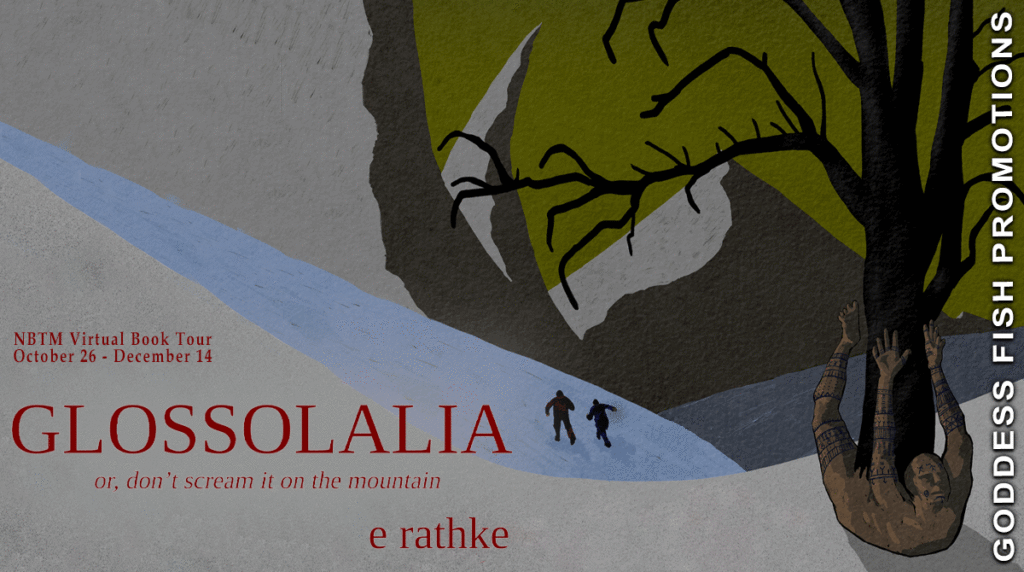
How to Handle Negative Criticism by e rathke – Guest Blog and Giveaway

This post is part of a virtual book tour organized by Goddess Fish Promotions. e rathke will be awarding a $50 Amazon or Barnes and Noble GC to a randomly drawn winner via rafflecopter during the tour. Click on the tour banner to see the other stops on the tour.

How to handle negative criticism

To publish at all is to invite criticism. No matter what you write, someone will hate it. Even if you end up as celebrated as Cormac McCarthy or sell as many copies as JK Rowling, people are going to hate every single word you write down. The bigger the audience of fans, the larger the number of haters. Ideally, the haters will always be outnumbered by fans or at least those who appreciate what you’re trying to achieve. But the reality of publishing is that people are going to tear apart your book in Goodreads or Amazon reviews.

The trick, I think, is understanding which criticisms to take in. My own fiction always bends towards the weird and the wild, the caustic and ecstatic. Try as I might to write a simple tale with broad appeal, I find myself always twisting the narrative towards those ancient dark trees and the cold caves where those with a commonsense dread of danger are unlikely to follow.

With that comes those who will not follow. They’ll see the way the road bends and they’ll realize this is a path they’d prefer not to see the end of. Some who do will wish they hadn’t and they’ll tell anyone who will listen that they should avoid those woods, those caves, for there are monsters lying in wait.

Some, though, will hear of these strange dark forests and feel compelled to see them, to experience them. They may go with great trepidation and they may be shaken by the experience. But they may also find something there—a sensation, a new perspective, a burgeoning desire—that makes them seek other dark forests, other abandoned caves. They may spend the rest of their lives hunting out monsters, not to kill them, but to bask in their monstrousness, their weirdness.

We invite criticism when we publish anything, but we don’t need to give every criticism equal weight. Often the reviewer will let you know within a few sentences whether they were the target audience or not. If someone who was never going to like your novel tells you that they didn’t like your novel, should you be surprised? Should you take that criticism to heart?

But there will be those who came to your book with open eyes and open arms, excited for the weird and the wild, the uncanny and the ecstatic, and they will find your attempts lacking. They’ll find your words stilted and your world flimsy, your characters automatons without personality, and every joke you spent hours perfecting will leave them cold.

What do we do with this?

Well, first we shatter, fragile creatures that we are. We shatter and moan and maybe rage a bit at the unfairness of it all. And why did they have to write the review publicly anyway? Why couldn’t they have just rated it two stars and moved on?

The first thing: do not respond to the review. If you feel you must respond, definitely don’t argue. There is no way for this to work out well for you, even if you’re right. It’s an argument you lose the moment you engage.

Give yourself time. Try to forget about the review for a while. Read a book. Play a video game. Go for a run. Walk your dog. Cuddle your cat. Cry in the shower. Whatever you need to do to get past the fact that someone hated your book in public for good and real reasons.

It may take a week or a month or a year, but eventually you should look at that review again. With the distance of time, you’ll hopefully be able to acknowledge where this person had a point and where they missed or misunderstood something or where they simply didn’t like something for reasons so unknowable or personal that it may have nothing to do with your writing or book. But pick through these criticisms and find the ones that may apply. The ones that make you nod along or accept that, yes, they had a point.

Use this to write the next book.

“My name is Ineluki. I come from past the mountains and ice. It took me many days to reach here. All I know are dead. Will you take me in?”

And so begins a calamitous year at the edge of the world.

Chief for the year, Aukul’s life has never been better. His people respect him, he spends his nights with the love of his life, and his skills as a butcher and chef improve every day. Then Ineluki, a young stranger, wanders into town with nothing but an empty book. He begins telling stories of the world beyond the one they know. His stories challenge their reality and lead to a summer of unprecedented disasters.

One by one, the villagers begin dancing. Dancing tirelessly, as if in a trance, until they die. Believing Ineluki is to blame, Aukul confronts him on the worst night of his life.

Enjoy an Excerpt

Umok was the first to see the boy. There was nothing special about the boy except that he wasn’t one of us and didn’t seem to be an Uummanuq. Not that anyone really knew, then, what the Uummanuq looked like. Not really. But he was too tall to be one of them and much too short to be one of us. Maybe strangest of all, he was dressed as a woman. One of ours, not the Uummanuq women, assuming anyone knew, then, what the Uummanuq looked like when they weren’t smashing our homes down. But he wore a loose, open vest, his trousers tight and reaching just past his knees. In his hands, a hidebound book.

It was a clear day, just past spring, and though the edge of the world is known for its deathly cold, our summers are quite warm. Warm enough to wade out into the sea and gather crabs or lobster. Or even to swim out to where the leviathans burst through the water, spraying the skies with their misted breath.

Umok was so distracted by the boy that she dropped her arm, accidentally flinging her gyrfalcon, Feo, to the ground. When Feo shrieked the way she does, the boy turned to Umok and smiled a big toothy grin. To hear Umok tell it later, the boy had fangs like a wolf and eyes that glowed with menace.

We’re not prone to superstition, but much changed that summer and especially come winter, when the days last barely a blink and the nameless ones call out to us in the long night, and mothers wake to missing children, never to be seen again.

But the boy didn’t stop when he saw Umok. It was like he had a set destination. Like he knew where we were. And maybe that’s the most shocking of all. That he just wandered out from the dark green summer mountains and walked right to our little village at the edge of the world with nothing but the clothes he was wearing, an empty book, and a mouthful of words that would change the shape of all our lives.

About the Author:e rathke writes about books and games at radicaledward.substack.com. A finalist for the 2022 Baen Fantasy Adventure Award, he is the author of Glossolalia and several other forthcoming novellas. His short fiction will appear in Queer Tales of Monumental Invention, Mysterion Magazine, and elsewhere.



Substack | Goodreads

Buy the book at Amazon.

a Rafflecopter giveaway